
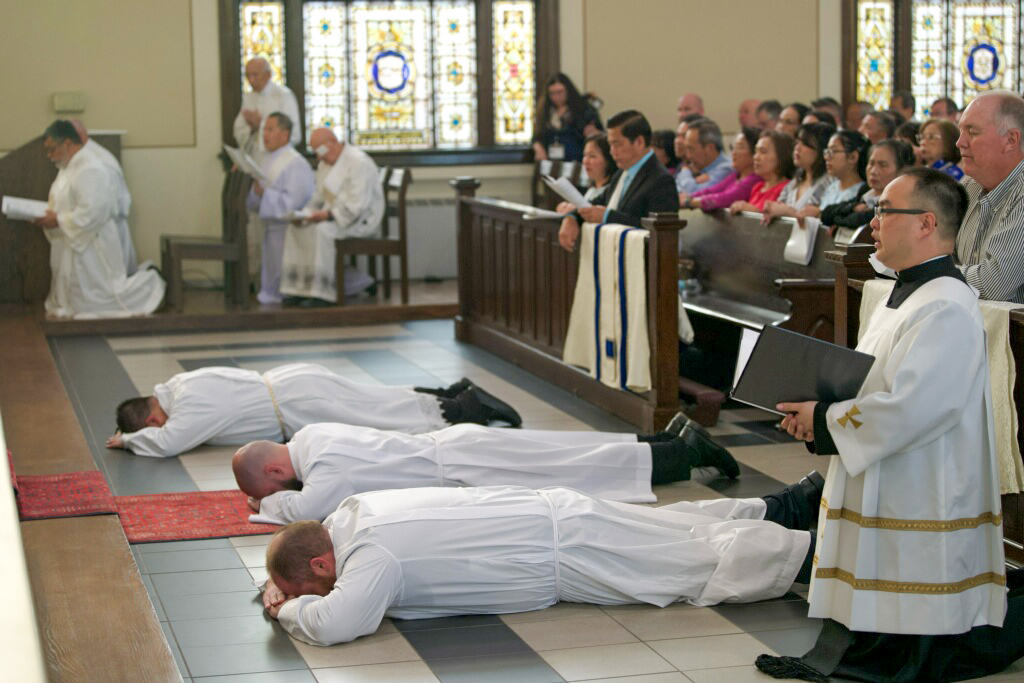
Homily for the Ordination to the Transitional Diaconate of Trent Barton, Paul Trinh, and Jeffrey Ambreit Jr.
Vigil of Saint Joseph, Husband of Mary
March 18, 2026
Saint Mary of the Assumption Catholic Church
Fort Worth, Texas
Numbers 3:5-9
Psalm 89:2-3, 4-5, 27, 29
Acts 6:1-7b
Luke 2:41-51
Tonight, we pray for these men who are to be ordained to the transitional diaconate for God’s blessing and mercy to come upon them because in this liturgy of ordination God calls them to service of others, especially the poor; God entrusts to them the responsibility of preaching the Gospel of Christ; and God appoints them as stewards and ministers of His mysteries. God calls. God entrusts. God appoints.
God calls these men to service of others, especially the poor. We read tonight in the Acts of the Apostles that the Apostles were faced with an urgent challenge that they as the Apostles might become distracted from the spiritual mission given them at Pentecost and replace the Gospel with a social program of the distribution of resources. It is only after prayer and discernment that the Apostles recognize that the demands of the Gospel require the Church to care for the needs of the foreign widows and orphans, the poorest and most vulnerable among their number, to fulfill the Lord’s primary command “to love one another as I have loved you.” So, guided by the Holy Spirit, the Apostles called seven men to serve as deacons to protect the foreign widows and orphans who were most vulnerable to abuse, neglect, and mistreatment.
Like the Apostles, we too must recognize that the poor and vulnerable among us are most in need of the Gospel as expressed in word and action. It is the deacon’s responsibility to guard the poor and to ensure that they receive the authentic Gospel of Christ offered in sacrificial love. In this way, your ministry as deacons assists the bishop in maintaining focus upon Christ present in the poor and in recognizing their proper place among His preferences.
Too frequently today, the poor and marginalized are not offered the Gospel but instead are exploited by activists with extreme partisan agendas. For this need and on your diaconal ordination day we turn to Saint Joseph as an example and intercessor for you who are to be entrusted with mindfulness for the poor and marginalized.
Pope Francis once taught, “Every poor, needy, suffering or dying person, every stranger, every prisoner, every infirm person is ‘the child’ whom Joseph continues to protect. For this reason, Saint Joseph is invoked as protector of the unfortunate, the needy, exiles, the afflicted, the poor, and the dying. Consequently, the Church cannot fail to show a special love for the least of our brothers and sisters, for Jesus showed a particular concern for them and personally identified with them. From Saint Joseph, we must learn that same care and responsibility.” This is the diaconal vocation — either transitional or permanent.
God entrusts to these men the responsibility of preaching the Gospel of Christ. As deacons you will not only be entrusted with the responsibility of preaching the Gospel of Christ but also you are entrusted with the privilege of proclaiming the Gospel of Christ. The General Instruction of the Roman Missal is clear that the ordinary minister for proclaiming the Gospel at Mass is the deacon. “The function of proclaiming the readings is ministerial and not presidential. The readings, therefore, should be proclaimed by a lector, and the Gospel by a deacon or, in his absence, a priest other than the celebrant.” (GIRM #59). The proclamation of the Gospel and the readings is the time for the bishop to listen and to be attentive to Christ. It is not intended as the time for him to speak presidentially but to listen attentively so that he might lead the Church more deeply into the mystery of salvation according to God’s plan. The deacon is entrusted with this ministry of proclamation.
The ministry of preaching and proclamation requires humility and moral integrity so that the deacon as minister might be a credible instrument of God’s Word. This ministry calls upon the deacon to be a man of prayer and contemplation of the Word of God. This ministry requires the transitional deacon to be a man of singleheartedness and chaste celibacy. He must be a man of mature freedom. The Church offers you again an example and intercessor in Saint Joseph.
The pure chastity of Saint Joseph is especially an example for those of us ordained who have made public promises of celibate chastity for the sake of the Kingdom, as you will promise in a few moments. The chastity of Saint Joseph is marked by his wholeness and his maturity. He is a man of complete integrity. He lives an integrity of life that confounds the world that is possessed by its passions and the carnal drives of the human condition: fear, anger, and physical pleasure. His purity of heart is so directly focused upon God that he can let go of his own expectations even around marriage and live with obedience and attentiveness to Jesus Christ, the Word made flesh, and to his wife, the Blessed Virgin Mary.
Pope Francis, writing in his Apostolic Letter Patris Corde, observed, “Chastity is freedom from possessiveness in every sphere of one’s life. Only when love is chaste, is it truly love…the logic of love is always the logic of freedom, and Joseph knew how to love with extraordinary freedom. He never made himself the center of things. He did not think of himself but focused instead on the lives of Mary and Jesus.”
God appoints these men as stewards and ministers of His mysteries. In the Gospel that we have proclaimed, Mary and Joseph find the twelve-year-old Jesus in the Temple after a hurried search for him. When they find Jesus, Mary says to Him, “Son, why have you done this to us? Your father and I have been looking for you with great anxiety.” Jesus responds, “Why have you been looking for me? Did you not know that I must be in my Father’s house?”
As Pope Saint John Paul II beautifully wrote about this episode, “The reply of Jesus in the Temple brought once again to the mind of his “presumed father” what he had heard on that night twelve years earlier: “Joseph…do not fear to take Mary your wife, for that which is conceived in her is of the Holy Spirit.” From that time onwards Joseph knew that he was a guardian of the mystery of God, and it was precisely this mystery that the twelve- year-old Jesus brought to mind: “I must be in my Father’s house.”
As deacons, you will be obedient guardians and stewards of the mysteries of Christ. You are not their designer or their author. This responsibility might prompt fear in your hearts about your own worthiness to accept this appointment by God. Remember that Saint Joseph was hesitant to accept Mary into his home because of his awareness of his own unworthiness not because of his suspicion of Mary’s worthiness. God quelled Joseph’s fears of unworthiness through the message delivered by the angel, “Joseph, son of David, do not be afraid to take Mary your wife into your home. For it is through the Holy Spirit that this child has been conceived in her.”
Likewise, your own doubts and fears about worthiness are addressed by God through these sacramental actions through which God calls you to service, through which God entrusts you with preaching, and through which God appoints you for stewardship. Seek God’s will and not your own. Trust God just as Saint Joseph did and return to His decision to give you this vocation.
 Life on the Chrism Trail