
Homily for Thanksgiving Day
November 23, 2023
Saint Patrick Cathedral
Fort Worth, Texas
Sirach 50:22-24
Psalm 145:2-3, 4-5, 6-7, 8-9, 10-11
First Corinthians 1:3-9
Luke 17:11-19
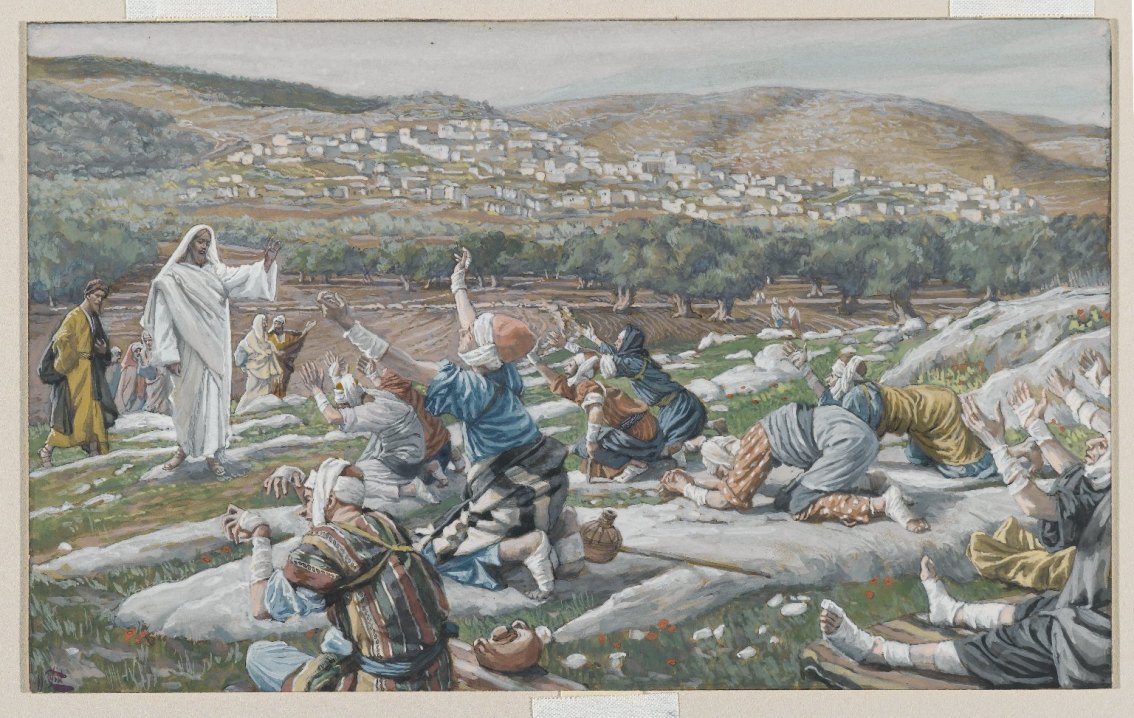
We are very familiar with the story of the healing of the ten lepers by Jesus. We remember that the only one to return to thank Jesus is the Samaritan, while those who do not return to Jesus with gratitude are Jesus’ own people. Perhaps our routine familiarity with this story might cause us to overlook the deeper message of this story, that is, that the gifts of God to us prompt us not merely to cherish the gifts but also to cherish the giver.
I think that it is important for us to realize that all ten lepers knew enough to ask for a healing from Christ. They recognized His authority to heal them. They knew that He could give them this gift. All ten receive the gift of healing from Christ, yet the healing takes time. It is given on their way to the Temple. All ten lepers are obedient to Christ in following His directive to go to the Temple to show themselves to the priests for the judgment of worthiness for reinstatement into Temple worship and then to thank God for the gift of healing by offering sacrifice, as was the prescribed ritual of the Law. The Samaritan, however, worshipped at a different temple at Mount Gerizim, not Mount Zion as the other lepers did, so he would not have been welcomed at the Temple on Mount Zion. He returns instead to Jesus to thank Him in part because he is blessed with gratitude and has nowhere else to go to offer thanks. Perhaps the other lepers, obedient as they were in going to the Temple, were grateful for the gift but distracted by the routine from the gift of the giver.
Gratitude for a gift is not just a recognition of the gift given. Gratitude also draws us more closely into relationship with the giver of the gift. While gratitude prompts us to recognize the gift as a gift, it also prompts an impulse within us to love the giver of the gift. This is at the heart of our Catholic understanding of grace. Saint Paul teaches this well as he writes to the Corinthians, “I give thanks to my God always on your account for the grace of God bestowed on you in Christ Jesus, that in Him you were enriched in every way, with all discourse and all knowledge, as the testimony to Christ was confirmed among you, so that you are not lacking in any spiritual gift as you wait for the revelation of our Lord Jesus Christ.” Grace given, grace received, gratitude offered, draws us into sacrificial communion with God and each other as human beings and children of God.
Today as we celebrate Thanksgiving Day, we do so in offering the Eucharist, the gift given to us for us to offer to God — the ability to thank God given to us by God that we might thank Him as He desires to be thanked. The Eucharist is both the gift given and the giver of the gift Himself — the transformation of bread and wine and through its transformation and our reception of the transformation, we ourselves are transformed as one with the giver and the gift given. As the Dominican theologian, Archbishop J. Augustine DiNoia once wrote, “Christ’s is the perfect sacrifice of thanksgiving re-enacted every day in the Eucharistic sacrifice recalling His passion, death, and Resurrection. Christ’s perfect sacrifice of thanksgiving gives meaning and substance to our own acts of thanksgiving which, without Him, would always fall short.”
The Lord asks each of us through the readings and prayers of this Liturgy, “Were not all ten made whole?” As imitators of the one Samaritan leper, we return to Jesus and receive the Eucharist that transforms us and makes us whole, that engenders gratitude within our hearts, that heals us and sends us forth as foreigners to evangelize the many who are still on the way to redemption and healing, as we cherish in our hearts both Jesus and Jesus’ words spoken to us today, “Stand up and go, your faith has saved you.”
 Life on the Chrism Trail