
Homily for the Commemoration of Saint Katharine Drexel
March 3, 2026
Oblate School of Theology
San Antonio, Texas
Isaiah 1:10, 16-20
Psalm 50:8-9, 16bc-17, 21 and 23
Matthew 25:31-46
Isaiah addresses Judah with searing irony, calling them “rulers of Sodom.” The prophet speaks in a liturgical context — Temple sacrifice is ongoing — but God rejects it because it is unaccompanied by righteousness and just actions. Israel’s sin is not primarily ritual failure but ethical rupture. God’s invitation follows: “Though your sins be like scarlet, they may become white as snow.”
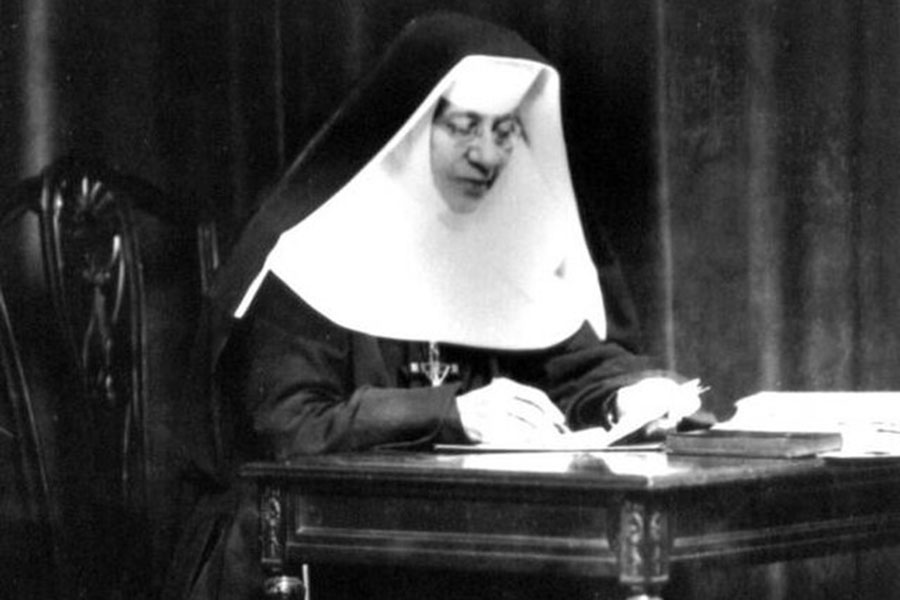
Today we celebrate this commemoration during Lent of a great American saint, whose life and ministry manifested the truth of these words of Isaiah for the Catholic Church and society in the United States in need of conversion in action and not just in liturgical ritual. Katharine Drexel, a United States citizen, was born in 1858 in Philadelphia into a wealthy family. She founded the Sisters of the Blessed Sacrament and in 1925, she founded Xavier University in New Orleans, the only Catholic University dedicated to the higher education of African-American people.
At her canonization in 2000, Pope Saint John Paul II preached, “Mother Katharine Drexel … from her parents she learned that her family’s possessions were not for them alone but were meant to be shared with the less fortunate. As a young woman, she was deeply distressed by the poverty and hopeless conditions endured by many Native Americans and African Americans. She began to devote her fortune to missionary and educational work among the poorest members of society. Later, she understood that more was needed. With great courage and confidence in God’s grace, she chose to give not just her fortune but her whole life totally to the Lord.”
In 1886, on a pilgrimage to Rome, she was received in audience by Pope Leo XIII, and she informed him of the great needs of the disenfranchised African Americans and Native Americans and that missionary outreach was desperately needed. Just as he would do one year later with Frances Cabrini, Leo XIII challenged Katharine Drexel to be a missionary herself in the United States of America. She heard the voice of Christ in the voice of the Holy Father.
The cause of her dedication to correcting the racial injustices committed against African Americans and Native Americans was her awareness of Christ’s love for her and for all people as He gives Himself for us and to us in the Sacrifice of the Eucharist that endures in the presence of the Blessed Sacrament. Katherine Drexel exemplified and taught a spirituality based on prayerful union with the Eucharistic Lord and out of that union, zealous service of the poor and the victims of racial discrimination. Her apostolate helped the Church in the United States to bring about a growing awareness of racism as a sin offensive to Christ and the need to combat all forms of racism through education and social services.
We need her prayers today. Katharine Drexel reminds us not only of the sinfulness of racism but also of the unconditional love of Christ Himself, who is the only remedy for racism and for all sin. As Catholics, we cannot settle for the position that racial discord is simply a matter of systemic sin that can be remedied by the implementation of another system like some forms of DEI. Any system built or reformed by humans must always be flawed because we are fallen. Our hope is not in ourselves but in God Almighty, Who loves us enough to offer to save us from ourselves and loves us so much that He invites us to join Him in His saving work.
We must repent and recognize that the sin is not in some alien system, but rather in ourselves. As Alexander Solzhenitsyn, who suffered imprisonment in the unjust Soviet system, wrote in his book entitled The Gulag Archipelago, “The line separating good and evil passes not through states, nor between classes, nor between political parties either — but right through every human heart…even within hearts overwhelmed by evil, one small bridgehead of good is retained.” That small bridgehead is our free will and our hope.
The change that is required is not a utopian change in society brought about by theories or the violent activism that we currently see in our streets; the change required is not a perfect enforcement of our laws; the change required is my own conversion of heart and your own conversion of heart to see in each and every human person a mysterious dignity measured only by the image and likeness of God. We must take to heart the words spoken by God in Psalm 50 that we have just prayed, “When you do these things should I be silent? Do you think that I am like you? I accuse you; I lay out the matter before your eyes.” Recognizing Christ in the Eucharist opens our eyes to love Him, to treat Him justly in our neighbor of different race and color. Without Christ who reveals the face of God to us, we sinfully distort God into our own image.
Our shared mission entrusted to us by God requires on each of our parts a renewed gratitude and celebration of our common humanity; a humanity that is able to be expressed by us but not mastered by us, a humanity that is not exploited by us, nor exhausted of its meaning by us. Does the language we hear in our streets and in our social media express the mystery of our common humanity? Does it do violence to it? What about our own language? How do we express the mystery of our common humanity as the place where God chooses to redeem us?
Our responsibility is to point to the solution which only God has revealed fully in the humanity of His Son Jesus Christ — a humanity by which He saves us and a humanity that we share in common with Christ, with His Blessed Mother, and with each other. This should be the subject of our prayer during Lent. Let us now bring this intention to the altar of God.

