
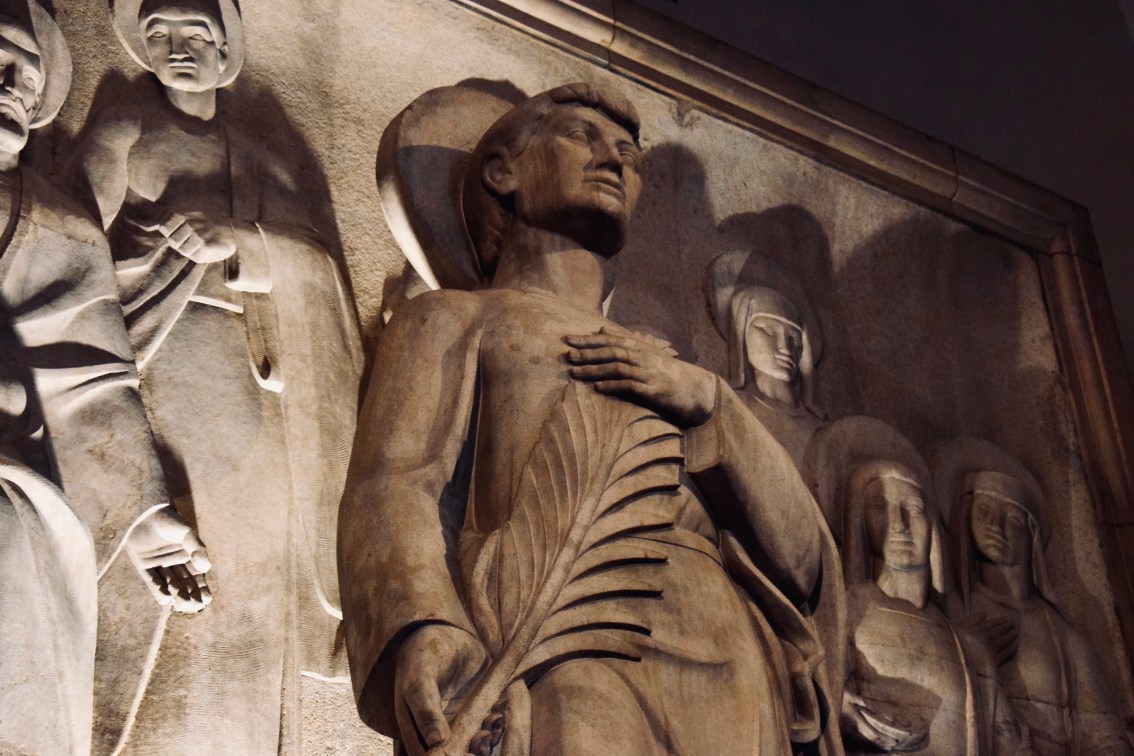
Homily for the Feast of Saint Stephen, First Martyr
December 26, 2023
Saint Patrick Cathedral
Fort Worth, Texas
Acts 6:8-10, 7:54-59
Psalm 31:3cd-4, 6 and 8ab, 16bc and 17
Matthew 10:17-22
“Yesterday, the Lord was born on earth, that Stephen might be born in Heaven.” This phrase is part of the celebration of the liturgy of the Ambrosian Rite of the Mass. It answers very clearly the question that we might have as to why we seem to jump so far ahead in a jarring way from the sweet image of the Infant in the Manger with Mary and Joseph, and the angels and shepherds, to the jarringly violent murder of Stephen.
Yet, Christmas is not about sweet nostalgia for even as an infant, Jesus Christ reveals the fullness of the Truth and the Gospel of love for which His Father sent Him, the Truth about God and about humanity and the relationship between the two to be reconciled in Him and by Him through love. The Church in her liturgy spares us from the saccharine nostalgia of a secular Christmas with today’s feast by reminding us that “the shadow of the Cross was already extending over the manger in Bethlehem.” The Cross is present in the poverty of the stable in which the infant cried, the prophecy of Simeon concerning the sign of contradiction that would be opposed, the sword destined to pierce the heart of the Blessed Mother, and Herod’s slaughter of the Holy Innocents that would make necessary the Holy Family’s flight for refuge into Egypt.
Saint Stephen, through his love and ministry for Christ, especially incarnate in the poor, is configured by love to Jesus Christ true God and true man. Stephen’s death shows that discipleship and the ministry of deacons is not simply about conveying values or social work, but really involves a conformity to Christ – not in His words, not just in His deeds, but in His very life and being. Stephen’s death is configured to Christ because his life was first configured through his preaching the truth and his love for the poor and marginalized.
It is in this way that Stephen the Deacon made incarnate the mystery of Jesus Christ, first introducing Saul of Tarsus to Jesus even as Saul was taking part in Stephen’s murder. This act of selfless love on Stephen’s part, and not just Stephen’s eloquent apologetics, prepared Saul for his dramatic encounter with Christ where he was knocked off his horse and temporarily blinded that he might be given true sight as Saint Paul. In witnessing the martyrdom of Stephen, Paul meets Christ and is affected by Him, to the point of preparing him to receive the forgiveness for which Stephen prayed in imitating Christ not only in his life but in his death. Stephen’s ministry and death are good reminders for us in this current time of rancor and discord in the Church that none of the martyrs died angry. As Pope Saint Paul VI wrote in Evangelii Nuntiandi, “The person who has been evangelized goes on to evangelize others. Here lies the test of truth, the touchstone of evangelization: it is unthinkable that a person should accept the Word and give himself to the kingdom without becoming a person who bears witness to it and proclaims it in his turn.” (EV #24)
The preaching ministry of Stephen and his service to the poor were inseparable in his diaconal vocation being configured to Christ the Servant. Likewise, Stephen’s ministry of charity as a deacon and his supreme witness as a martyr are inseparable because the complete unity of love and truth are fused together only in Christ. As deacons you share this privileged vocation with Stephen whose ministry was based in the certainty that he was loved unconditionally by God. This witness borne by Stephen the Deacon and Martyr, shows us, along with the baptized whom we serve, and the cynics and disbelievers of our age, that we should place our trust only in Jesus Christ whose birth on earth we celebrated yesterday, that we too might be born in Heaven.
 Life on the Chrism Trail