
Homily for the Fourth Sunday in Ordinary Time
February 1, 2026
St. Patrick Cathedral
Fort Worth, Texas
Zephaniah 2:3, 3:12-13
Psalm 146
1st Corinthians 1:26-31
Matthew 5:1-12a
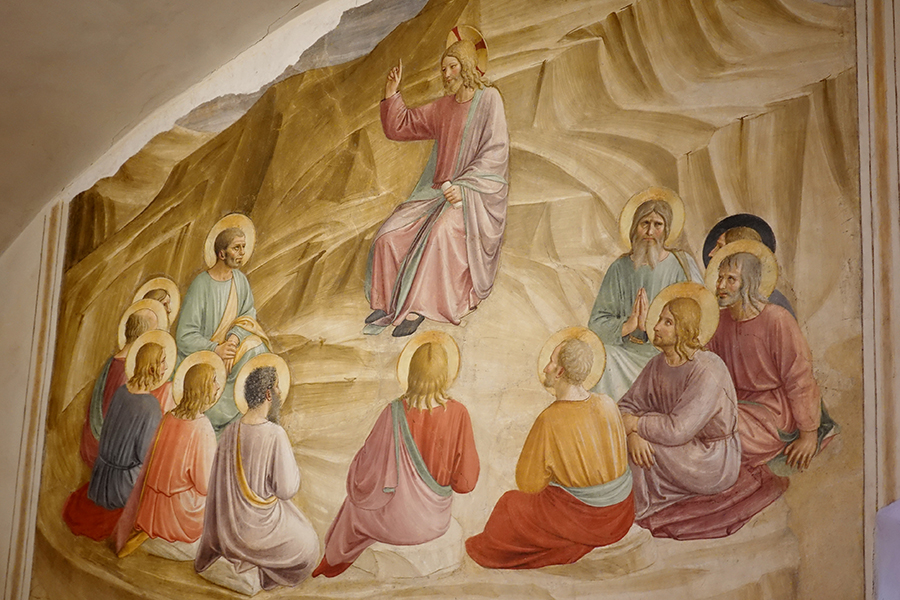
“When Jesus saw the crowds, he went up the mountain, and after he had sat down, his disciples came to him. He began to teach…” There are two groups depicted in today’s Gospel: the crowds and the disciples. Jesus teaches His disciples, and they listen because He has called them by name, and they belong to Him. A crowd is without identity and thrives on frenzy. Crowds are pieced together by individuals who out of fear or indifference have jettisoned the responsibility that accompanies belonging as a lawful member of society in exchange for fitting in with the prevailing mood of the time. The disciples are governed by faith in God as Christ’s Church.
The crowd is dominated by their passions, and this dynamism compels them to be afraid and to become lawless and perpetrate violence against others. The disciples belong to Jesus and are sent on mission by Him to offer the crowd His gift of love and authentic justice through the teaching and witness of His Gospel by a fruitful life lived by the Beatitudes.
The Beatitudes are Christ’s response to the question of what makes human beings happy. It is a question that influences how we approach our own learning and how fathers and mothers teach and provide examples for their children. Before Jesus imposes any laws for His disciples to follow, Jesus begins His Sermon on the Mount with the question of human happiness because happiness is the object of God’s creative design of our human nature. God desires us to be happy. How we approach this question of what makes us happy sets the direction of how we choose to live our lives as family members and participants in a society governed by the rule of law and in accord with the good that we naturally cherish. It is the Grace of the Beatitudes that transforms what we fear brings unhappiness into the path towards eternal happiness.
The late Dominican priest and theologian Father Servais Pinckaers once observed, “To satisfy our appetite for riches, the beatitudes suggest poverty. In place of our aggressiveness, they would have us be meek. They would slake our thirst for pleasure with patience and love of justice, and turn our hard-heartedness into mercy, our inclination to evil into purity of heart and our touchiness to a peaceful spirit, while our vanity would be transformed into a carefree acceptance of insults and calumny. The Beatitudes seem to delight in promising us happiness in all that we loathe and fear.”
It is in this way that the Beatitudes helped by the Gifts of the Holy Spirit form us completely but not all at once, because their operation fits neatly with our gradual learning and natural development as human beings. The New Law expressed in the Beatitudes is different from the Old Law of the Commandments because unlike the Old Law, the New Law does not first confront our free will with external commands. The New Law of the Beatitudes internally nurtures us in the action of the Holy Spirit with a confidence born of humility and a desire to know God.
The Beatitudes precede law in the order of charity and justice in which we all have obligations. For us to fulfill our responsibilities of charity and justice for our neighbors before God we must live in accord with the authentic rule of law. We are called to design and to administer our laws with due process within a structure that is respectful of human nature and renewed in the truth that gives each person what they are duly entitled to and mercifully assists them in discharging their responsibilities. The end does not justify the means and the remedy for lawlessness in society is not more lawlessness even when it is wrongly sanctioned by officials in the government or even the Church.
The responsibilities of loving God and our neighbor are not fostered if the rule of law is abandoned in practice or in theory and replaced by a narrative that only incites our fears and places willfulness in front of right reason. Yet, the narratives of the vulnerable and the poor must be clearly heard by us and their needs cared for by society if laws should be rightly enacted and enforced for the sake of justice for all.
Yet, our Catholic faith informs us that the just rule of law is absolutely essential but incomplete unless tempered by mercy within the wider obligations of charity — directed first to the weakest and most vulnerable in our community, those who are most prone to the dominance of the powerful and elite. This point is central on the Church’s call for legitimate immigration reform in our nation.
As the late Pope Benedict XVI wrote in his final encyclical, Caritas in Veritate, “On the one hand, charity demands justice: recognition and respect for the legitimate rights of individuals and peoples. It strives to build the earthly city according to law and justice. On the other hand, charity transcends justice and completes it in the logic of giving and forgiving. The earthly city is promoted not merely by relationships of rights and duties, but to an even greater and more fundamental extent by relationships of gratuitousness, mercy, and communion. Charity always manifests God’s love in human relationships as well, it gives theological and salvific value to all commitment for justice in the world.”
Our faith, which engenders hope, must be first in our practice of morality so that it will become the source of our charitable and just works. The corner stone of our faith is the grateful humility that we know that we have received everything from God and that we confidently entrust ourselves to His power who is greater than each one of us. As we heard today from the prophet Zephaniah, “Seek the LORD, all you humble of the Earth, who have observed His law; seek justice, seek humility.”
In a few moments, we will humbly seek the Lord again as we approach the altar of Christ’s sacrifice to be nourished at His eternal banquet table. He will totally offer Himself to us. He will offer us His Body, Blood, Soul, and Divinity. He will offer us. To whom He has given the Grace of being are poor in spirit, the gift of being loved that comes from Communion with Him, the Communion that saves us from the chaos of lawlessness, anger, and death.

