
Homily for the Memorial of Saint Thomas Becket, Bishop and Martyr
December 29, 2023
Montserrat Jesuit Retreat House
Lake Dallas, Texas
2 Timothy 2:8-13; 3:10-12
Psalm 34:2-3, 4-5, 6-7, 8-9
Matthew 16:24-27
“For whoever wishes to save his life will lose it, but whoever loses his life my sake will save it. What profit would there be for one to gain the whole world and forfeit his life?”
Thomas Becket was born into a poor family but gradually was able, through education and politics, to become wealthy and influential. He became a longtime friend of Henry II, the King of England, who very much counted on the personal loyalty and friendship of Thomas to achieve his priorities, especially in favor of the power of the state over the rights of the Church— religious liberty. He was among the influential and elite of society, and he also was known to have a luxurious lifestyle— even as a priest. Henry II used his influence to have Thomas Becket chosen as the Archbishop of Canterbury to secure the subordination of the church to his control.
Yet, something happened. God intervened at Thomas’ consecration as a bishop because Thomas experienced a radical conversion of life and immediately through grace gave up his opulent and wealthy lifestyle to embrace poverty to be completely at the service of Christ and His Church.
“For whoever wishes to save his life will lose it, but whoever loses his life for my sake will save it. What profit would there be for one to gain the whole world and forfeit his life?”
We frequently hear the distinction between the sacred and the profane. To consecrate is to sacrifice. It means to make something sacred “facere sacrum.” That which is made sacred, that which is sacrificed, is completely and absolutely set aside for God’s service. The fanum is the sanctuary of the temple. The profanum is that which is left on the threshold of the sanctuary, outside the sanctuary. That which is left outside the sanctuary is profane.
When we sacrifice something, we are not simply giving up something that we really like in order to make God happy. When we sacrifice something, we place it on the altar that it might be offered completely to God for the service and use that He determines. What we place upon the altar is known as the oblation. The oblation must be consumed entirely because anything of the oblation not consumed in the sacrifice is not something that you get to take back. Rather, that which is not taken up and consumed in the sacrifice does not return to you but rather is stolen and devoured by the evil one. “For whoever wishes to save his life will lose it, but whoever loses his life for my sake will save it. What profit would there be for one to gain the whole world and forfeit his life?”
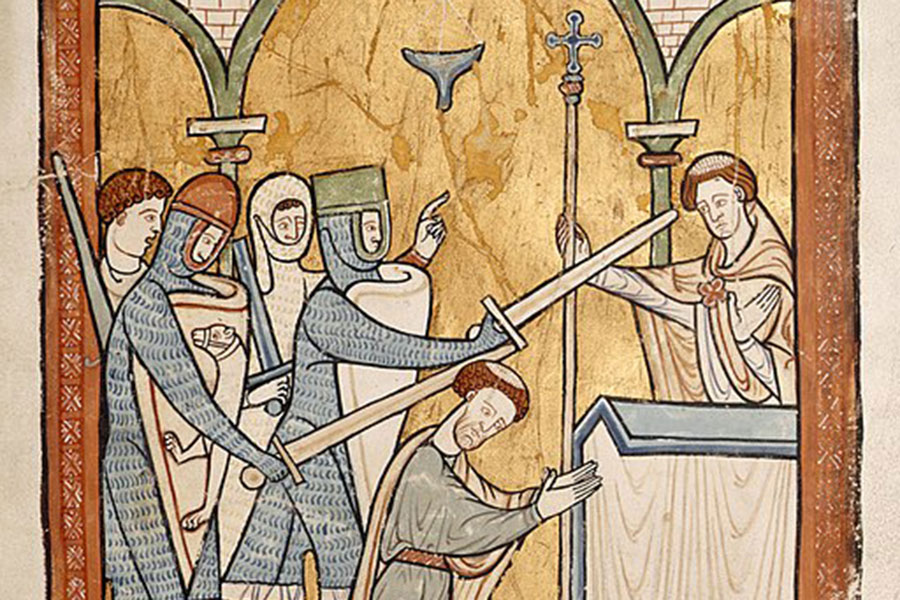
Thomas Becket lived much of his life in the profane order, even that which was intended to be consecrated to God at his Baptism and should have been kept sacred. Henry II wanted to make profane what was rightly sacred — control of the offerings of the Church and the administration of the sacraments. They soon became at odds with each other, and Thomas challenged Henry with the Truth of the Gospel instead of telling Henry and his colleagues simply what they wanted to hear. The courage of Thomas enraged Henry, and four of his knights, in their enthusiasm to please the king, mistook remarks of Henry and went and murdered Thomas in his own Cathedral in Canterbury — between the altar and the bishop’s chair. Saint Thomas’ consecration to God was real and not just gestural — not just a social construct.
As the four knights were charging towards the Cathedral to murder the bishop, the monks present attempted to brandish weapons and to fortify the Cathedral from their attack. The authoritative account by an eyewitness of the murder cites St. Thomas’s last words as: “It is not right to turn the house of prayer, the church of Christ, into a fortress… we will triumph over the enemy not by fighting but by suffering, for we have come to suffer, not to resist… See I am ready to suffer in the name of Him who redeemed me with His blood. For the name of Jesus and the protection of the Church, I embrace death.” It is not right to treat the sacred as profane. Becket learned this and gave the entirety of his life, formerly mistreated as profane, to Christ as a sacred offering for God’s service. He took nothing back. “For whoever wishes to save his life will lose it, but whoever loses his life for my sake will save it. What profit would there be for one to gain the whole world and forfeit his life?”
What were Thomas’ fears? Initially, he feared giving up his profane life, the loss of friendship, and the loss of the esteem of the powerful. Yet in the end, he feared his rejecting the sacred for the profane by abandoning Christ’s love. The Lord delivered Thomas Becket from all his fears.
We are here today to listen to the Lord and to pray that He delivers us from all our fears. What do we fear?
Do we fear losing what we should offer to God to make sacred? Do we fear losing our friends and the esteem of others who see priesthood as a waste of a profane and pleasant lifestyle?
Do we fear persecution, mockery, and the Cross?
Do we fear even though we believe what we have heard today in Paul’s words to Timothy, “In fact, all who want to live religiously in Christ Jesus will be persecuted”?
Do we fear all that would follow if we were to stand firmly with Christ in the priesthood that is itself a life of sacrifice which the world demands to be profane?
Do we try to fortify our lives from the tender love of God? We have nothing to fear because we celebrate this liturgical feast in the season of Christmas when God has disarmed us by becoming a tender infant who asks only for our love and who makes sacred the profane stable of our wounded humanity. The Lord has delivered us from all our fears.
 Life on the Chrism Trail