
Homily for the First Sunday of Lent
February 18, 2024
Saint Patrick Cathedral
Fort Worth, Texas
Genesis 9:8-15
Psalm 25:4-5, 6-7, 8-9
1 Peter 3:18-22
Mark 1:12-15
The covenant between God and Noah symbolized by the rainbow foreshadows the covenant between God and the Church; the waters of the flood indicate the waters of Baptism – they bring life not death; the ark symbolizes the Church. Just as Noah and his family received refuge in the ark from death by being carried upon the waters of the flood, so, God offers us refuge in the Church from the death of sin and its punishments by carrying us upon the waters of Baptism that open for us the gates of eternal life.
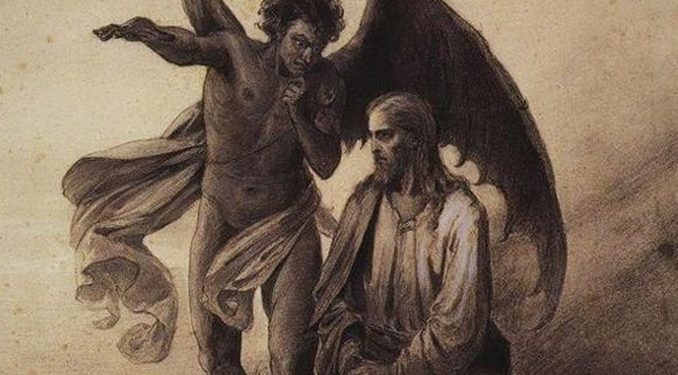
Yet, Baptism does not in itself remove from us the experience of temptation or our weakness to succumb to temptation. Mark’s Gospel succinctly reveals that immediately after His Baptism by John, the Holy Spirit leads Jesus into the wilderness where He undergoes and withstands temptation by the devil. Remember that Adam and Eve were cast out of the Garden of Eden into the wilderness because they succumbed to the temptation of the devil. It is in that spiritual and moral wilderness where their descendants, including us, remain so prone to capitulating to temptation and the resulting misery of sin. Benedict XVI offered us this insight, “The wilderness referred to has various meanings. It can indicate the state of abandonment and loneliness, the ‘place’ of human weakness, devoid of support and safety, where temptation grows stronger. However, it can also indicate a place of refuge and shelter — as it was for the People of Israel who had escaped from slavery in Egypt — where it is possible to experience God’s presence in a special way.”
This is the same wilderness that Christ enters willingly to endure temptation and to withstand the devil to give us an example of how to overcome temptation. St. Leo the Great comments that “The Lord wanted to suffer the attack of the tempter in order to defend us with His help and to instruct us with His example.”
Saint Mark’s account of Jesus’ temptation in the wilderness lacks drama. The account is very direct and includes no dialogue between Jesus and the devil. This is a key point for our reflection because too frequently we attempt to engage the devil in dialogue when he comes to tempt us, and we end up entering the occasion of sin and entertaining the possibility of sin. The compelling drama of temptation is seductive for us and allures us to the excitement of sin that is part of the empty show and pomp of the devil by which he ensnares us. So, Jesus shows us that we should not dialogue with the devil by entering the occasion of sin. Dialogue with the devil leads to our attachment to sin.
Saint Mark further reveals that when Jesus was tempted in the wilderness, angels came and ministered to Him. This too is part of the example that Christ offers us. We should never overlook the existence and ministry of angels that the Lord offers us to guide us away from the temptation of the devil. The angels, particularly our guardian angels, prompt us to ignore the empty show of the devil and to follow peacefully the right path from which we can too easily stray while we are in the wilderness. The good news of Christ is that the wilderness of our spiritual and moral lives no longer must be a place of isolation and defeat through temptation but can become a place where we receive the grace and assistance of God either directly or through the ministry of His angels.
We cannot contend with the devil successfully without Christ. To attempt to do so is to believe the lie of the devil. Temptation should prompt us to turn to Christ in prayer and to seek the protective intercession of His Blessed Mother, the Refuge of Sinners, to whom Jesus entrusted us as He died on the Cross.
The temptation that Christ endured took place in the wilderness for forty days, but unlike the Israelites who are changed by their forty years in the wilderness, the wilderness is changed from a place of certain defeat by the forty days spent there by Christ. He maps out the wilderness for us, and the key to the map that He offers to us is honest repentance and humble prayer. The forty days of Lent are our entrance into the wilderness transformed by Christ by which we are prepared for Easter. Prayer is our refuge from the temptation to engage the devil alone because prayer requires our humility and honest admission of our powerlessness.
The Gospel today is profoundly good news. We do not need to despair or give in to temptation as if our commission of sin is inevitable. When we are tempted to sin, let us consider that to be our prompting from the Holy Spirit to pray — even if it is the brief but effective prayer, “Lord, help me!” Lent is a time to pray, to name our sins honestly before God, and to ask God’s forgiveness sacramentally so that His Holy Spirit can fill our lives. As we prepare to approach the Altar of the Lord in the Eucharistic Covenant, Jesus gives us a clear invitation today: “This is the time of fulfillment. The Kingdom of God is at hand. Repent and believe in the Gospel.” This Lent He is waiting for our response.
 Life on the Chrism Trail