
Homily for Holy Thursday: Mass of the Lord’s Supper
March 28, 2024
Saint Patrick Cathedral
Fort Worth, Texas
Exodus 12:1-8, 11-14
Psalm 116:12-13, 15-16bc, 17-18
1 Corinthians 11:23-26
John 13:1-15
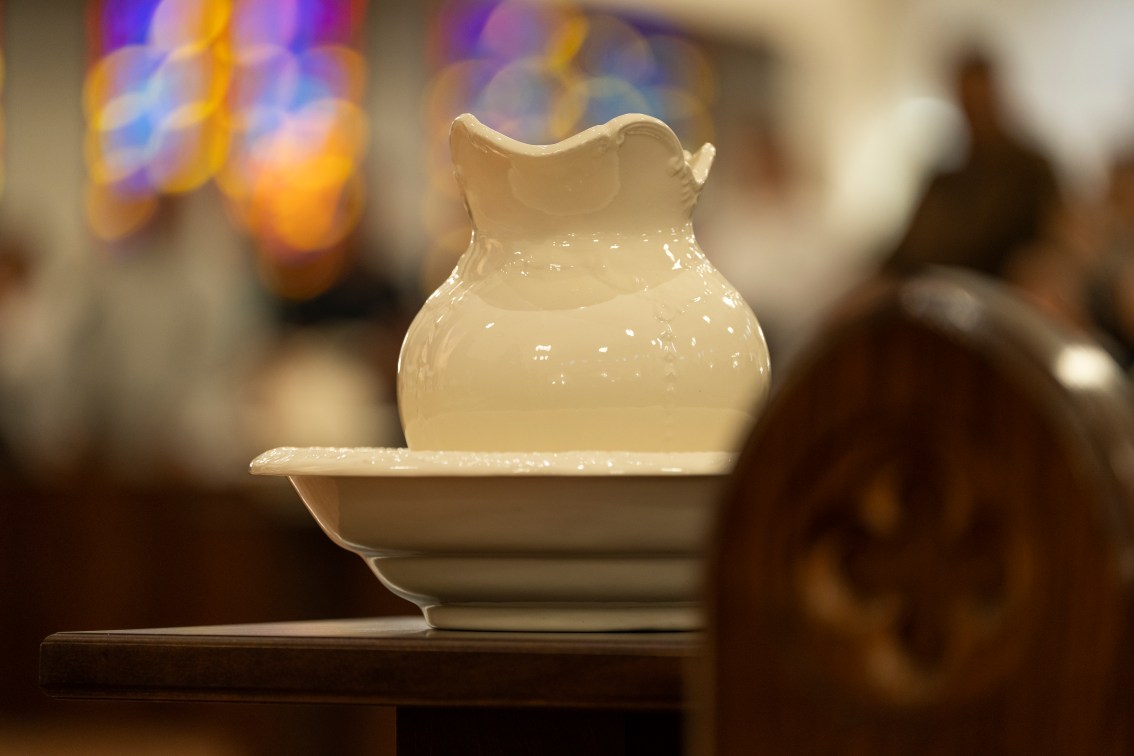
As we have just heard in the Gospel, Peter impetuously remonstrates Jesus for suggesting that Jesus should wash Peter’s feet. Peter is articulating a reverence for Jesus but a reverence that has not yet come to accept the truth that the majesty of God revealed fully in Christ strips itself of all earthly power and manifests itself in humble service and true mercy. When Jesus corrects Peter and tells him that without the washing of the feet Peter would not be able to have any part in him, Peter immediately asks just as impetuously that his head and hands be washed. Then Jesus offers Peter a response that should prompt our reflection in prayer. Jesus says, “Whoever has bathed has no need except to have his feet washed, for he is clean all over; so, you are clean, but not all.”
Jesus was alluding to a cleansing with which the disciples had already complied; for their participation in the banquet, only the washing of their feet was now required. What was Jesus alluding to? We do not know for certain. In any case, let us bear in mind that the washing of the feet, in accordance with the meaning of the whole chapter, does not point to any single specific sacrament but the enduring gift of Christ present in all of the sacraments – in the presence of the Church itself. This is Christ’s mission of salvation, His descent even to the Cross, His love to the end that purifies us and makes us capable to enter God’s presence. The distinction between bathing and the washing of the feet, an allusion to life in the community of the disciples also becomes perceptible, an allusion to our life with and in the Church.
The bathing that purifies us once and for all and must not be repeated is Baptism – being immersed in the death and Resurrection of Christ, a fact that fundamentally changes our life, giving us as it were a new identity that lasts, if we do not reject it as Judas did. Furthermore, the washing of feet signifies for us that Baptism without the other sacraments of initiation is incomplete. If we consider Baptism to be the only thing necessary without reference to the Eucharist, we run the risk of reducing the Christian life to a passive way of life that does not require our response to any mandate of Christ – the very mandate He offered His disciples at the Last Supper.
The washing of the feet signifies that even in the permanence of this new Christian character, given by Baptism, for communion at the Banquet table of the Eucharist with Jesus we need the “washing of the feet.” What does this involve? Let us consider the first Letter of John for a deeper insight, John writes, “If we say we have no sin, we deceive ourselves, and the truth is not in us. If we confess our sins, He is faithful and just, and will forgive our sins and cleanse us from all unrighteousness.” The washing of feet cleanses our daily sins, and for this reason we need to confess our sins as John spoke of in this Letter. We must recognize that we sin, even in our new identity as baptized persons.
This sin is offensive to God, so God through Christ’s Grace cleanses us from sin, venial and mortal, and gives us the capacity to hold God within – that is Grace, the reason for which the second Person of the Holy Trinity became man in Jesus Christ and suffered rejection and death on a cross. We need confession in the form it has taken in the Sacrament of Reconciliation. In it the Lord washes our dirty feet ever anew and we can sit with him at His Eucharistic table.
The gift of Christ’s presence offered in the Eucharist at the Last Supper on Holy Thursday is not momentary. In the Eucharist, Christ shares Himself with His disciples not merely as a memorial, He does so that He might always be truly present with us in His love even as He completes His mission on earth and returns to His Father. As Pope Benedict XVI once offered, “It is not as though after paying the world a brief visit, Jesus now simply departs and returns to the Father. The passage is a transformation. He brings with Him His flesh, His being as a man. On the cross, in giving Himself, He is as it were fused and transformed into a new way of being, in which He is now always with the Father and contemporaneously with mankind.”
Yet, the washing of feet by Jesus not only reveals His mission to cleanse us of our daily sins, it goes further. Christ offers us the command that after we have been washed by Him of the grime of all sin, we must also forgive each other especially before receiving Him into our very being through reception of the Holy Eucharist. Christ gives us the example that denies us of the false stance of humanity to judge others and to keep any grudge or resentment while striving to belong to Him. Through our own acts of forgiveness of others, we can now participate in communion with Christ’s perfect act of forgiveness and expiation on the Cross. If I, therefore, the master and teacher, have washed your feet, you ought to wash one another’s feet. “I have given you a model to follow, so that as I have done for you, you should also do.”
 Life on the Chrism Trail