
Homily for the Third Sunday of Easter
Sacrament of Confirmation
April 14, 2024
Holy Family Catholic Church
Fort Worth, Texas
Acts 3:13-15, 17-19
Psalm 4:2, 4, 7-8, 9
I John 2:1-5a
Luke 24:35-48
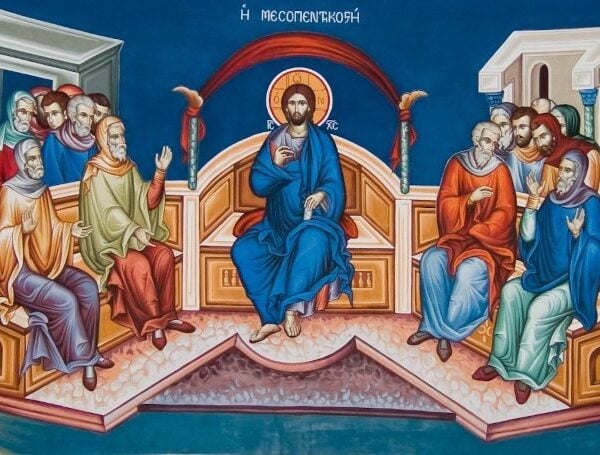
The disciples had returned to the Apostles after encountering Jesus while they were on the road to Emmaus. They were describing to the Apostles how they recognized Jesus in the breaking of the bread, when Jesus suddenly appears among them and speaks to them the words, “Peace be with you.” The disciples thought they were seeing a ghost, but Jesus showed them His wounds and told them to touch Him to prove He was not a ghost. He even asked them for something to eat.
The fear and amazement of the disciples was the fact that Jesus had really been raised in His body, even though He had told them this would happen. This was the Jesus who had called them, lived with them, taught them, befriended them, and died for them, yet all the Gospels speak about the difficulty of recognizing Jesus. Something had changed about Him, in addition to the fact that He was not limited by the physical materiality of his body. He would appear out of nowhere, pass through walls and closed doors, and even the look of His wounds had changed in their being glorified.
It was by means of these very realistic signs that the disciples overcame their initial doubt and opened themselves to the gift of faith; and this faith enabled them to understand what was written on Christ “in the law of Moses and the Prophets and the Psalms.” Indeed, we read that Jesus “opened their minds to understand the Scriptures, and said to them, ‘thus it is written, that the Christ should suffer and on the third day rise from the dead, and that repentance and forgiveness of sins should be preached in His name to all nations…. You are witnesses of these things.’”
What happens to us after death has fascinated and puzzled human communities throughout history. Some pagans, especially the ancient Greeks, argued persuasively that the human soul was immortal but not the human body. So, they reasoned that the body was just a shell or even the tomb of the soul and that the body was not truly important. This prompted them to understand the differences between the sexes as only material and not real or spiritual.
But we as Catholics know that as human beings, we are not just souls, we are living and embodied spirits with sensations, memories, intelligence, distinct sexuality, relationships, and commitments. Our bodies and souls are distinct but truly inseparable, influencing and affecting each other physically, psychologically, and spiritually. We cannot talk about personal immortality if our bodies are not part of the picture. If only our souls were to exist, we would be incomplete. We cannot think, decide, pray, or love without our bodies. The Resurrection of Christ shows us that we will be resurrected in our bodies, truly our bodies but glorified.
The stories of Jesus’ Resurrection are important to teach us not only what will happen to us after death, they also tell us about how we should live our lives in the present and how we should live our lives before death. The Resurrection of Christ offers each and all of us eternal life, body, and soul, and not simply an afterlife involving only the soul. We will be alive in our bodies, and glorified and resurrected bodies, freed from their organic, material limitations and disabilities, yet truly in our bodies. The wounds that we experience through sin will remain but with glory and love and not with pain and suffering. We will be more fully our true selves than we are able to be now in this world fallen and wounded by sin. We will be most truly ourselves by how we receive love now and offer love now.
God has created and redeemed us in His image and likeness. Saint Augustine taught that we are born in God’s image and our likeness to God develops after Baptism by how faithfully we live our lives by following the Commandments as Christ taught us by loving God and our neighbor. The Sacrament of Confirmation gives you the gifts of the Holy Spirit that enable you to think, to act, and to love as Jesus did with His full and integrated character presenting His likeness to all whom you meet and serve. As Saint Teresa of Calcutta once said, “The only Gospel that some people might ever know is the Gospel of Jesus written and expressed in your lives by how you love your neighbor.”
The gifts of the Holy Spirit touch us and draw us into God’s life. As Saint John indicates in our second reading for today, the gifts of the Holy Spirit provide us with the conditions needed for us “to know Him by keeping His commandments and being faithful to His word that the love of God be perfected in us.” Our share in eternal life begins today by how we do that in our shared and loving experience as baptized men and women who consume the Eucharist and thereby compose the Body of Christ, the true Church of Jesus Christ who is risen from the dead.
 Life on the Chrism Trail