
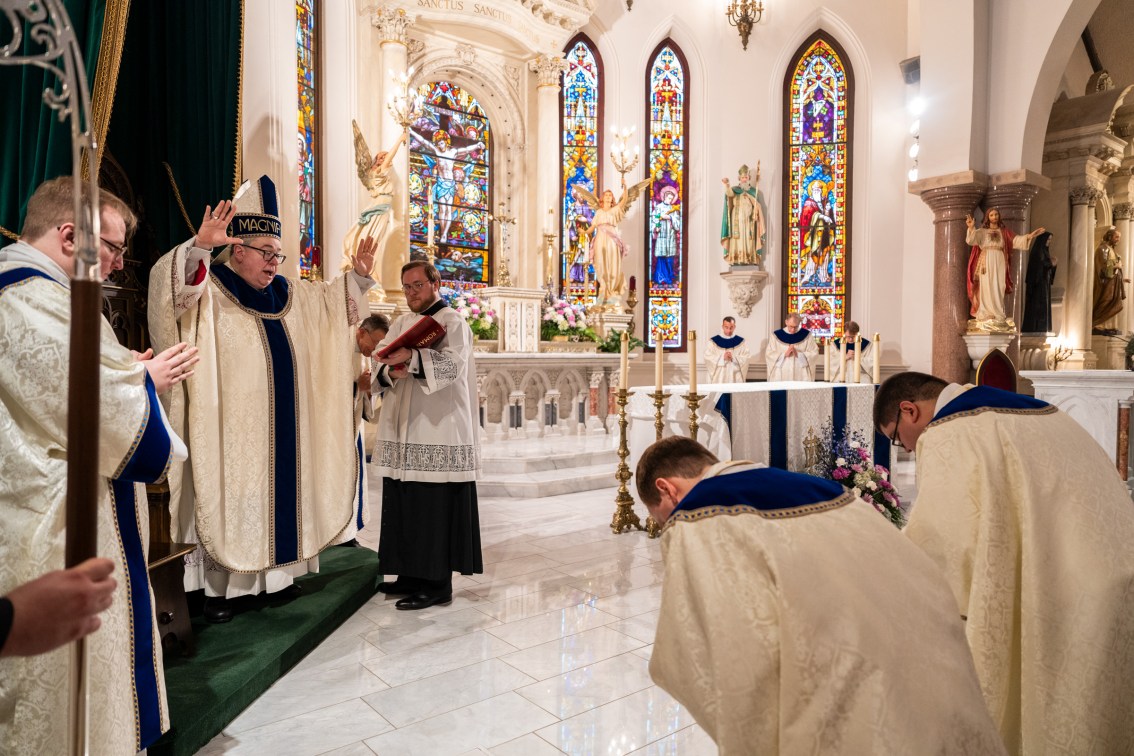
Homily for Priestly Ordination of Rev. Benjamin Grothouse and Rev. Eric Flores
May 18, 2024
Saint Patrick Cathedral
Fort Worth, Texas
Jeremiah 1:4-9
Psalm 116:12-13, 17-18
1 Timothy 4:12-16
Luke 10:1-9
Bishop Michael Olson’s homily in English begins at paragraph 3.
El evento real de la ordenación sacerdotal ocurre en silencio en la imposición de las manos. Es un gesto sencillo pero lleno de significado. Por medio de este gesto silencioso, una comunión ocurre entre el Señor y el que va a ser ordenado por medio del obispo, el presbiterado y toda la iglesia. Es decir que el Señor los agarra a ustedes; acepta su disponibilidad que acaban de expresar. Es como si esté diciendo, “Tú eres mío. Y tus caminos deben llegar a ser mis caminos. Esta comunión se expresa tan radicalmente que la persona de Cristo—su “Yo”—se identifica por medio de la persona del sacerdote: “Este es mi cuerpo.” “Yo te absuelvo de tus pecados.”
La vocación y el ministerio sacramental de un sacerdote requieren que él sea un puente humano, un pontífex como San Pedro, para aminorar la experiencia de aislamiento y pérdida de identidad de tantas personas hoy día, dentro y fuera de la iglesia, y llevarlas al sentido de pertenencia que Dios ha elegido dar a su pueblo a través de sus vidas y la comunión como Su Iglesia.
After today’s ordination, the Diocese of Fort Worth will have four priests under the age of thirty. This has not occurred before in the Diocese of Fort Worth, which in my memory goes back over a span of thirty-five years. We are blessed in this development because in Deacon Ben Grothouse and in Deacon Eric Flores we have two examples of youth well spent. They have persevered in their vocations, discerned with the Church, and done what is necessary so that they would be adequately prepared for the next step: priestly ordination and priestly ministry. This next step requires a renewed fidelity and personal growth in being configured to Christ, Head and Shepherd of the Church. It also requires God’s grace and our prayers.
In our first reading and again in our second reading we have examples of young men, Jeremiah and Timothy, who each are called by the Lord for a specific mission. In each of these readings, both Jeremiah and Timothy are vigorously charged neither to make their youth an excuse for not answering the call of the Lord, nor to allow others to have contempt for them because they are young.
We must be very careful in listening to these exhortations because, while the Lord in speaking to Jeremiah, and Saint Paul in speaking to Timothy, are each clear that the youth of Jeremiah and Timothy are not disqualifiers for their respective vocations and missions given by God; neither is their youth the justification for their vocation or the grounds for the authority of their respective missions. They receive their calls on the Lord’s terms and for His purposes. The exaltation of youth is one of the measurements by which the fallen world establishes the false religion of celebrity and it has no place in the Church and especially not in the priesthood.
There are two Greek words to convey “time.” There is chronos and there is kairos. Chronos refers to time as it is measured by history and recorded in the way that a wristwatch, schedule, stopwatch, or calendar does. Kairos refers to time as the point where circumstances and needs converge for the right human decision and intervention by God into human affairs. The vocations of our ordinands, and each of our vocations, should not be celebrated because of the chronological measurement of age; rather what brings us here today is kairos. God has called each of these men to the priesthood at the precise moment required for their happiness and salvation and that they might conduct the Lord’s mission entrusted to the Church to proclaim and carry out the work of salvation throughout all the world. God has intervened in their lives. They have faithfully discerned and answered this call from Christ. The Church has prayerfully ratified their discernment.
The priestly vocation has this character rooted in kairos because the Church has an eternal character established by Christ through His death on the Cross and sustained by the coming of the Holy Spirit at Pentecost. To understand this requires the grace of faith and an outsider who refuses this grace to believe cannot understand this mystery. One without faith can only judge the Church and measure the priesthood on strictly linear terms as a transactional organization with a chronological history and an urgent need for the organizational value of technological efficiency and precision.
Deacon Ben and Deacon Eric, the world into which Christ is sending you as priests has developed a habit of living life as if God does not exist, let alone care for anybody. This functional atheism has led to the decline of our institutions and beguiled them to reject the Church and to develop systems of law and policy that do not require human beings to be good, to excel in virtue, or most especially to love one’s neighbor. The late poet T.S. Eliot described this prophetically and poignantly in 1934 in his poem entitled Choruses from the Rock. He writes, “Why should men love the Church? Why should they love her laws? She tells them of Life and Death, and of all that they would forget. She is tender where they would be hard, and hard where they like to be soft. She tells them of Evil and Sin, and other unpleasant facts. They constantly try to escape from the darkness outside and within. By dreaming of systems so perfect that no one will need to be good. But the man that is (good) will shadow the man that pretends to be.”
At times, people in the Church and those involved in priestly formation are tempted to adopt this approach to teaching and ministry in seminary work, programmatically reducing the priesthood to a functional ritualism with neither a mind nor a heart. To stave this off, we should do well by reflecting on today’s Gospel that shows us what is entailed in faithfully carrying out the ministry entrusted to us priests at our ordination.
In the section immediately preceding the section we read from Luke’s Gospel, Jesus speaks of three other disciples whom He has called but who have excused themselves from answering the call because they have other priorities than following Christ to Jerusalem where He will be crucified. Three offer Jesus excuses, but seventy-two disciples say “yes” to Him. Jesus sends out the seventy-two disciples in front of Him, “two by two” to ensure that they might help each other and bear witness to brotherly love. Jesus warns them that they will be like “lambs in the midst of wolves.” They were to be serene in spite of everything, and were to bear a message of peace in every situation; they were not to take clothes or money with them in order to live on whatever Providence offered them; they were to heal the sick as a sign of God’s mercy; wherever people rejected them, they were to depart, doing no more than to alert those who rejected them to their responsibility for refusing Christ’s offer of the Kingdom of God.
The mission of the disciples described in the Gospel very much corresponds with the character and vocation of priestly ministry. As priests, we preach and practice God’s mercy, we face rejection many times, and we rely only on God’s Providence for our sustenance. The sending of the disciples in pairs underscores for our purposes that priestly life and ministry is a profoundly human endeavor of divine origin with an essential need for priestly fraternity among the priests of the presbyterate in all of their uniqueness. God has given to us priests the gift of each other as brothers in fidelity to Christ’s call and helping each other to share joyfully the burdens of our respective participation in the mystery of the Lord’s Cross to which we have conformed our lives.
Kairos is the paradox of the meeting of the eternal and the present. It is the paradox of the mystery of the Lord’s Cross, the mystery to which you are directed in this ordination to conform your lives. The perennial becomes timely by descending upon our here and now and lifting us up into a context of everlasting meaning and value. This lifting up will characterize every encounter you have with the members of the Church whether in a ministerial setting or not. In seeing you, they will expect to encounter Christ the Good Shepherd even if they meet you in the grocery store or on the golf course.
Kairos is always rooted in God’s initiative. Our candidates are not demanding ordination. They are responding to a divinely initiated call made personally and intimately to them by Christ. There has been a process of discernment with the Church that has confirmed the authenticity of that call and the authenticity of their response. This is what is happening to our young disciples Deacon Ben Grothouse and Deacon Eric Flores, your relatives and friends who are candidates to be ordained through the imposition of my hands as a Successor of the Apostles and the imposition of the hands of every priest in the presbyterate here present today. Deacon Ben and Deacon Eric, this gesture of the imposition of my hands and that of the concelebrating priests on your heads is not a symbol of sacramental power being transferred into you from above for you to use according to your whim or self-interest. Rather, the gesture is a symbol of you being drawn into the ministry of the Church through and into my ministry as your bishop and through the ministry of the accompanying priests here today.
May all of us, priests and bishop, and every member of the Church treasure this gift. And may each of us take to heart the words of Saint Paul to Saint Timothy, “Do not neglect the gift you have, which was conferred on you through the prophetic word with the imposition of hands of the presbyterate.”
 Life on the Chrism Trail