
Homily for Christmas Mass During the Day
December 25, 2024
Saint Patrick Cathedral
Fort Worth, Texas
Isaiah 52:7-10
Psalm 98: 1, 2-3, 3-4, 5-6
Hebrews 1:1-6
John 1:1-18
It is exceedingly difficult to see in the darkness. We can stumble over things and get hurt in the darkness. We can become agitated by our imagination when we are in the dark. The darkness can make us feel isolated and lonely, not seeing and not being seen. Yet, our eyes can soon grow accustomed to the darkness and we can become satisfied with stumbling around a room in the dark. We can soon numb our imagination’s turbulence simply by imagining that “there’s no need to be afraid of the dark.” The darkness can begin as our acquaintance, soon become our companion, and end up serving as a friend of our convenience.
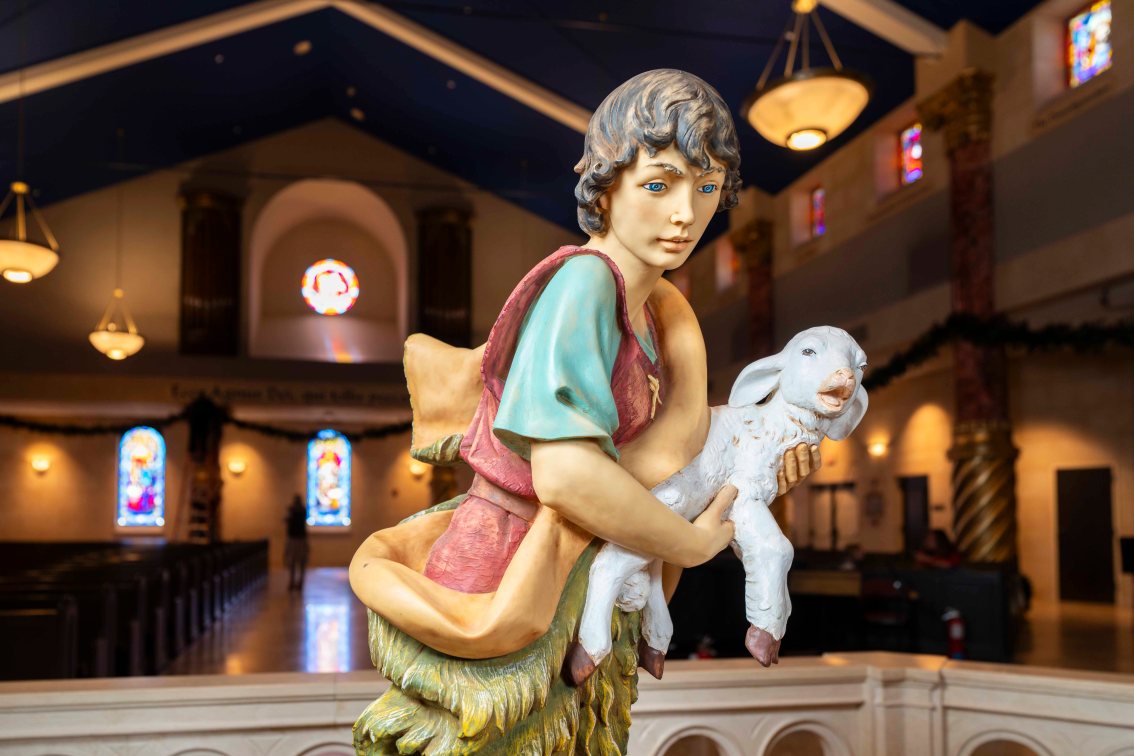
The shepherds kept watch over their flocks in the dark of night. They paid attention and kept watch amid the darkness in order to protect their flocks from very real dangers that they knew prowl in the dark of night to prey upon the flock. Dangers that their experience had taught them were not simply figments of their imagination. The shepherds paid attention in the darkness of night. Their attentiveness to their watch prepared them to hear the angels sing and to see God’s glory in the Christ Child born in circumstances familiar to them including the dark dank of a stable, probably where many of them had been born or seen their children born.
They were accustomed to the dark and how to pay attention in the dark but their encounter with the Christ Child revealed to them that they do not belong to the dark nor would the dark prevail. They recognize in the Child that even more than the Child belonging to them in their poor circumstances, they belong to the Child who is born as the Light of the World in the midst of darkness — so that they might become one with this Light of the world.
Unlike the figments of our imagination stunted by the dark, the Christ Child is not imaginary, He is really born of Mary. Christ is the Light of the World, who can neither deceive nor be deceived. A proverb holds that you become what you love. Adam and Eve loved the darkness, and so human beings became dark. Yet, God loved human beings, and so He became one of us that we might be one with the Light and no longer of the dark. The real presence of God’s love outflanks and undercuts the pretense of human imagination.
In the Book of Genesis, we read that when the universe was created, “the earth was without form and void, and darkness was upon the face of the deep.” “God said, ‘Let there be light;’ and there was light.” (Gen 1:2-3). The creative Word of God is Light, the source of life. All things were made through the Logos, not one thing had its being but through Him (cf. Jn 1:3). That is why all creatures are fundamentally good and bear within themselves the stamp of God, a spark of His light.
Nevertheless, when Jesus was born of the Virgin Mary, the Light himself came into the world: in the words of the Creed, “God from God, Light from Light.”
The vulnerable baby in the manger, the Word Incarnate, proclaims in the wordlessness of infancy that He requires of us only our love. As Pope Saint Paul VI reminded us on Christmas night many years ago, “Is not that power which is Christ exercised completely for us, for our benefit, for our salvation, for our love? Christ came for us, not against us. He is not a competitive rival to us. He is not an enemy. He is a guide for us on our way, He is a friend; that means for all of us, each and every one of us can rightly say: the Christ Child has come for me.” Today is born our Savior who is Christ the Lord.
 Life on the Chrism Trail