
Homily for the Fourth Sunday of Lent
March 30, 2025
St. Patrick Cathedral
Fort Worth, Texas
Joshua 5:9a, 10-12
Psalm 34:2-3, 4-5, 6-7
2 Corinthians 5:17-21
Luke 15:1-3, 11-32
In today’s Gospel from Luke, we find Jesus is on his way to Jerusalem and engaged in a discussion with the Scribes and Pharisees. They are watching for Him to make a mistake and find a reason to judge and to condemn Him since “He welcomes sinners and eats with them.” So, Jesus instructs them by telling them a parable.
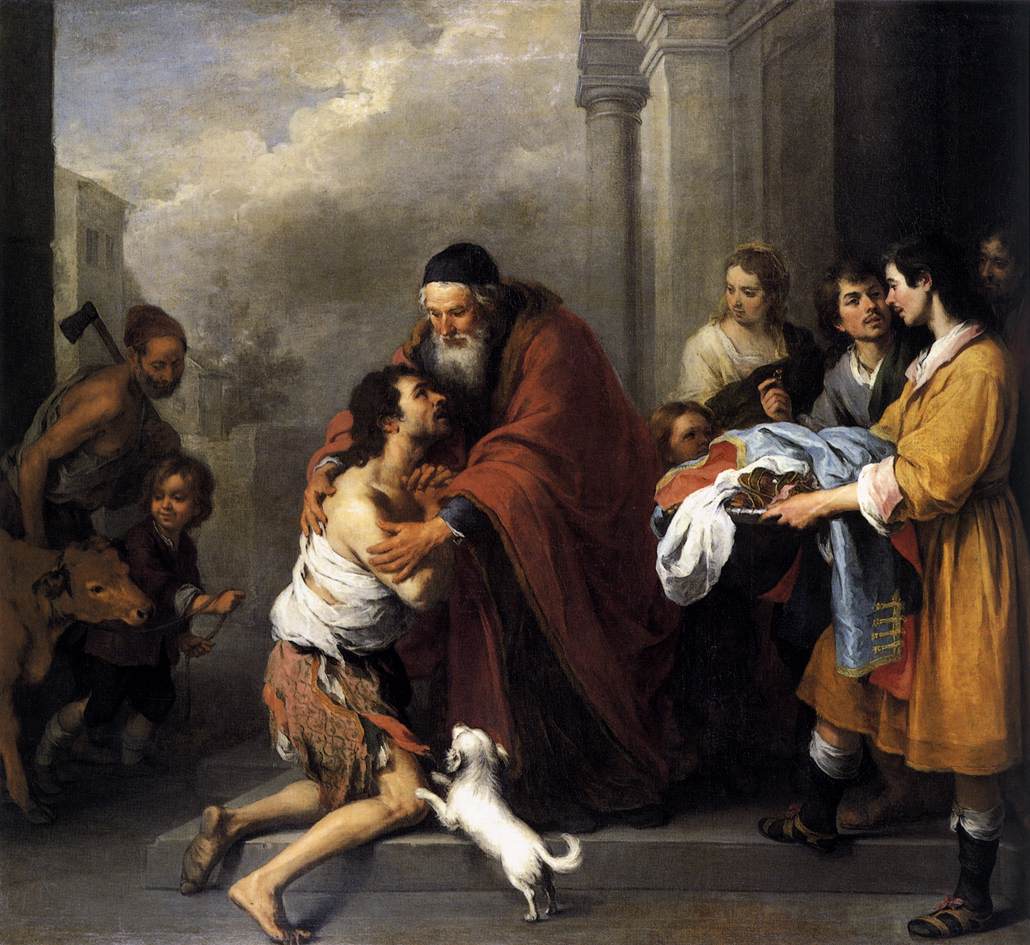
A thoughtless and ungrateful son, seduced by the false promises of greed and lust, asks his father for his inheritance and leaves home to squander it. Once destitute, he becomes remorseful and soon realizes the error of his way, regrets his decision, finds himself without hope, and takes a chance on returning home. On his way home his remorse develops into contrition, and he musters courage to ask for forgiveness. He hopes that his father will be willing to forgive him. His father’s response overwhelms him. The wayward son had been rehearsing his speech, but before he has the chance to deliver it, his father takes the initiative. The father runs to his son and embraces him. The father’s forgiveness overflows.
The older brother is confused by his father’s enthusiasm for his younger brother … the robe, the ring, the banquet? He seethes with resentment not only at his brother but also at his father and becomes insolent. He refuses to share in his father’s joy and can find no room in his heart to welcome his brother. The parable makes us question which son is really the true prodigal. As Pope Benedict XVI observed several years ago, “The two sons represent two immature ways of relating to God: rebellion and childish obedience. Both these forms are surmounted through the experience of mercy. Only by experiencing forgiveness, by recognizing one is loved with a freely given love, a love greater than our wretchedness but also than our own merit, do we at last enter into a truly filial and free relationship with God.”
Jesus’ point to the scribes and Pharisees is God’s unrelenting mercy and unconditional love overcomes all sin. If we, like the religious leaders around Jesus, fail to understand God’s freely given and unearned love, we fail to understand Jesus Christ and His message. If we change the Gospel into a set of ideals, regulations, and external rules, then we begin to think we can earn God’s love. Love can never be earned because it is priceless. This is the mistake of the older brother, who feels he has earned his father’s love and has no need for forgiveness. The story reveals that the older son, while appearing to be faithful and responsible, in fact does not love his father nor accept the love that his father holds for him.
Sometimes like the prodigal son, our remorse for our sins leads us to contrition; sometimes like the older son we feel justified before God, believing ourselves to have no sins and needing no forgiveness, we exchange sham compliance for filial love. This, of course, is the far greater scandal. Lent invites us honestly to become aware of our sins, to become contrite and not simply remorseful, and humbly ask God for His forgiveness. This is a parable about realizing our sin, seeking forgiveness, and being forgiven. But it is also about forgiving those who have sinned against us. As Saint Paul reminds us today in his second Letter to the Corinthians, “we are ambassadors for Christ, as if God is appealing through us,” by how we are willing to forgive those who have really hurt us. By virtue of our Baptism and membership in the Church, we are ministers of His forgiveness and mercy. That means that the character in the parable that we must absolutely imitate is the father.
This Sunday and every Sunday God throws a banquet for us prodigals. God invites us to the Banquet of the Eucharist, the Sacrifice of His Son’s own Body and Blood that redeems all sins. He reconciles us and nourishes us for eternal life. As He did almost two thousand years ago as recorded in today’s Gospel, Christ is among us and desires to eat with us sinners. Are we willing to trust Him and enter the banquet hall, or are we too attached to our own self-righteous rationalization and resentments to enter and be nourished at His banquet? Lent is the time for us to leave outside our resentments and sins, to be forgiven and reconciled sacramentally, and to enter into the celebration that the Father has prepared for us through the gift of His own Son.
 Life on the Chrism Trail