
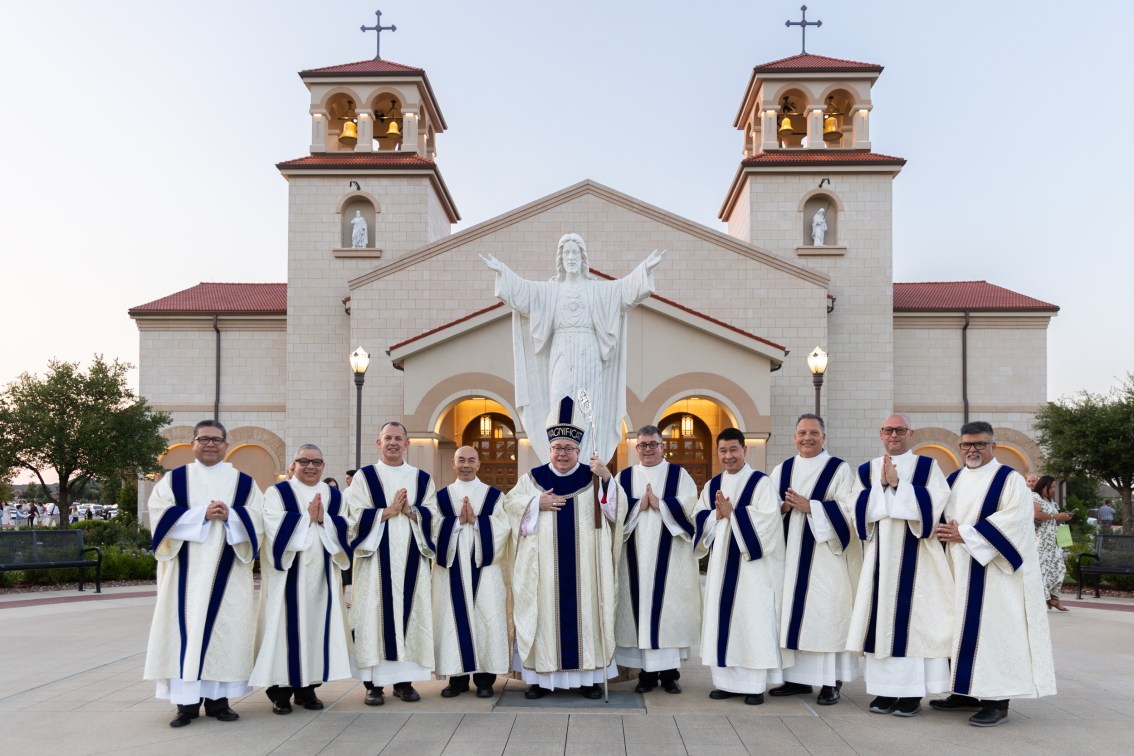
Homily for the Ordination of Permanent Deacons
Feast of Saint Dominic
August 8, 2025
St. Mark Catholic Church
Argyle, Texas
Jeremiah 1:4-9
Psalm 100:1b-2, 3,4, 5
Acts 6:1-7b
John 12:24-26
Today, the Church gathers us together to celebrate the ordination of these seven men, whom with the support and encouragement of their wives and families, have presented themselves and been called by the Church to serve as permanent deacons. We do so today on the Feast of Saint Dominic, founder of the Order of Preachers, who is honored and recognized by the Church as a saint who dedicated his entire life as a mendicant priest to charity and to preaching the Good News of Jesus Christ. He is certainly an example and friend for our new deacons who today are ordained as ministers of the Word, ministers of the Altar, and ministers of Charity.
On his travels as a diplomat prior to experiencing a call to religious life, Dominic became aware of two enormous challenges for the Church of his time: the existence of people who were not yet evangelized in the northern frontiers of Europe, and the religious schism that undermined Christian life in the South of France where the activity of the heretical sect known as the Albigensians was distancing people from the truth of the Christian faith. So it was that missionary action for those who did not know the light of the Gospel and the work of the re-evangelization of Christian communities that awakened within Dominic an apostolic zeal to spread the Gospel of Jesus Christ.
Pope Innocent III learned of Dominic’s natural talents and supernatural gifts and asked him to devote himself to preaching to the Albigensians. These heretics upheld a dualistic conception of reality, that is, with two equally powerful creative principles, Good and Evil. They despised the material world as coming from the principle of evil. They refused marriage not for the sake of chastity but out of disdain for its obligations between husband and wife. They went so far to the point of denying the Incarnation of Christ and the sacraments in which the Lord “touches” us through matter, and the resurrection of bodies. The Albigensians esteemed the poor and austere life. In this regard they were even exemplary and criticized the riches and elitist ethic of many of the clergy of that time.
Dominic enthusiastically accepted this mission from the Pope and carried it out with the example of his own poverty, and by explaining the Gospel in charitable discussions with those who had become indoctrinated with intellectual trends that rejected the heart of the authentic faith: the Incarnation. Dominic responded to this assignment from the Pope by living a life of poverty in which he relied with complete dependence on God as a witness to Christ which especially spoke clearly to the Albigensians and others, and by his dedication to study of the Word of God, the Word Incarnate, Jesus Christ.
Like the time of Saint Dominic, there exist today many confusing intellectual trends in our culture and even in the Church. We know the cultural trend among too many young people who are afraid to marry because of their fear of the risk of vulnerability to love a spouse. We know sadly that there are too many who so spiritualize a relationship with God offered through Christ that they ignore the efficacy of the sacraments and misunderstand them as romantic symbols. We also recognize the paralysis in our political life as a nation that is ensnared by ideological extremes offering a false dilemma between charity for migrants and refugees or justice for victims of crime. All of this is because of intellectual trends that polarize justice against charity as if each had different principles, resulting in the relativizing of objective morality in favor of private and economic interests.
Like Saint Dominic did, we must not see those confused people as adversaries, but we must love them as Christ does. We are in need of the service and witness of deacons ordained as ministers of the Word, of the Altar, and of Charity.
Pope Benedict XVI reminded us in his third encyclical entitled, Caritas in Veritate, “Without truth, charity degenerates into sentimentality. Love becomes an empty shell, to be filled in an arbitrary way. In a culture without truth, this is the fatal risk facing love. It falls prey to contingent subjective emotions and opinions, the word “love” is abused and distorted, to the point where it comes to mean the opposite…Charity goes beyond justice, because to love is to give, to offer what is “mine” to the other; but it never lacks justice, which prompts us to give the other what is “his,” what is due to him by reason of his being or his acting. I cannot “give” what is mine to the other, without first giving him what pertains to him in justice. If we love others with charity, then first of all we are just towards them. Not only is justice not extraneous to charity, not only is it not an alternative or parallel path to charity: justice is inseparable from charity.”
Like the seven men named in today’s reading from the Acts of the Apostles, these seven men will be ordained in order to extend in our time and place Christ’s own ministry of word and sacrament. Word and sacrament — taken together properly — always lead to justice, mercy, and charity. To be the conduit of what Christ offers His people through His ministers, these ordinands must be formed, informed, and transformed by the Word — as He comes to us in Sacred Scripture and Sacred Tradition. Consequently, it is fitting to close this homily, preached on the feast of Saint Dominic, with a quote from Saint Dominic himself: “I kept on studying the Scriptures, and the more I read, the more I burned with the desire to preach.”
To this I add my own gloss: My brothers, welcome the Word, worship the Word, proclaim the Word, witness to the Word with deeds of justice, mercy, and charity. This is how we follow Christ, lose our life with Him, and preserve it for eternity.
 Life on the Chrism Trail