
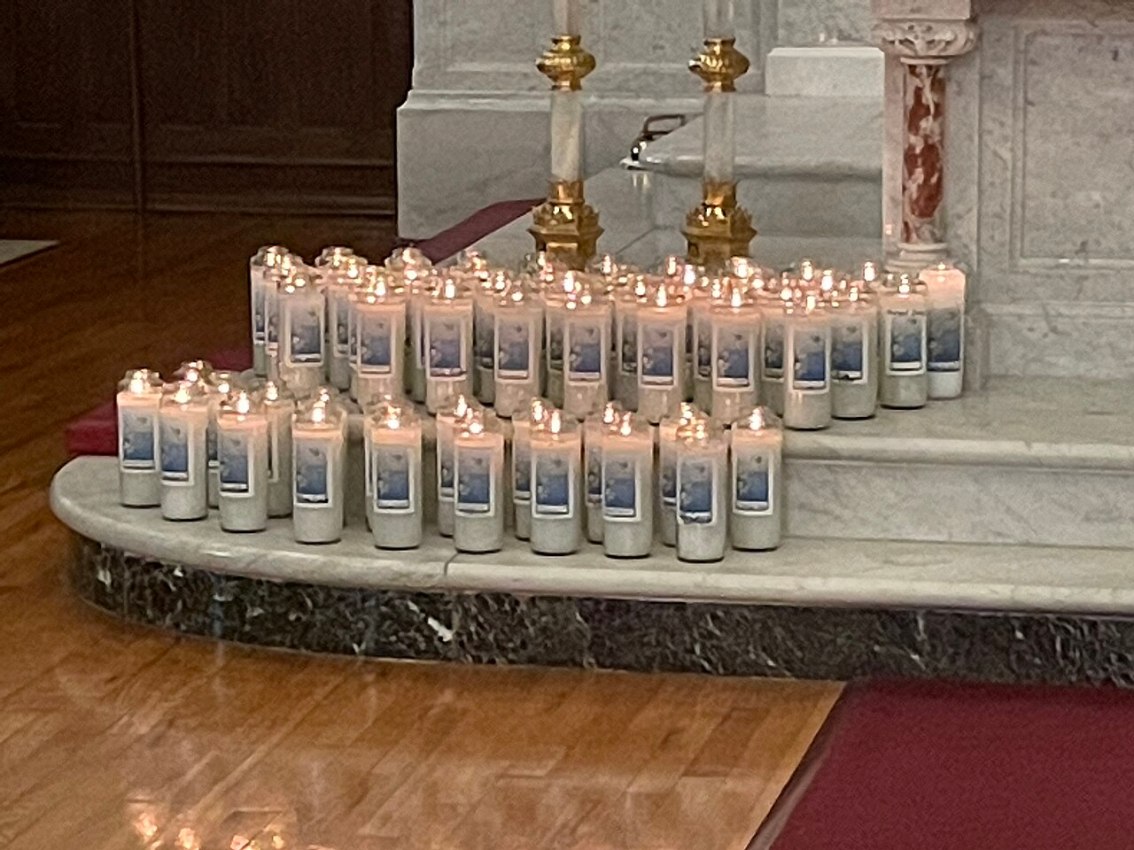
Homily for All Souls Day
November 2, 2025
Casa Santa Maria
Rome, Italy
Wisdom 3:1-9
Psalm 23:1-3a, 3b-4, 5, 6
Romans 5:5-11
John 6:37-40
Last weekend here in Rome you set your clocks back one hour. This weekend in most of the United States we turn our clocks back one hour to try and rescue some of the daylight that quickly disappears this time of year. We love the daylight because it helps us to use our time better for work and to enjoy our time together. In a certain sense, the setting of our clocks back one hour as part of Daylight Savings Time is an attempt by us to stave off the darkness that inevitably comes with winter. It is as if we compromise with time to negotiate with the darkness instead of simply accepting the light as it is given.
As we begin November, the Church gives us two feast days on which we consider the time of the past, the time of the present, and the time of the future. What we celebrate in both feasts is what is known as the “Communion of Saints.” The saints are those who lived in time before us and who understood and heroically embraced Jesus’ gift of the light of the Gospel received at their Baptism and Confirmation. They found ways to make God’s love and mercy real and effective in people’s lives by prayer, witness, suffering, and service and by rejecting the darkness of sin and hatred, by living their lives in imitation of Jesus through integrity, sacrifice, and perfect charity.
Yesterday, on All Saints Day, we celebrated the truth that Jesus’ Resurrection and Ascension mean that death does not separate us from the love of God, nor does it separate us from each other, so that the saints in heaven pray for us that we will join them one day.
Today is All Souls Day. This day remembers that our journey to Christ’s eternal kingdom is not complete without a stage of purification — a stage that removes us from our selfishness and prepares us to receive the fullness of God’s love. The life we live in the present is a part of that process of purification to the extent that we are willing to let go of ourselves and embrace Christ wherever He is to be found. While the saints pray for us, we in turn pray for the souls of the departed — especially remembering those souls most forgotten and most in need. And our prayers for the dead bring us closer to them and to God.
Faith has as its object God’s revealed truth. Hope has as its object God’s omnipotence. Canonization of a saint by the pope in service to the Church infallibly declares and invites an act of faith on our part, that we can say with Divine and Catholic faith that this person is in heaven and worthy to intercede for us and to be imitated in his or her love for God. Our preaching at funerals should involve the confidence of hope more than the certitude of faith that the deceased person worked to live the Gospel and that we place our hope in God’s power to purify the soul of the faithful departed for entrance into beatitude.
Human life can be brilliant, but the words of the Canticle of Zachariah recorded in Luke’s Gospel remind us that even at its brightest, human life in this world is lived “in the shadow of death.” Yet, the darkness of human death, the shadow it casts over human life, is the place where God’s love is most clearly shown to us, in the death of Christ and by association with His death in our own dying. God’s power and love can conquer even this. God’s power needed to reach this extreme to redeem us. The Resurrection of Jesus Christ shows us that death does not silence the Eternal Word. His Resurrection shows what the words He spoke about life truly mean. And the words and actions of Christ were not just those of a prophet or a saint; they were the words and deeds of God himself, God incarnate, speaking to us and acting toward us as a full human being in His own voice, the Son of God and the Word of God.
We must remember to pray for those who have gone before us and resist the temptation to canonize them in accord with our own limited judgment, because even though we can admire a person’s life for its excellence, there remains a great difference between even the best of human beings, and the blinding, ineffable goodness of God, and Christ shows us that we need God’s mercy and grace to come into His presence.
November can be a shadowy month but, in those shadows, God makes us aware of a different kind of light. The Holy Spirit, whom we received at Baptism and again at Confirmation, enlightens us in many ways, especially in Sacred Scripture and Tradition. The light of the Holy Spirit teaches us that because of Christ we do not have to compromise with time and negotiate with darkness.
Jesus comes to us again today, right now in the present, as we celebrate Mass and receive Him in Holy Communion. So, as we pray together the words of the Mass and as we receive Holy Communion together, let us remember the Communion of the Saints, especially to pray for the poor souls in Purgatory, with confidence in what we heard the Incarnate Word of God speak in the Gospel of today: “This is the will of my Father, that everyone who sees the Son and believes in Him may have eternal life, and I shall raise him on the last day.”
 Life on the Chrism Trail