
Homily for the Fourth Sunday of Advent
December 21, 2025
St. Patrick Cathedral
Fort Worth, Texas
Isaiah 7:10-14
Psalm 24:1-2, 3-4, 5-6
Romans 1:1-7
Matthew 1:18-24
At this Eucharist on the Fourth Sunday of Advent, the Church provides us with a set of readings from Scripture that present us with two different paths on which we are free to travel but on which only one leads us to God-with us-Emmanuel. There is the way of Ahaz and there is the way of Saint Joseph, the righteous man. The way of fantasy and cunning or the way of dreams and grace.
Ahaz lived some 700 years before the birth of Christ during the time of the prophet Isaiah. He was of the lineage of David and was the King of the Southern Kingdom of Judah and was by all accounts a terribly corrupt king. King Ahaz was cunning. He had been invited by two other hostile but larger Gentile kingdoms to enter an alliance against the super-power of the Assyrians. The Assyrians had crushed all other smaller and neighboring kingdoms. Ahaz refused the entrance into an alliance with these Gentile kingdoms against the Assyrians not out of fidelity to the Lord but out of a strategic recognition that such an alliance could not overcome the power of the Assyrians.
These two smaller Gentile kingdoms then decided to march against Ahaz and his kingdom of Judah. So, Ahaz decides to outdo his enemies in cunning and by negotiating a truce with the Assyrians that also betrayed the Northern Kingdom of Israel but promised to guarantee the protection of Judah by the Assyrians against these enemies. The one condition was that Judah worship the false gods of the Assyrians with the desecration of the Temple including the introduction of such abominable practices as human sacrifice.
Isaiah challenges Ahaz to ask the Lord for a sign; Ahaz refuses to do so with pious language but not out of authentic piety — he refuses because he has deluded himself through his own fantasy and cunning. Yet, Isaiah will not be deterred and prophesies the sign of contradiction as the mystery of the Lord, “A virgin shall conceive and bear a son, and shall call his name Emmanuel, God is with us.” This results in Judah’s conquest and subjugation and Ahaz’s death.
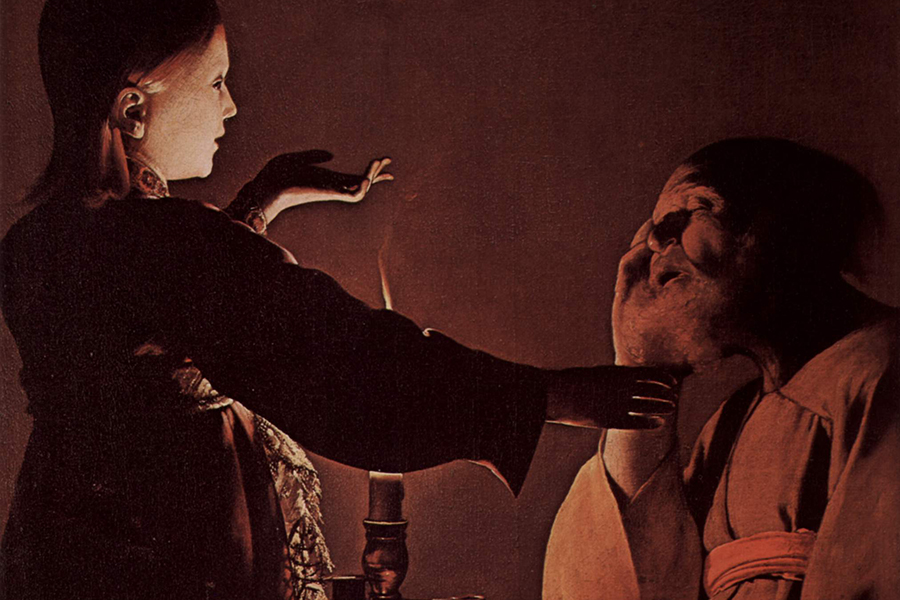
Saint Joseph is a descendant in the line of Ahaz and of David. God sends His angel to Saint Joseph while he sleeps to declare to Joseph in a dream that he should not be afraid of taking Mary as his wife, for the child she carries in her womb is conceived by the Holy Spirit. Mary receives her annunciation while fully awake and conscious. Saint Joseph receives his call in a dream. Mary responds with humble words of obedience. Joseph responds with attentive and silent contemplation of the significance of the dream.
There is a difference between a dream and a fantasy. Dreams are anchored in our experience of reality in the present moment of daily life, but they are found deep in our human subconscious. Dreams in themselves are unclear but meaningful. Dreams require interpretation for understanding what is true about them amidst their obscurity. Dreams, when brought to prayer and discernment, can enable each of us to envision the future through our desire to know and to love something lasting that is beyond our immediate pleasure or satisfaction. Authentic dreams gradually take shape in vision, move through planning, and culminate with our decisive action in response to the eternal call and promptings of the Holy Spirit.
Fantasies, unlike dreams, are not related to reality. Fantasy restricts us from growing and developing as human beings. Fantasy leads us to see the world unrealistically and only through the prism of our passions and compulsions. Fantasy numbs us to the sensitivity required for the compassion and empathy needed to flourish as human beings in family life and society. Dreams can reveal a purpose. Fantasies are always conjured for selfishness, and they are the provenance of the false idols that seek to rob us of our freedom and our lives. As we see from the example of Saint Joseph in today’s Gospel, the Lord chooses at times to invite us to follow Him in our dreams and to do His will. God never speaks to us through our fantasies.
The benefit of attending to a dream, rather than becoming lost in fantasy, is that a dream can lead us to aspiration, to the desire and necessary action to realize the dream. Aspiration without discernment and decisive action becomes merely wishful thinking. Aspiration and a pattern of intelligent action guided by prayer leads to freedom, to generosity, and to our love of God and neighbor and never to our subjugation by our unrestrained passions.
During these final days of Advent in which we prepare for Christ’s coming at Christmas, let us pray in the same silence of Saint Joseph over what the Lord asks of us. Are we willing to reject the path of Ahaz and instead accept the challenge of Isaiah and ask the Lord for a sign and to trust Him? Are we willing to offer Him the treasures of our freedom and love just as Saint Joseph did in accepting Mary into his home? Finally, are we willing to accept His invitation to encounter Him in a new way in this Eucharist that we might let the Lord enter our hearts in triumph as the King of Glory.
 Life on the Chrism Trail