
Homily for the Third Sunday of Lent
March 8, 2026
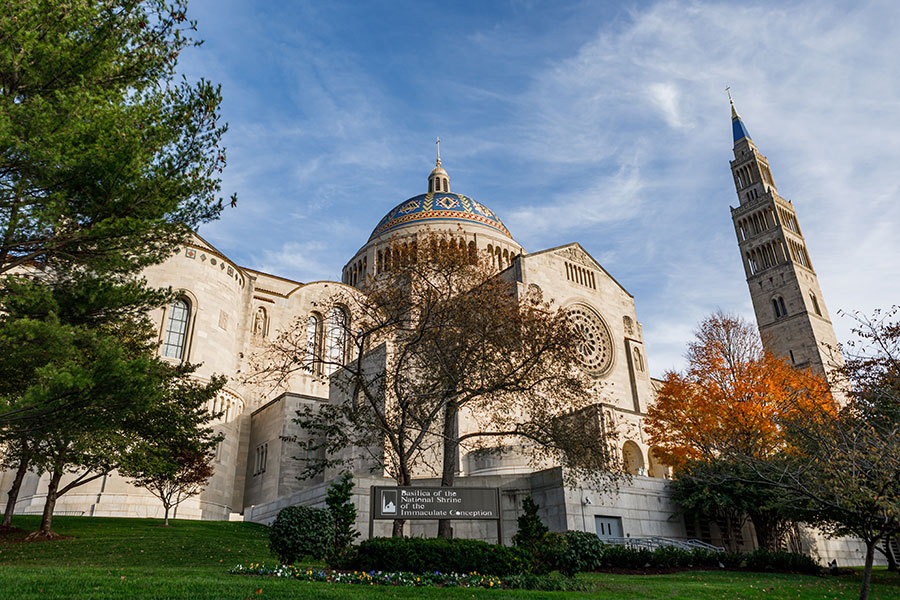
Basilica of the National Shrine of the Immaculate Conception
Washington, D.C.
Exodus 17:3-7
Psalm 95:1-2, 6-7, 8-9
Romans 5:1-2, 5-8
John 4:5-42
The woman whom Christ meets at the well is herself thirsty. If she is not physically thirsty, she is at the very least existentially unsatisfied and thirsting for meaning and for love. She has come to the well at the middle of the day, at a time when the women of the town would not have been at the well to draw water. They would have drawn water at the break of the day. Perhaps she has come to the well at that time so as to avoid the shame she would suffer from other women because of her sinful life. Perhaps, she came to the well at midday because she was sleeping at the earlier hour. Perhaps, she has come to the well to seek yet another husband — repeating the same behavior but expecting a different result. Yet, the point is that she has come to the well and she meets Christ, who asks her, a Samaritan, for a drink — because He Himself thirsts. He thirsts for her faith and for her repentance.
The conversation at the well is perplexing at first, but it becomes deeply moving. This woman’s life is a mess. She has been married to five different men and is now living with a man to whom she is not married. She is riddled with shame so she comes to the well at midday, a time when nobody else would go to the well. That is, nobody, except Jesus, who is there for her. Jesus knows all of this, as He knows all things about each and all of us, and He loves her and us still the same. We should note that she already knew her life was a moral mess; she just didn’t know how to change her heart to quench her interior thirst for love and peace.
Jesus acknowledges the emotional and moral chaos in her life without any scorn or contempt, but then He gently calls her to everlasting life through conversion and the acceptance of the Truth by the gift of God’s revelation. He makes no excuses or rationalizations for her miserable state in life. He does not blame culture, or gender inequity, or abstract structures of exclusion, nor does she. Even if these other things do exist, the Light of Christ makes clear that the root of her misery is her sin. So, moved in the depths of her soul by His gracious mercy and the power of His Word, the Samaritan woman is enlightened and changed by the Lord Jesus, and she then shares the liberating truth of the Gospel with all the other people in her town whom she previously avoided because of her state in life, many of whom would come to believe as disciples of Jesus Christ.
Like the woman at the well, we too are thirsty. Our lives are too often filled with moral confusion and insecurities which lead us to do strangely destructive things, not least because we fear death and want to live forever but know that in fact we will all die.
Without trusting Christ such fear compels us to resist the Lord and quarrel with His Church because we do not like what the Gospel reveals in our consciences about our lives. Out of fear we can demand that the Church change the teaching given to Her by Christ to suit our preferences and to pacify our fears. We numb our consciences and allow our eyes to grow accustomed to the darkness of our sins. Our hearts become hardened, and we soon become indifferent to those whom we hurt. We soon insist that our sins are not really sins at all. We become discouraged and turn away from the means of grace because we conclude that the grace of God is insufficient to change us, and so we no longer follow the Way of the Cross.
Yet, our sins are real. They really offend God, and they really harm us and others. We cannot explain them away. The Good News of salvation is that only Jesus Christ forgives our sins, heals our wounds, answers our doubts, replaces our fears with confidence, because He is the living water that becomes in those who believe and trust in Him a spring welling up as the Grace of eternal life. The ordinary way that this spring of living water opens up is through Baptism for which our elect are preparing this Lent to receive at the Easter Vigil, and the promises of which we the baptized are preparing to renew on Easter Sunday.
The story of the woman at the well does not end with the conversation of mercy that Jesus offers her. We would be remiss if we passed over what she did next. She introduced
Jesus to everyone — including those who probably didn’t like her. She said, “Come meet the man who just told me everything I have ever done!” Most of us would not want to meet a man who knows everything about us, especially our sins, much less introduce Him to others. Why would she do that? But a prior question — how could she do that?
She could do that because in responding to Jesus, she found herself to be a loved sinner. Secure in that knowledge, she now has a peace and freedom that extends beyond her
misery and her shame. More than that — now she has charity for her neighbors, including those who probably didn’t like her. She wants others to meet Jesus so that they could see for themselves that they are loved sinners.
And now, it’s our turn. Lent is the time for us enter the conversation that Jesus initiates at the well. Lent is the time to hear clearly the Word of God and to look into the eyes of the Light of the world, in order to become, like the illuminated Samaritan woman of the Gospel, grateful and confident disciples of the Lord Jesus Christ. Lent is the season for us to soften our hearts and to drink more deeply from the water of conversion offered us by Christ that we might hear His plea to drink of our trust and repentance on Good Friday when He speaks his final words, “I thirst.” Lent prepares us to quench His thirst. Then, at Easter, with the grace of knowing that we are loved sinners, it’s our turn to go out into the world and say, “Come meet Jesus — who knows my sins, forgives my sin, and loves me enough to want me to walk with Him into Heaven.”
 Life on the Chrism Trail