
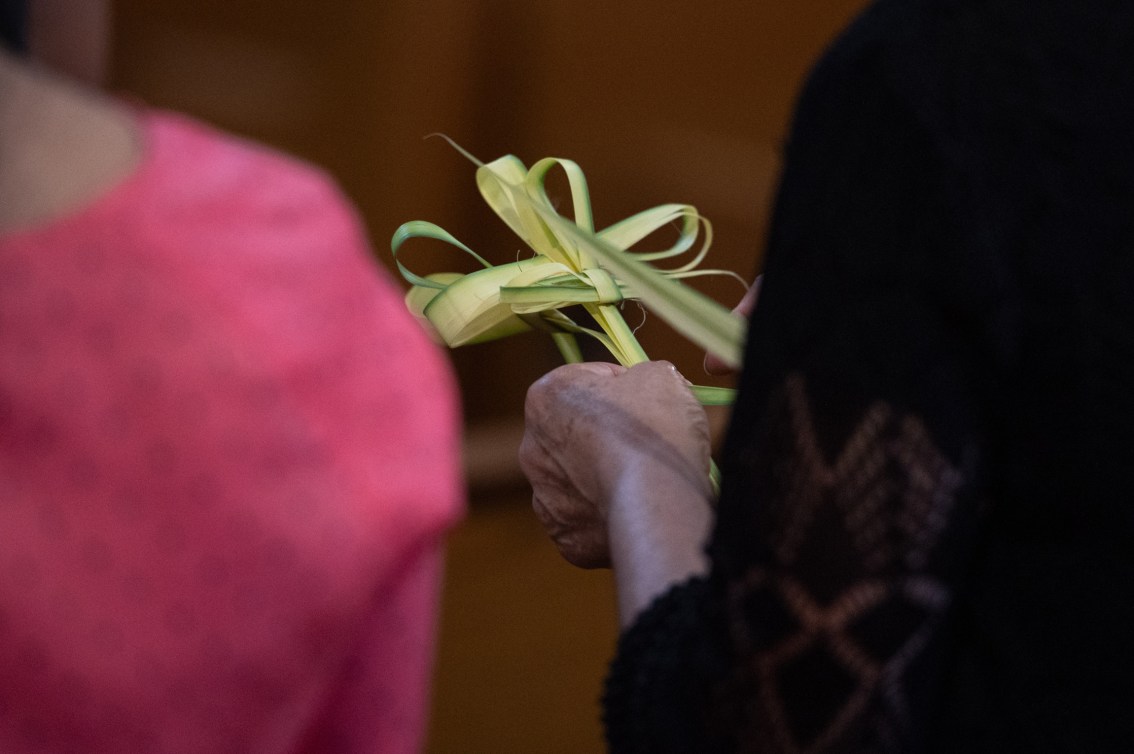
Homily for Palm Sunday
March 29, 2026
St. Patrick Cathedral
Fort Worth, Texas
Isaiah 50:4-7
Psalm 22
Philippians 2:6-11
Matthew 26:14 – 27:66
Saint Augustine and other early fathers of the Church held that people stand at an intersection between two diametrically opposed forces, almost like the force of gravity. There is the force of evil that pulls us away from God, down beneath our true and unique human dignity inherent in our nature. Then there is the force of God’s unconditional love, that pulls us up towards Him and draws from us the desire to love God in return.
Today, Jesus clearly reveals to us that we as human beings cannot lift ourselves up nor ascend to the desired heights of the pure life of God by our own efforts. Our desire for the Divine life will always be frustrated when we attempt to fulfill our desires to come to God without God. Jesus, fully human, empties Himself of all claims to Divinity (claims that are rightfully only His to make) and humbles Himself and shows us the only path upwards is not by way of the steep climb on a rough and slippery staircase of willpower, but through His Grace that empties us and draws us upwards to the Father with Him. Christ shows us that the only path for us to come to God is following Him on the way of the Cross and uniting the suffering that comes our way with love. This is the only way that our sinful pride inherited from Adam and Eve can be vanquished.
When we attempt to approach the Cross without humility and gratitude for Christ’s love, we run the risk of scandalously weaponizing the Cross in religious polemics and being pulled towards evil and away from God. We have just heard the Passion proclaimed according to Saint Matthew. This account includes the cries of the crowd, “His blood be upon us and upon our children.” Over the centuries, those words have too many times been twisted to justify hatred and persecution of the Jewish people.
I am obliged by the truth of the Gospel to recognize and to indicate clearly: such interpretations are a betrayal of the Gospel itself and offend God. The authentic teaching of the Church, as articulated at the Second Vatican Council in the Declaration on the Relation of the Church to Non-Christian Religions (Nostra Aetate), has repudiated every form of anti-Semitism. The Passion of Jesus is not a weapon to be used against Jews or Muslims; it is a revelation of God’s mercy.
Pope Benedict XVI in his work Jesus of Nazareth movingly observed: “…the Christian will remember that Jesus’ blood speaks a different language from the blood of Abel…: it does not cry out for vengeance and punishment; it brings reconciliation. It is not poured out against anyone; it is poured out for many, for all. …[R]ead in the light of faith, it means that we all stand in need of the purifying power of love which is His blood. These words are not a curse, but rather redemption, salvation.”
Today we stand at the intersection of two forces, good and evil. We are too weak to take the good path alone without God’s mercy. To even think that we can do it without God’s mercy estranges us from God and drags us downwards. It is only the intersection of the horizontal and vertical beams of the Cross of suffering and love that can empty us and pull us upwards to God.
We must humbly and contritely acknowledge before God that our voices that enthusiastically cry out “Hosanna” will also scream, “Crucify Him!” Unlike us, the Lord is not fickle and does not turn away from His Father’s merciful will that He save us from our sins. Christ allows His blood to be poured out upon us — upon all of us and our children — not as a mark of shame, but as the Sacrament of the New and Eternal Covenant. His Blood, be upon us and upon our children — now and forever.
 Life on the Chrism Trail