
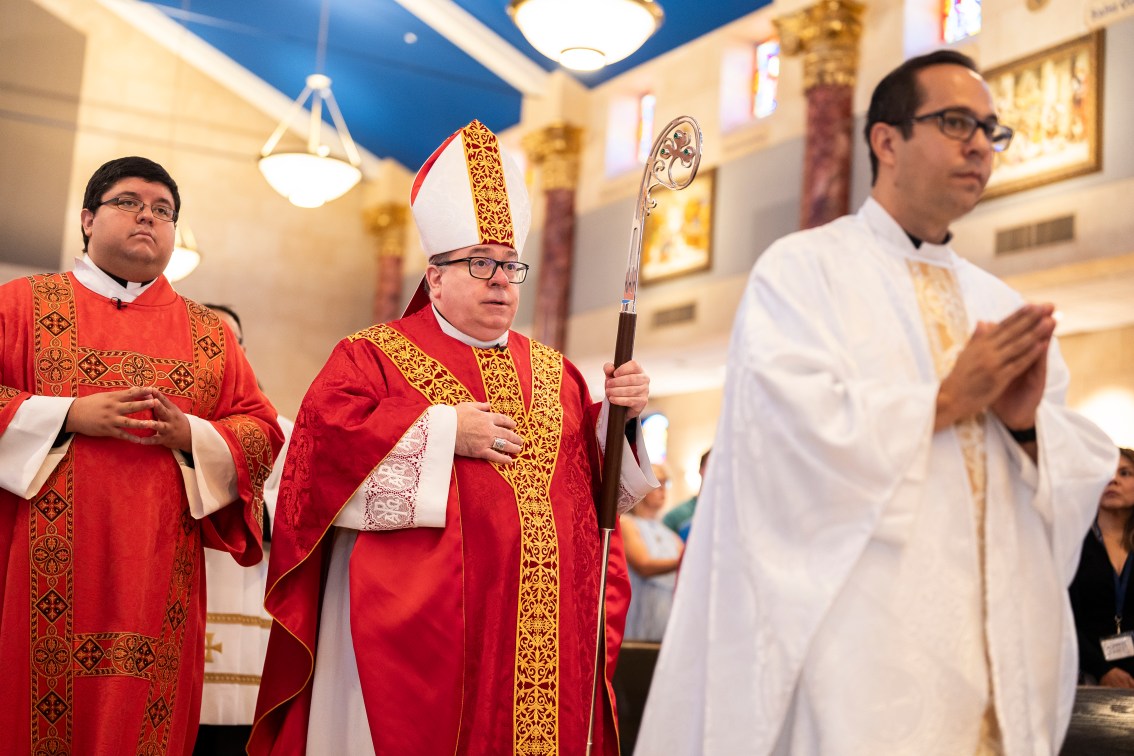
Homily for the Memorial of Maximilian Kolbe
Mass for Convocation of Teachers of the Catholic Schools of the Diocese of Fort Worth
August 14, 2023
Saint Elizabeth Ann Seton Catholic Church
Keller, Texas
1st John 3:14-18
Psalm 116:10-11, 12-13, 16ac-17
John 15:12-16
“Precious in the eyes of the Lord is the death of his faithful ones. How shall I make a return to the Lord for all the good He has done for me?”
Today we celebrate the liturgical memorial of one of those precious ones in the eyes of the Lord, Saint Maximilian Kolbe, one of the friends of Christ, who was martyred in Auschwitz when he offered to take the place of another prisoner who was arbitrarily sentenced to die by the Nazis. The setting of Kolbe’s martyrdom was the death camp of Auschwitz, the chaotic result of the tyranny of relativism and the place where human life and love were replaced by the instinct for survival and hatred.
As the story is recounted, a prisoner escaped and in retribution and revenge ten men were selected at random by the guards to die in a starvation bunker. One of the men selected, Francis Gajowniczek, exclaimed the natural and human cry for family amidst this inhumanity, “My wife and my children!” Father Kolbe stepped forward and spoke, “I wish to take this man’s place; I am a Catholic priest.” How poignant and how true!
Father Kolbe does not give the guard his own name. He does not identify himself by his prison number, he offers no other reason, and he wastes no words. “I am a Catholic priest.” These words and the accompanying actions put the truth to the lie of every oppressive ideology. He gives his life freely, prophetically and with love in that moment as a priest as he takes the place of Francis Gajowniczek.
As heroic as this action is, his identity and mission as a priest shine even more brightly after taking his place in the death chamber because there he continues to shepherd and to lead each of his nine fellow prisoners with the solace of the Gospel, the grace of the sacraments, and the mystery of the cross so that in the end they do not abandon faith, hope, or charity nor reject the salvation of their souls won for them by Christ’s sacrifice on the Cross even in the face of great suffering where there is much evidence to disbelieve God’s existence let alone His love. “This is my commandment: love one another as I have loved you. No one has greater love than this, to lay down one’s life for one’s friends.”
In our contemporary society, once again we see so much anger and inhumanity among people that it seems that many feel compelled to decide between the false options of either attacking or being attacked. They do not understand or have forgotten that God is their friend and that He invites them to friendship with Him. The Commandments are not just a list of rules and edicts around which we maneuver to get our way. They are part of God’s selfless Covenant, and imbalanced act of love, that prepared the world for the New and Eternal Covenant offered and completed by His Son’s death on a cross.
Our responsibility is to remind each other and our students and their families by our words and actions that God, and particularly Christ, offers and invites each of us to friendship and love. The friendship between teacher and student is an imbalanced one, but it is real friendship and the inconvenience you endure for the sake of teaching them the (too frequently) thankless lessons is itself part of a lesson that they might only learn years from now in the memories of their adulthood. “The way we came to know love was that he laid down His life for us; so we ought to lay down our life for our brothers and sisters.”
 Life on the Chrism Trail