
Homily for the Nineteenth Sunday of Ordinary Time
August 13, 2023
St. Patrick Cathedral
Fort Worth, Texas
1 Kings 19:9A-11-13A
Psalm 85:9, 10, 11-12, 13-14
Romans 9:1-5
Matthew 14:22-33
Today in our Sunday Mass we will also celebrate what is known as the Rite of Reception of Candidacy for Isaac McCracken, a seminarian for the Diocese of Fort Worth. The Rite of Candidacy is an official step in the process of priestly formation.
In this rite, the seminarian makes a public commitment to the bishop and through him to the People of God assembled for liturgy. The seminarian answers two questions and in so doing makes a public declaration that he is committed to persevere to prepare himself for ordination for service, generous service, to Christ and to His Church.
The seminarian in formation is stating that he has discerned that he has decided to trust that he is indeed called by Christ to be a priest, and the bishop, speaking on behalf of the Church, publicly acknowledges that the man is called to the priesthood and that the man is to proceed to the final stage of formation to prepare for ordination and all that will be expected of him as a priest.
As we celebrate this rite on this Sunday, the Church’s liturgical year has provided us with readings that speak to us about the Lord’s call and our discernment and response to His call. The readings today speak of three possible meeting places of encountering God and His call: the mountain, the storm, and the gentle breeze.
God tells Elijah to go and stand on the mountain because God is about to pass by him. Elijah does not find God in the strong wind, the earthquake, or the awesome fire, places where he as a Hebrew would have expected to find God. Instead, Elijah does not find God so much as that God reveals Himself to Elijah in a place that Elijah could not predict, a tiny whispering sound. This leads us to consider where and when we have encountered God in unsuspected places. The call of the Lord is recognizable by the fruits of the Holy Spirit, but the call of God is not predictable because He is incomprehensible to our minds without His Grace and inscrutable are His ways. His passing can be as subtle as a gentle breeze, or as fearful as the sudden and powerful storm reported in the Gospel. We need to pay attention through prayer to hear the Lord where He chooses to call us, not just where and when we expect Him to call us and not just what we expect to hear from Him.
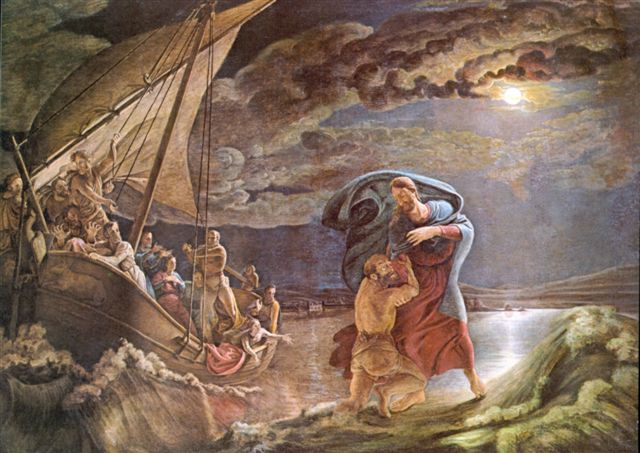
Today’s reading from Matthew’s Gospel contrasts Jesus praying alone on the mountain, and the Apostles crossing the lake in a storm. The ancient Hebrews associated God with Mount Horeb or Mount Sinai, and the storm with the confusion and chaos in the world that they could not control but to which only God can bring calm and ordered tranquility. In the middle of the darkness, Jesus, the Son of God, comes down from the Mount Horeb and walks on the water toward His disciples who are struggling in the boat. The disciples become terrified, thinking Jesus is a ghost.
Jesus tries to calm and encourage them, but Peter, still unsure that it is Jesus, asks Jesus to call him that Peter might approach Him on the water. After a few steps Peter falters and begins to sink, which Jesus attributes to Peter’s little faith. Faith will probably not help us walk on water, nor does it remove the difficulties and darkness of life, but faith does enable us to maintain our focus on Jesus that we might move through difficulties and darkness and to acknowledge that for Jesus, even our darkness is not dark.
The example of Peter reminds us that Baptism begins our life of faith, but faith requires more than Baptism, it requires our continual focus upon Jesus Christ to persevere in answering His call by coming to Him through the storm of the human condition and the darkness of the world disordered by original sin. It also reminds us that the first step of faith is frequently the easiest to take with the rush of enthusiasm but those steps of faith that follow the first are more difficult because they are less emotional and require perseverance and ongoing trust in Jesus. Our journey on these waters to Jesus is our part given to us by Christ in contributing to the new creation of the world carried out by the power of the Holy Spirit.
Peter begins the journey but soon becomes distracted by the storm and what he is doing and begins to sink because he removes his focus from Christ and instead places it on himself and on his own enthusiasm. When we do that, we must continue to follow Peter’s example and call out in prayer to Jesus, “Lord, Save me!” It is always the Lord who catches us, calls us back into focus, and places Himself in our focus that we might continue our journey begun in the waters of Baptism to return to Him with our profession of faith, “Truly, Lord, you are the Son of God.”
The Rite of Reception of Candidacy for Holy Orders is marked by the simplicity of faith; it is the faith required to hear a vocation and to say “yes.” Faith begins with listening to and for God Who is incomprehensible. It is the simplicity of faith that, as God shows us through the example of Elijah, comes from listening.
The rite is steeped in simplicity because our human condition encounters so many temptations to complicate and to distract us from our call. Like Peter, who initially begins with enthusiasm to answer Jesus’ call to come to Him on the water amidst the storm, a man can begin to sink if he takes his focus away from Jesus Christ. Like Peter, a man can become distracted and overcome by fear because of the storm or because of the exhilarating experience of walking upon the water, which is an action that, like a vocation to the priesthood, is impossible to carry out without the grace of a confident faith in Jesus Christ.
In a few moments, Isaac McCracken will declare that he has heard the call of Jesus Christ to follow Him as one of His priests. Isaac McCracken will declare that he trusts God and that he has adequately discerned this call with serene and moral certitude in the confidence of faith. Isaac will declare in our presence that he is resolute to keep his focus upon Christ that he might persevere and prepare for the expectations of ordained ministry as a priest. As the Church, we pray for him.
Finally, as the rite requires of the bishop, I will acknowledge publicly on behalf of the Church and receive Isaac’s declaration of candidacy. My statement of reception is short and to the point. The reception is joyful; it is hopeful because it is made in faith and through it the Church acknowledges gratefully the good work that God has both begun in this man and that only God, and neither the bishop nor the Church alone, can bring it to fulfillment. At this moment in the Rite of Candidacy, Christ speaks to us again with the words that He spoke to His disciples, “Take courage, it is I; do not be afraid.” And as His disciples we respond in faith, “Truly, you are the Son of God.”
 Life on the Chrism Trail