
Homily for the Twenty-first Sunday of Ordinary Time
August 27, 2023
St. Patrick Cathedral
Fort Worth, Texas
Isaiah 22:19-23
Psalm 138:1-2, 2-3, 6, 8
Romans 11:33-36
Matthew 16:13-20
In our second reading today, taken from Saint Paul’s Epistle to the Romans – Saint Paul abandons himself to the Mystery of God, whose judgments are inscrutable and whose ways are unsearchable. While Saint Paul is speaking particularly about the question of Israel’s destiny, his point is that only the truly wise and prepared are humble enough to acknowledge that they really do not know – “the when,” “the how,” and “the why” of God’s call to them. Paul faithfully trusts the One whom no one can fully comprehend but who is revealed to us fully in Jesus Christ. Thus should each of us believe that God is upright and will never reject us His People – His Church – even when we cannot grasp the details of the entire picture.
The Church is a mystery. The Church is not simply a congregation of like-minded people with shared values, a collection, and a covered dish luncheon. The Church is the People of God, a people of faith. formed and informed by God’s initiative through His gift of faith that comes through our listening. As Saint Paul writes in another part of this Epistle to the Romans, “Thus faith comes from what is heard, and what is heard comes through the word of Christ.” Perseverance in listening to the Word of Christ with the Church is required for us to grow and develop in the gift of faith and the unity that only comes from the embracing what is fully revealed but not always fully understood as true. What unites us as the Church is that we have all heard the Lord’s call and we all hear and obey the Divine Revelation.
Christ reveals the Church to be a Mystery. It is not a riddle to be solved but it is a mystery to be received. A mystery is something that we can somewhat know, but which cannot be completely grasped by our intellect. Our Gospel reading today presents one of only two times in which Jesus speaks about the Church. He presents the Church as having the mission of bringing into being God’s design to unite the entire human race into one family in Himself. Jesus entrusts to Peter and to Peter’s successors the mission of serving this unity of one Church belonging to God formed not according to nationality, ethnicity, race, culture, language, or political principles. Peter is given the indispensable ministry to ensure that the Church is never identified exclusively with a single ethnic group or with a single culture, but is the Church comprised of all peoples in unity established through faith in the love of Christ. This unity of the Church is established only in the fullness of the truth revealed in Jesus Christ and brings about God’s peace and the renewing power of His charity.
This unity is not the result of a synthesis of cultures or political compromise among individuals. The unity rests alone in the truth revealed fully by Jesus Christ for human salvation. This includes that we are sinners and are saved from our sins and the power of death by the death and resurrection of Christ and into which we are baptized. It includes the Creed that we profess every Sunday after the homily; it includes the Doctrine contained and explained in the Catechism of the Catholic Church, including the nature of sacraments and the nature of the Church as One, Holy, Catholic, and Apostolic as intended by Christ.
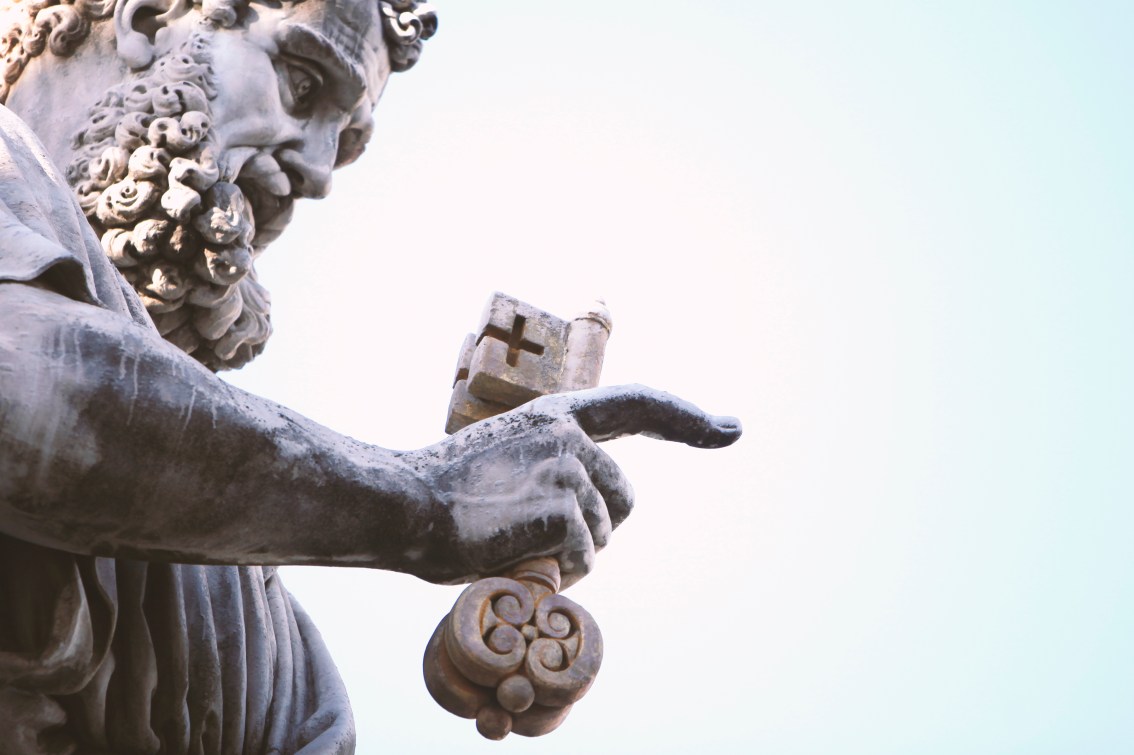
For this unique mission within the Church, Jesus entrusts the keys of binding and loosing to Peter and to his Successors, the popes. This authority is shared in communion with the bishops, the college of the Successors of the Apostles, who together and under the guidance of the Holy Spirit are entrusted with maintaining and preaching the Deposit of Faith, the authoritative teaching of the Gospel revealed and conveyed through Scripture and Tradition. These keys are what open the gates of death and allow those souls trapped and doomed to death to be freed to enter eternal life. All this rests upon Peter’s simple and humble confession of faith that Jesus is the Christ, the Son of the living God, and not deduced by the power of Peter’s own intellect. Peter receives this insight as a grace, as a conversion, and he humbly makes an act of faith.
Regarding this unique ministry of the Pope to preserve the unity of the Church, Pope Saint John Paul II wrote in his encyclical Ut Unum Sint, “This is a specific duty of the Bishop of Rome as the Successor of the Apostle Peter. I carry out this duty with the profound conviction that I am obeying the Lord, and with a clear sense of my own human frailty. Indeed, if Christ Himself gave Peter this special mission in the Church and exhorted him to strengthen his brethren, He also made clear to him his human weakness and his special need of conversion: ‘And when you have turned again, strengthen your brethren.’ It is precisely in Peter’s human weakness that it becomes fully clear that the Pope, in order to carry out this special ministry in the Church, depends totally on the Lord’s grace and prayer: ‘I have prayed for you that your faith may not fail.’ The conversion of Peter and that of his Successors is upheld by the very prayer of the Redeemer, and the Church constantly makes this petition her own. In our ecumenical age, marked by the Second Vatican Council, the mission of the Bishop of Rome is particularly directed to recalling the need for full communion among Christ’s disciples.”
In Peter’s profession of faith that Jesus is the Christ, the Son of God, he manifests humility, he trusts in Jesus and in what he has seen revealed in Jesus. This example of humility sets an example for all of us and is key to ensuring the unity intended by Christ. This unity is compromised and threatened today because too many of us see the Church not as a spiritual mystery to be received gratefully and lived graciously, but as an earthly institution that is to serve as a political vehicle for imposing our own individual will upon reality through partisan activism.
The current polarization and division that we are experiencing in our society and in the Church, replete with hostility to the ministry of pastoral leadership and authority to teach, to govern, and to sanctify, entrusted by Christ to the Pope and to the bishops in communion with him, is based upon an ingratitude not unlike that of the example of the early church in Corinth. Pope Benedict XVI put it this way when discussing the situation of the Corinthian church, a church beset by division: “The Corinthians see in Christianity an interesting religious theory that answers to their tastes and expectations. They choose what suits them, and they select it in the form that pleases them. But when one’s own will and desire is the decisive criterion, schism is a foregone conclusion…a club, a circle of friends, a party can grow from such ideological choice, but not a Church that overcomes antitheses between human beings and unites them in the peace of God. The principle by which a club develops is personal taste; but the principle on which the Church is based is obedience to the call of the Lord as we see it in the Gospels.” Humility is a crucial component of our discipleship at the service of communion.
In our first reading from Isaiah, we see in the example of Shebna what happens when humility is lost. Shebna stops listening. He stops persevering. He forgets that he has been entrusted with the keys of the master’s household; he stops using the keys as the faithful porter who opens the door to the master’s home for his people to enter. Shebna refuses to use these keys at the time of crisis when the people most need to be escorted into the security of the master’s house. Shebna refuses to do what he has been called to do and instead builds for himself a grandiose tomb. A grandiose tomb is the best our human condition can expect without the grace and humility of faith. Shebna, intoxicated by egotism, rejects what he has been given. The result is that the master thrusts Shebna from his duties and instead entrusts the keys of authority to Eliakim because Shebna has chosen the path of entitlement that only ends locked in an enclosure behind the gates of death.
Pope Francis reminds us, “Jesus intends to give life to his Church, a people founded no longer on heritage, but on faith, which means on the relationship with Him, a relationship of love and trust. The Church is built on our relationship with Jesus. And to begin his Church, Jesus needs to find solid faith, ‘steadfast’ faith in his disciples.”
It also means that faith which marks our conversion takes time as the Pilgrim Church processing to God’s Eternal Kingdom in communion with Christ and with each other and never alone. Patient perseverance in listening must characterize our sacramental life and discipleship for our faith to be strengthened. The gift of rightly ordered authority by Christ to Peter and his Successor, the Pope, along with the successors of the other Apostles, the bishops in communion with him, for His Church underscores the need for rightly ordered disciples who can only become so through the honest simplicity of faith that comes from listening obediently to the word of Christ.
In a few moments in the mystery of the Eucharist, when Jesus will speak to the depths of our hearts yet again and ask us as He asked Peter, “Who do you say that I am?” Each of us needs to listen carefully to His question with humility before giving our response, because how we answer His question and why we answer His question is as important as what we answer to His question to enter fully into the sacred mystery of Christ’s love.
 Life on the Chrism Trail