
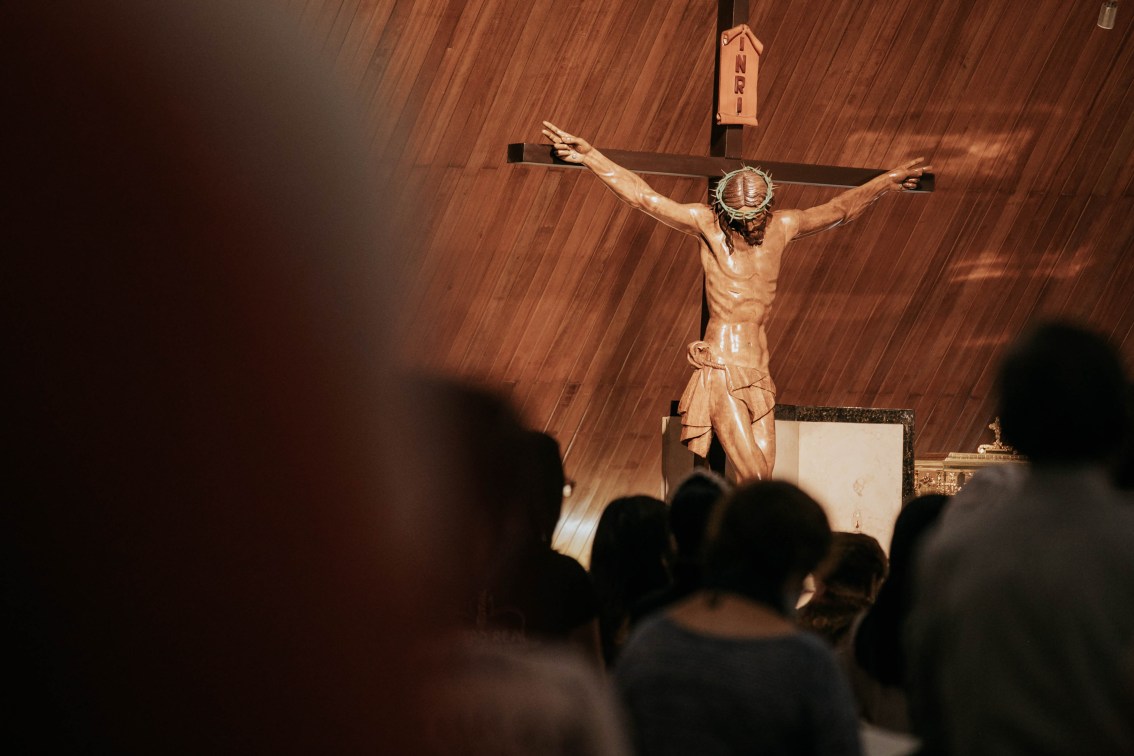
Homily for the Feast of the Exaltation of the Holy Cross
Mass for Young Adults
September 14, 2023
St. Joseph Catholic Church
Arlington, Texas
Numbers 21:4b-9
Psalm 78:1bc-2, 34-35, 36-37, 38
Philippians 2: 6-11
John 3:13-17
We have just listened to the following words from our second reading from Saint Paul’s Epistle to the Philippians, “Christ Jesus, though He was in the form of God, did not regard equality with God something to be grasped. Rather, He emptied Himself, taking the form of a slave, coming in human likeness; and found human in appearance, He humbled Himself, becoming obedient to death, even death on a cross.” These words of Saint Paul have come to be understood as exemplifying what theologians call “kenosis.”
This term describes what the Second Person of the Holy Trinity did in becoming fully human in Jesus Christ, in order to save us from our sins and its effect of eternal death and damnation. Christ emptied Himself of all the rightful power and glory of divinity so that He might remain truly divine but also be fully human in all things but sin that God might save us by our humanity.
The self-emptying of Jesus Christ, the New Adam, is in contrast with the grasping for the power of divinity committed by the first Adam in the Garden of Eden when Eve conveyed to Adam the cunning lie of the serpent, “God knows well that when you eat of it your eyes will be opened and you will be like gods, who know good and evil.” This attempted power grab by the first Adam resulted in the warping of our humanity by sin, resulting in misery, alienation from God, estrangement between the sexes, toil, illness, and death. God in His mercy sends His only Son “so that everyone who believes in Him might not perish but might have eternal life.”
This self-emptying is foreshadowed by the loving “yes” of the Immaculate Virgin Mary, who obediently responds with a “yes” to God’s invitation to be the mother of His Son as conveyed through the service of the Archangel Gabriel. Just as Christ’s obedience contrasts with and repairs the disobedience of Adam, so the obedience and docility of the Immaculate Virgin Mary contrasts with and repairs the conniving of Eve. Self-emptying becomes the only path for Christians to take towards holiness. This self-emptying is the way of the Cross, our share in the Cross of Jesus Christ.
The late theologian Joseph Ratzinger once related the following legend to illustrate how today’s feast manifests the kenosis required for Christians to follow the way of the Cross. “The Byzantine Emperor Heraclius seized the cross from the Persians who had removed it from Golgotha and took it back himself to its original site in a triumphal procession. Carried aloft, the cross was decorated with the insignia of a world conqueror. When the Emperor reached the gate of the city, he suddenly found that he could walk no further. The Bishop of Jerusalem at that time told him: ‘Emperor, with all this triumphal ornamentation that surrounds the carrying of the cross, you are not imitating the poverty of Jesus Christ.’ The Emperor stripped off his lavish garments and was at once able to continue on the way of the cross.”
The message of this legend about the meaning of this feast is clear: we cannot truly embrace the Cross if we are encumbered by the clutter of human pride, that which this fallen world considers to be glorious and the best that it can offer — power, fame, riches — the life of the elite influencers of today. We must resist the temptation to try to make the cross and our acceptance of the cross fit in with the ever-eroding values of this fallen world. At times, because of our honest fear of isolation in our contemporary society, we can try to minimize our mission and identity as Christians marked at Baptism by the Sign of the Cross. We can follow the weak example of Peter and deny our Lord as we flee the foot of the Cross — the very place where Mary stands firmly with love. It is true that we must allow God to empty us and to give us the grace to empty ourselves through love of all that the world considers worthwhile and valuable. The decision before us is either to fit in with the fallen world or to accept belonging at the foot of the Cross with Mary and the Beloved Disciple.
Yet, in this emptying of ourselves, the Lord does not only take from us. He also gives to us the grace of compassion, the grace of true and sacrificial love for God and for other human beings. He gives us compassion. The grace of compassion established in the redemptive suffering of Christ transforms our pain and woundedness — the effect of sin — into a positive action for our own performance. Christ offers this to us, and we receive it through the grace of the sacraments. Compassion requires humility, gratitude, and awe in the complete selflessness of Christ’s love that goes to such great lengths to save each person from sin and its bitter effects. The grace of this lacuna as a compassionate gift from Christ is the source of our renewed freedom and capacity to love with charity. It marks our path to full humanity, the way of the Cross.
This grace transforms the impoverishment and paralysis of pain, illness, isolation, estrangement, and dying into a dignified human action replete with generosity and freedom. This transforming and sacramental grace, with faith and wisdom, changes our suffering into patience, our patience into fortitude, fortitude into hope, hope into love, and love into Divine Charity. All of this is manifest in authentic compassion, and it is the ministry of the priest to be stewards of this mystery in everything we do and with every word we preach. It also is manifest in the tender love reciprocally shared between man and woman in sacramental marriage. It is further manifest in simple discipleship lived according to God’s plans and not our own preferences. Without the grace of the lacuna in Christ’s afflictions left for us by Christ, there can be no compassion for human beings, just pity or denial.
In a few moments we will not simply go to Communion. We will rather accept the Lord’s invitation to enter more deeply into the mystery of His compassion for us given completely through His total emptying of Himself by His sacrificial death on the Cross. It is this mystery that transforms us to love as He loves. We enter the mystery of Christ’s suffering and our redemption. “For God did not send his Son into the world to condemn the world, but that the world might be saved through Him.” May the Eucharist never allow us to forget this saving work of the Lord.
 Life on the Chrism Trail