
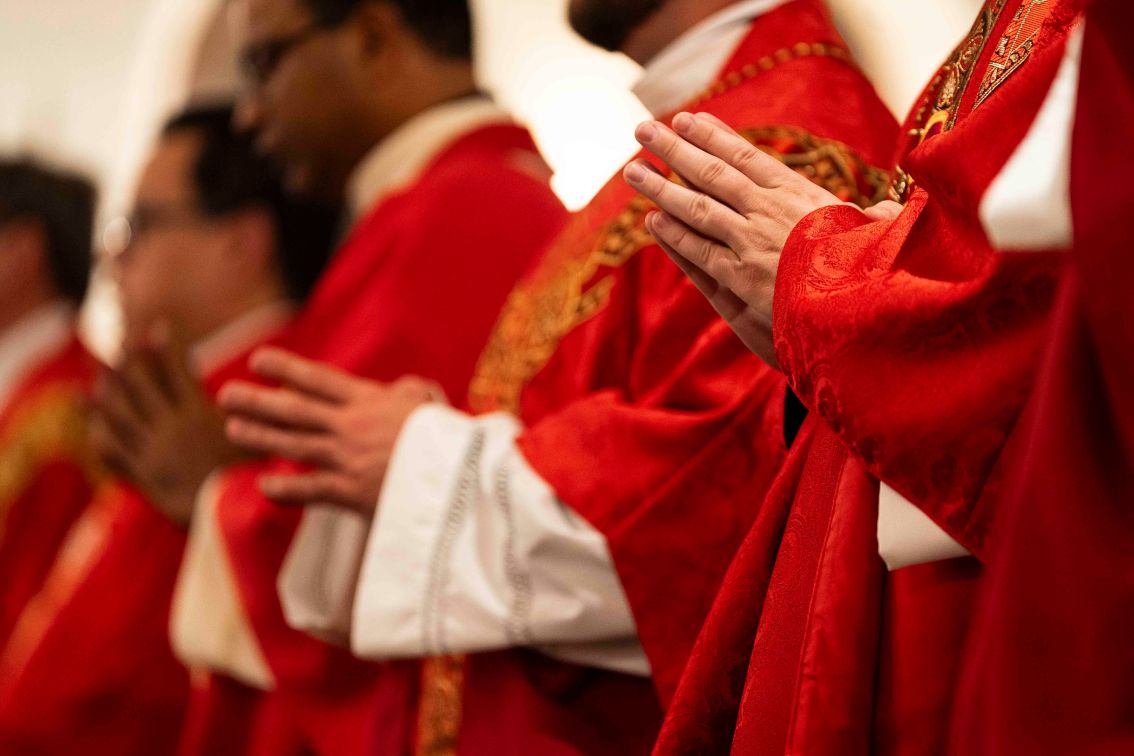
Homily for Red Mass for the Diocese of Fort Worth
September 28, 2023
St. Patrick Cathedral
Fort Worth, Texas
Daniel 13:1-9, 15-17, 19-30, 33-62
Psalm 104:1-2, 24, 35, 27-28, 29, 30
Romans 5:5-11
John 14:15-21
Our first reading today presents a story from the Book of Daniel that seems very worthy for our reflection as we come together both as the Church and as the legal community to invoke the guidance of the Holy Spirit upon all lawyers, judges, and government officials entrusted with the administration of justice among individuals for the sake of both the particular and the common good. The story involves the corruption of two judges who harass the beautiful Susanna and threaten her with false allegation if she does not give in to their harassment. The story continues with the integrity of Susanna upheld in the face of their calumny and slander by the advocacy and argumentation of the young Daniel. It concludes with the demise of the unjust and disordered corrupt officials and the vindication of Susanna.
It is a compelling story about evil and good, injustice and justice, and falsehood and the truth. It offers us insight into the human condition and the legal vocation that is as applicable today as when this ancient story was first recorded. It underscores the truth that the lawyer’s role in defending and promoting justice is more than a technical understanding of the law accompanied by artful glib. Yet, we would very much miss the most important insight if we were to overlook the main and essential point of the story: the Advocacy of God on behalf of the vulnerable for the sake of the Truth.
Susanna, in facing the threats of the corrupt officials, comes face to face with the choice between good and evil. She could give in to the officials and excuse herself because of the imminent danger posed to her by their threats, or she could take a heroic path and stand for the truth even if she is not supported by others in the crowd. Saint John Paul II wrote of this dilemma in his encyclical entitled Veritatis Splendor, “Susanna, preferring to ‘fall innocent’ into the hands of the judges, bears witness not only to her faith and trust in God but also to her obedience to the truth and to the absoluteness of the moral order. By her readiness to die a martyr, she proclaims that it is not right to do what God’s law qualifies as evil in order to draw some good from it. Susanna chose for herself the ‘better part’: hers was a perfectly clear witness, without any compromise, to the truth about the good and to the God of Israel. By her acts, she revealed the holiness of God.”
Susanna cries out for help. As she expected, she is shamed by the crowd because they believe the false narrative of the two elders instead of her testimony since the two elders possess the influence and presumed status of the elite. In fact, she is resigned to the belief that her demise is inevitable because the court of public opinion has reached its verdict without appeal to the facts. The verdict is compelling but not convincing. There are those in the crowd who are collusive with the corrupt officials; there are others in the crowd who are indifferent to her plight; and there are those who fear the same plight if they oppose the officials and advocate on her behalf.
Susanna really has an authentic love for God in telling the truth. She does not want to harm her real relationship with God by becoming involved, even passively, with the evil that the two corrupt judges wish to perpetrate against her and against the Law of God. She manifests the Gift of the Holy Spirit known as the Fear of the Lord. As Pope Benedict XVI wrote about the Fear of the Lord, “Perhaps this is a phrase with which we are not very familiar or perhaps we do not like it very much. But “Fear of the Lord” is not anguish; it is something quite different. It is the concern not to destroy the love on which our life is based. Fear of the Lord is that sense of responsibility that we are bound to possess for the portion of the world that has been entrusted to us in our lives.”
The Fear of the Lord is the Grace of the Advocate, the Holy Spirit, promised by Jesus in our Gospel just proclaimed: “I will ask the Father, and He will give you another Advocate to be with you always, the Spirit of truth, which the world cannot accept, because it neither sees nor knows it. But you know it, because it remains with you, and will be in you.”
Susanna is heroically not concerned about self-interest in the short-term nor bringing a compelling narrative to counter the false narrative of the two corrupt elders; she tells the truth even though she is certain that she will not be believed by those who are conspiring against her and those who are indifferent to her plight. She all but resigns herself to her wrongful death, except for one thing: Susanna in manifesting the Fear of the Lord exemplifies the theological virtue of Hope. She prays, “Eternal God, you know what is hidden and are aware of all things before they come to be: you know that they have testified falsely against me. Here I am about to die, though I have done none of the things for which these men have condemned me.”
The Lord answers the prayer of Susanna and He prompts Daniel to carry out the Lord’s work and to advocate on behalf of Susanna in the face of such injustice and blasphemy. It is Daniel alone among the mob who has the same Fear of the Lord and reverence for truth to advocate for Susanna by advocating for the truth. He insists that God’s Chosen People of the Covenant return to the Fear of the Lord and reverence for the truth. He exclaims, “Are you such fools, you Israelites, to condemn a daughter of Israel without investigation and without clear evidence? Return to court, for they have testified falsely against her.”
The Holy Spirit’s gift of the Fear of the Lord always brings us authentic hope. The virtue of hope is entirely necessary for our salvation. As we were reminded earlier in the second reading by the proclamation of the words of Saint Paul to the Romans: “Hope does not disappoint, because the love of God has been poured out into our hearts through the Holy Spirit that has been given to us.” Saint Thomas Aquinas identified the motive for our hope as being God’s omnipotence. “Nothing is impossible for God.”
The story of Susanna in the Book of Daniel reveals to us in light of the fullness of revelation that we are accountable to more than the conventional norms of this world, and that while all lawyers and judges are to cultivate the acquired moral virtues and to act more than simply practitioners of procedural technique, the expectation for a Catholic lawyer, judge, or civic official is even greater because of the life of Grace that each has received through Baptism and the sacramental life of the Church. As Saint Thomas Aquinas wrote so clearly, “In brief, the acquired virtues ready one for civil life, but the infused virtues for a spiritual life, which comes only from grace as a result of the virtuous one’s membership in the Church.”
The acts of the acquired virtues and the acts of the virtues infused by grace remain externally identical, but formally they differ. One lawyer acting with the acquired virtues of fortitude and justice does so for the sake of the good of society; another lawyer acting in an externally identical way but with the infused virtues of fortitude, justice, and hope, does so for the same sake of the good of society, but most importantly for the sake of the love of God and for eternal life. God’s love and His Grace offer a Catholic lawyer in the state of Grace a stronger capacity for justice and a broader scope of understanding the Truth than merely serving as a private but spiritual motive for the practice of law.
The real difference between infused and acquired virtue is that the Catholic, with the virtue infused through the state of Grace, possesses the freedom that the Gospel promises. This radically new character comes from the personal character of Jesus Christ Himself. “For Christ, while we were still helpless, yet died at the appointed time for the ungodly.”
The vocation of the Catholic lawyer, the Catholic judge, and the Catholic civic official is to rely on the Grace of God, including the gifts of the Holy Spirit, particularly the Fear of the Lord; the infused moral virtues, particularly fortitude and temperance; and the theological virtues, particularly hope, received at Baptism, strengthened in Confirmation, nourished in the Eucharist, and developed through prayer and the sacramental life of the Church. The vocation of the Catholic legal professional is to advocate for clients and their character as persons and not just for their interests, to ensure due process in judicial proceedings, and to uphold laws for the common good because with the Fear of the Lord and the theological virtue of hope they possess a reverence for God’s truth even in the face of hostile threats, slander, and calumny.
The Grace of God bestowed through the Sacraments to the Catholic lawyer, the Catholic judge, and the Catholic civil official provides each with an understanding to see every person as being created in God’s image and likeness, especially but not exclusively the vulnerable client or defendant who have no advocate but the truth of God and are caught in the grip of bureaucracies and institutions that cannot know or love them. This grace-filled understanding accompanies a new capacity to serve both the individual person and the society of human persons as a matter of charity delineated by justice because of who God truly is, and because of who these people are and what they mean to God.
Your Catholic faith, which engenders hope, must hold pride of place in your practice of law and ethics so that it will become the source of your good and just works. The cornerstone of your faith is the humility that you know that you have received everything from God and that you confidently entrust yourself to the power of God who is greater than each of us, as contrasted with the corrupt and secret pride of those who have deceived themselves to think that they can discharge their duties of office and practice of law by glib tongue and technical prowess. This requires daily prayer, regular and contrite recourse to the Sacrament of Penance, and most importantly attendance and active participation at Mass every Sunday and on Holy Days of Obligation.
We ask the Lord’s blessing upon each and all of you for He has called you to advocate for the Truth in the promotion of authentic justice for all. We ask Him to protect you from temptation to corruption and cowardice. We ask that you might fear the Lord to hope in Him that you might receive a listening heart and keen mind to distinguish evil from good, injustice from justice, and falsehood from the truth. We ask for His protection upon our society, upon you and your families from all enemies of the truth who would threaten to do harm. We ask this Grace from the Lord who can neither deceive nor be deceived as we approach Christ’s altar of perfect sacrifice and love with humility to receive and be transformed by His Body and Blood, His Soul and Divinity.
 Life on the Chrism Trail