
Homily for the Thirty-third Sunday of Ordinary Time
November 19, 2023
Saint Patrick Cathedral
Fort Worth, Texas
Proverbs 31:10-13, 19-20, 30-31
Psalm 128:1-2, 3, 4-5
First Thessalonians 5:1-6
Matthew 25:14-30
Saint Paul writes to the Thessalonians and through the liturgical proclamation of this epistle, to us, “(We) are children of the light, and children of the day. We are not of the night or of darkness. Therefore, let us not sleep as the rest do, but let us stay alert and sober.” This means that through the virtue of faith, that the Holy Spirit gives us as members of the Church at Baptism, we can see the world as it really is, as created by God as good, as wounded by the evil of sin, and as redeemed by Christ who will call us into the eternal Kingdom when this world comes to an end.
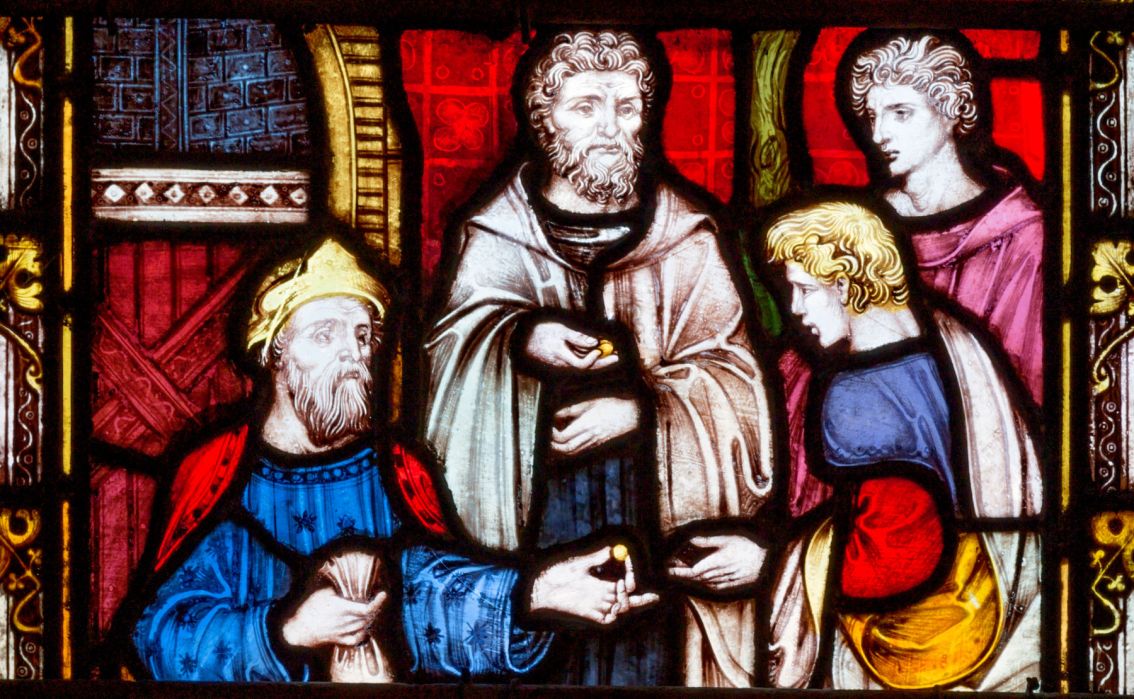
This is a perspective on the world that can only be revealed through faith. It is not a perspective on the world at which one is able to arrive simply by considering the world through reason unaided by faith. It is precisely this perspective of the children of the light that is at the heart of the parable taught by Jesus in today’s Gospel. Jesus presents the story of the three servants who are each respectively entrusted with five talents, two talents, and one talent.
The “talent” as used in the parable is a form of currency that was worth fifteen years of wages. The point of the story is that God, represented by the Master in the story, is never outdone in generosity and gives us His servants an imponderable amount of grace that enables us to accomplish His work in the light of His grace and with the power of His selfless love. What each servant accomplishes is done only through the grace that God gives, but each accomplishment is done freely and is a sign of hope in God’s power that surpasses human abilities and that transcends the limits of the world’s horizons. Thus, every good work done in the light of faith brings us more deeply into hope, the confidence in God’s omnipotence to change our world and to change us and our attachments to selfishness.
The “talents” that the Master gives represent God’s grace to us that include faith and hope, but that must blossom into His greatest grace of charity — the very selfless love of God into which we as children of the light will be drawn when we die and are judged as having been faithful servants. The servant who hides his talent refuses to trust God and instead turns inward on himself refusing Christian fortitude that requires the decisive action to love one’s neighbor and to assist those who are most in need — the hungry, the thirsty, lonely and estranged, the naked, and the imprisoned. The servant who is punished in the story refuses to take the decisive step of loving God and neighbor and instead sees the talent that he has received as a private gift that at best entails only a private relationship with the Master and not a relationship that requires a generous response through service and love.
The wicked and lazy servant of the parable in the Gospel is ungrateful to God, inattentive to his responsibilities to care for both his family and the stranger and inebriated by preoccupation with himself. These are precisely opposed to the qualities that Saint Paul describes as belonging to the children of the light and of the day. They are the sins and vices of the night and of the darkness. The wicked and lazy servant responds to the Master, “I knew you were a demanding person, harvesting where you did not plant and gathering where you did not scatter;
so out of fear I went off and buried your talent in the ground. Here it is back.” This response shows that his cowardice is not authentic Fear of the Lord. His cowardice is based on a refusal to change and instead to see the Master’s gifts as unwarranted inconveniences from a self-driven life.
The Master has offered each of these servants the rightly ordered partnership of freedom in His Kingdom, and the lazy and wicked servant prefers slavery to the darkness. Yet, we know that “we are children of the light, and children of the day. We are not of the night or of darkness. Therefore, let us not sleep as the rest do, but let us stay alert and sober.” The Holy Spirit reminds us of this today and at every celebration of the Eucharist where we are transformed into Christ’s Mystical Body of the Church through our grateful participation in the Lord’s sacrificial banquet and most especially from which we are sent to glorify the Lord by our lives.
By the nourishment that we receive in the mystery of the Eucharist, we can go forth and live lives not for ourselves but for God and for others. We do so in the new horizon of the light of faith by which we see that we are destined for the fullness of eternal life, with the strength of courageous hope to act accordingly now in small matters that prepare us for the great responsibilities that, after our death and judgment, God will share with us to accomplish in our full participation in the Communion of His Saints.
 Life on the Chrism Trail