
Homily for the Twentieth Sunday in Ordinary Time
August 18, 2024
Saint Patrick Cathedral
Fort Worth, Texas
Proverbs 9:1-6
Psalm 34:2-3, 4-5, 6-7
Ephesians 5:15-20
John 6:51-58
The readings that the Church has prepared for our liturgy this Sunday evoke the image of the banquet to which all people are invited to dine but that only those who decide to seek and follow God are able to dine. The Book of Proverbs depicts Wisdom as an elegant woman who has prepared a banquet to which she invites those who lack understanding. They do not yet understand that true wisdom is found only in the search for God. The woman of Proverbs prepares a banquet of wisdom that helps us who dine as her guests to recognize God’s power and to enkindle in us the desire to know Him better.
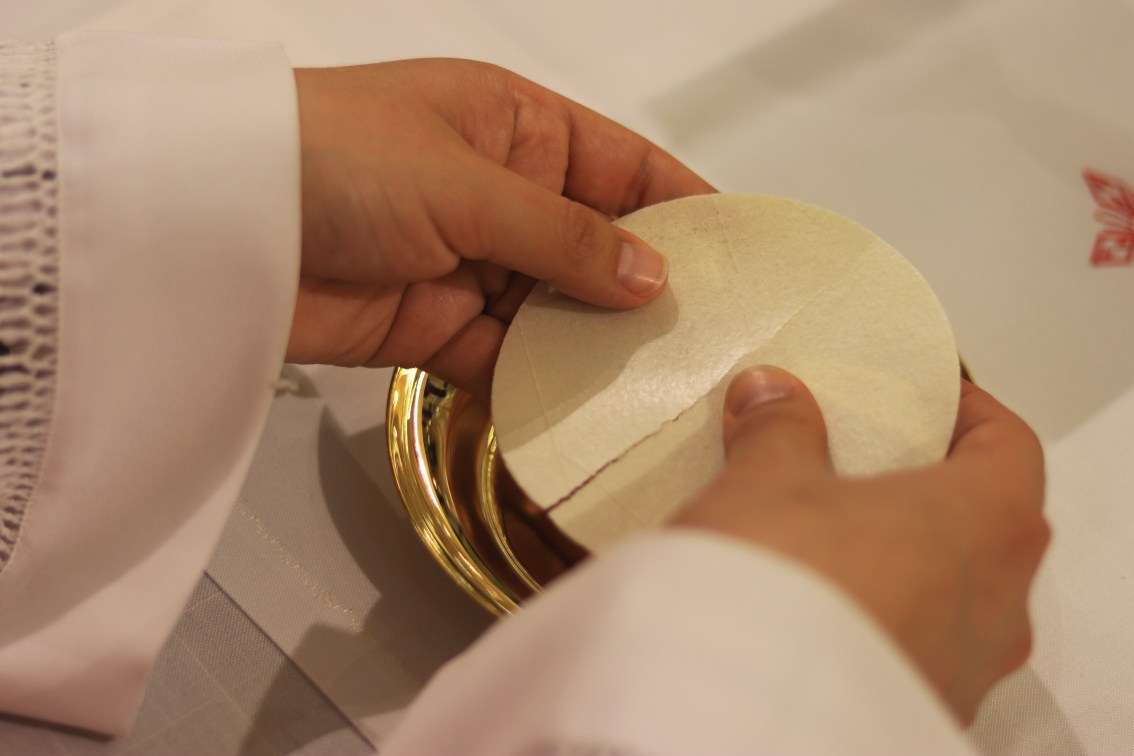
Jesus’ gift of His Body and Blood fulfills that desire and nourishes us in the Grace of the Holy Spirit that brings us to eternal life. For us as Catholics, wisdom begins at this banquet table with Christ’s sacrificial gift of Himself and carries with it obligations that require a firm decision on our part. The Eucharist is both sacrifice and banquet because of Christ’s merits. It is Christ’s perfect offering of Himself that makes this table to also be an altar. It is the Sacrifice of Christ that enables us through Grace to approach His table and be nourished. When we receive Holy Communion and become part of Christ, we accept His life as our own, decisively commit ourselves to Him, and bind ourselves to live His mission on His terms, and most especially to love Him directly and present in other people. In seeking not our happiness but the good of others, in care for our neighbor and charity in word and deed, we find true wisdom and the will of God as the fruit of our Communion with Him.
Today’s Gospel reading is the fourth in a series of five taken from the sixth chapter of the Gospel of John. Scripture scholars refer to this series as the “Bread of Life” discourse. The discourse begins with the miracle of the loaves and fishes and ends next week with many disciples deciding to leave Jesus because they find it too difficult to accept when He teaches that His flesh is real food and His blood is real drink. The discourse begins with people who become enthusiastic at the miracle of the loaves and fishes and seek to make Jesus king, but it ends with many of his followers leaving Him in disappointment after hearing in His discourse what Jesus expects of them.
Pope Benedict XVI offered an insight into today’s Gospel, “In listening to this address the people understood that Jesus was not the Messiah they wanted, one who would aspire to an earthly throne. He did not seek approval to conquer Jerusalem; rather He wanted to go to the Holy City to share the destiny of the prophets: to give His life for God and for the people. Those loaves, broken for thousands, were not meant to result in a triumphal march but to foretell the sacrifice on the Cross when Jesus was to become Bread, Body and Blood, offered in expiation. Jesus therefore gave the address to bring the crowds down to earth and mostly to encourage His disciples to make a decision. In fact, from that moment many of them no longer followed Him.”
What about us? Do we too want to leave Him because this teaching is too difficult to accept? Do we want the Eucharist only as our Sunday liturgical participation trophy but not as a bond that requires our decisive response to reject evil and to serve Christ present in others throughout the rest of the week?
Saint Paul, in his letter to the Ephesians, speaks about wisdom as our paying careful attention to use every opportunity that comes our way to do good. The obligations that come with eating the Lord’s Body and drinking His Blood require us to be attentive to His presence within other people, especially those who are most in need.
Saint Paul further reminds us that we do this not by getting drunk with the enthusiasm of the crowd on the spirits of lies and debauchery. We do this by prayers and thanksgiving — the very translation of the word “Eucharist.” In prayer and thanksgiving, we come to see the events and individuals in our lives not as problems, difficulties, or things to be exploited, but as Christ’s invitation to us to be kind, compassionate, and charitable to other people.
Pope Francis once told a group of young people, “Do not feel all is well when you refrain from doing evil. Everyone is guilty of not doing the good they could have done. It is not enough to refrain from hate. One must forgive. It is not enough to refrain from bearing grudges. One must pray for one’s enemies. It is not enough to refrain from causing division. We must bring peace where there is none. It is not enough to refrain from speaking ill of others. We must interrupt when we hear others speak badly about someone: stopping the gossip; this is doing good. If we do not oppose evil, we feed it tacitly. It is necessary to intervene where evil spreads because evil spreads in the absence of audacious Christians who oppose it with good, walking in love.”
The obligations of the Eucharist require us not just to avoid evil but most especially to care enough to perform good actions for others — those who hunger, those who thirst, the naked, the homeless, and the imprisoned. If God judges us by how much good we do rather than simply by how many sins we avoid, we must decide not to let these opportunities pass us by. If we settle on living lives where we only avoid doing evil but we are not committed enough to Christ to perform good actions for other people, we waste our life by passively not caring about others and become lukewarm and indifferent. In the words of the Jesuit Saint Alberto Hurtado, “It is good to do no evil, but it is evil to do no good.”
 Life on the Chrism Trail