
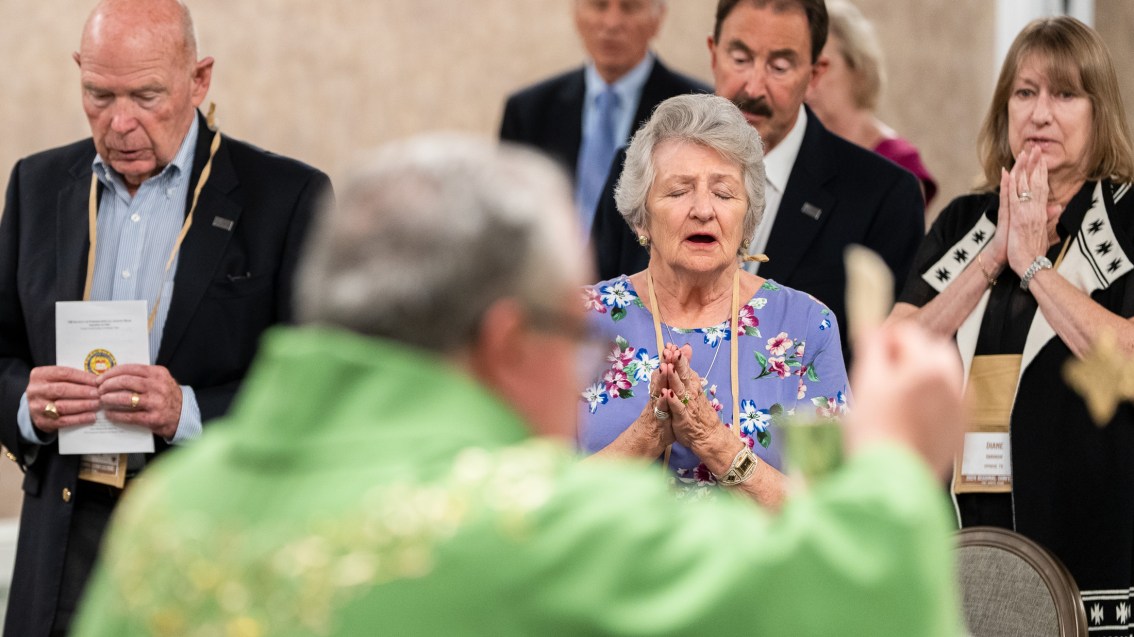
Homily for the Vigil of the Twenty-fourth Sunday of Ordinary Time
September 14, 2024
Society of Former Special Agents of the F.B.I.
Fort Worth, Texas
Isaiah 50:5-9a
Psalm 116:1-2, 3-4, 5-6, 8-9
James 2:14-18
Mark 8:27-35
The readings for today’s Liturgy on this twenty fourth Sunday in Ordinary Time direct two clear questions to us. Jesus asks the first question, “Who do you say that I am?” Secondly, paraphrasing the Letter of Saint James, “Is your faith demonstrated in good works, or not?”
In the Gospel reading from Mark, Jesus is on the road with His disciples within sight of Caesarea Philippi, an ancient pagan shrine built on a mountain top, and then rebuilt as a fortress by Philip the Tetrarch and named for the Roman Emperor, Augustus Caesar, who was officially revered as a god. It is a sign of the false religion of worldly power, and in the shadow of this sign of worldly power, Jesus first asks His disciples what the common opinion of Him is: “Who do people say that I am?” The disciples tell Him what they have heard: some say He is John the Baptist come back from the dead; others say He is Elijah the prophet returned; others say that He is simply a prophet from God. Jesus then directs his question specifically at them: “Who do you say that I am?” Peter gives an answer born not of the darkness of common opinion but born only of the graced light of faith: “You are the Christ.”
Jesus continues by teaching His disciples about His impending passion, death, and Resurrection and the necessity for these to happen for God’s plan of salvation of humanity to be accomplished. This is something the disciples did not expect of the Messiah. Instead of being a powerful political and military leader, Jesus teaches that the Messiah must suffer and be rejected like a criminal, a teaching that echoes Isaiah’s prediction in the first reading. Peter rebukes Jesus privately but receives a stern correction from Jesus that neither Peter nor we are ready to hear: “Get behind me, Satan.” Satan is the tempter, and Peter is tempting Jesus to bypass His passion and death in order to claim a power in accord with the way the fallen world understands both god and sovereignty.
But this was the reason Jesus came, to suffer and die to redeem us. If we really want to follow Him, we must take up our own cross with Him. Taking up our cross means facing difficulty and sorrow with Christ. It means accepting life on life’s terms and not becoming resentful when things do not go according to our own plans — even if what we plan for is something moral and good. It means that we believe that sin and death do not have the final say but that God has the final say in Christ expressed through the Resurrection and the forgiveness of sin.
In our second reading, Saint James reminds us that we live our faith through performing works of charity, authentic justice, and mercy. In so doing, we respond compassionately to the sufferings and tragedies of other people with grace that marks us as Catholics and as disciples of the Lord. How do we persevere in difficulties? Do we remain in the light of faith in Christ during dark times? Can we recognize and accept the grace God sends us on His terms? Saint John Chrysostom, whose feast the Church commemorated yesterday, wrote the following about this passage of Saint James, “A person moreover may have a righteous faith in the Father and in the Son, as in the Holy Spirit, but if he does not have a righteous life, his faith will not serve him for salvation. Therefore, when you read in the Gospel: ‘This is eternal life, that they know you as the one true God’ (Jn 17: 3), do not think that this verse suffices to save us: a most pure life and conduct are essential.”
We can only accomplish the good works of faith described by Saint James if we honestly and confidently believe that Jesus is the Son of God who has been sent to save us from our sins as well as the sins of others, sins and not only crimes. Our tolerance and compliance with procedures are insufficient to accomplish our salvation. The contemporary and postmodern social justice movement is an ideology that attempts to strip the Beatitudes of both God and His mercy. Without true faith in God as revealed fully by Christ, we see this world alone and its finite terms as all that there is, and we soon become cynical about human good and evil — seeing evil as inevitable and soon indiscriminate from that which is good. If we have no faith or if we honor and worship no God above the State, then the State will be treated as a god.
Without a confident and trusting faith in the Son of God as bolstered by good works, the line between agents of law enforcement and criminals becomes indiscernible and arbitrary because it is no longer delineated within a common humanity nor between the objective moral measurement of good and evil. The enforcement of law for the sake of authentic justice becomes reduced to measurement by the subjectively pliable claims of state interests over individual liberties. Police officers, soldiers, and agents of law enforcement who have righteously offered their lives in protecting the little ones of our society from the forces of evil have done so not first in compliance with the laws of the state, but in demonstrating their faith through works of charity and justice with personal sacrifice for God and for other people, especially the weak and most vulnerable. It is only in the light of authentic faith in the true God that you can endure suffering as nothing with confidence in God’s power who offered the Blood of His Son for our forgiveness and that we might live forever.
In the readings for this Mass, Jesus asks me, and He asks each of you the same question with the same direct discourse, “Who do you say that I am?” He likewise asks me, and He asks you, will you demonstrate that faith through works of justice and works of mercy? In the Sacrifice of the Mass, He offers us the Grace not to rebuke Jesus with the darkness of this world but with words and actions to answer Him correctly, honestly, and with the wisdom born of authentic faith, “You are the Christ.” May we never boast except in the cross of our Lord through which the world has been crucified to us and us to the world.
 Life on the Chrism Trail