
Homily for the Vigil of the Twenty-eighth Sunday of Ordinary Time
October 13, 2024
St. Patrick Cathedral
Fort Worth, Texas
Wisdom 7:7-11
Psalm 90:12-13, 14-15, 16-17
Hebrews 4:12-13
Mark 10:17-30
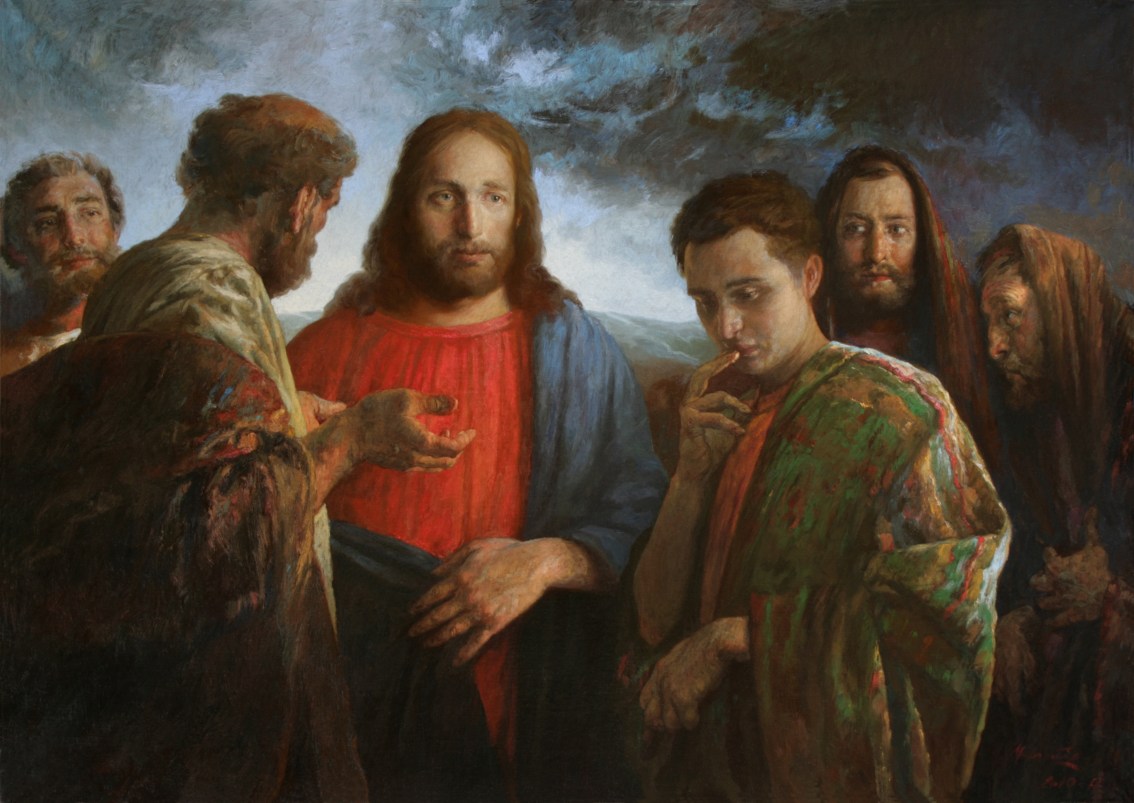
In today’s Gospel, the rich man who speaks to Jesus asks Him a question that reflects many people’s approaches to their faith: “What must I do to have eternal life?”
“What do I have to do — ideally, what’s the bare minimum I have to do — to get something out of my faith?” Give me the bottom line. What do I get if I go to Mass every week? What do I get if I go sometimes? What will God do for me if I pray the Rosary? What will God do for me if I give a homeless person some money? “What must I do to have eternal life?”
Reflecting on these words, Pope Francis once said, “Notice the verbs that he uses, must do — to have. Must do, to have.” This man’s question — and the attitude that leads us to ask it ourselves — reflects what Pope Francis calls a “commercial relationship with God, a quid pro quo, a this for that — a faith seen as a mechanical ritual,” in which religion consists of doing a few arbitrary tasks so as to receive some sort of divine treat, as if Holy Communion were a participation trophy.
In response to a man’s question about what he must do to inherit eternal life, Jesus begins by declaring that God’s goodness is at the root of all reality. In a way, this summarizes the first three commandments. Then Jesus spells out the minimum we must do to love our neighbor. He mentions five of the last seven commandments, and adds a prohibition against defrauding others, a combination of dishonesty and greed. Without arrogance, the man honestly answers that he has observed these commandments but still he is unhappy, unfulfilled, and unsure of eternal life.
Saint Mark comments that Jesus looks upon this man with divine love, invites him to let go of his wealth, and distribute it to the poor and needy. In loving the man, Jesus shows the man how to love God and His neighbor. Jesus promises him that it is only through love that the man will find the path to eternal life. Following the Lord involves living the commandments, but also letting go of the hold this world has on us. Placing our possessions, both material and immaterial possessions, as primary in our lives will always prevent us from the true fulfillment that comes with following Jesus, sharing His Cross, and entering eternal life.
It is not simply the question of material or even immaterial wealth that prevents one from entering eternal life. Saint Clement of Alexandria commented: “Let the parable teach the prosperous that they are not to neglect their own salvation, as if they had been already foredoomed, nor, on the other hand, to cast wealth into the sea, or condemn it as a traitor and an enemy to life but learn in what way and how to use wealth and obtain life.”
Jesus’ invitation to him to surrender proves to be too difficult for the man. Like many of us, the young man is a believer and wants eternal life, but is hesitant to let go of his security, comfort, and wealth. He is afraid to love God because he is afraid to trust. Wanting eternal life, which is another way of saying that we want to go to heaven, is not exactly the same as deciding to love and to follow Jesus, especially to love Him in the challenging disguise of the poor. What should be most important in our lives is knowing the Lord, living His love, and willingly carrying His Cross with Him … being one with Him for eternity in heaven. Our goal is not heaven as a place but the gift of becoming one with our Savior. Jesus takes this opportunity to make it clear to His disciples that attachment to wealth and the status and power it provides are major obstacles to enjoying His friendship.
As Pope Francis once observed, “A faith without giving, without gratuitousness, without works of charity, makes us sad in the end: just like that man who returned home ‘sorrowful’ with a fallen countenance, even though he had been looked upon with love by Jesus in person.”
In the celebration of this Eucharist the living God looks at us and loves each and all of us. Everyone here has the God-given capacity to love Jesus Christ and discover the joy of the Gospel. If you want to move away from a dry, exhausted, resentful, mechanistic faith, the only way to do so is to stop and to become aware of His look of love — and start to return it.
Take time each day to pray by listening. Come to Adoration and spend quiet time with Christ. Trust God and allow yourself to be forgiven in the sacrament of Penance and Reconciliation especially if it has been a while. These encounters are the starting point of an electrified faith. From them, God might be giving your life a completely new and exciting direction that will necessarily involve generosity, service, and charity.
If you’re a young man, God might be calling you to leave everything and serve Him and His people as a priest or religious. If you have been given great financial resources, God might be asking you to give significantly from those resources, including the resource of your time, to serve the poor.
As Jesus looks upon each of us with love today in the Eucharist, may we let ourselves be loved by Him. Ask Him to help you to trust and to be open to whatever He asks of you because He will never abandon you. From the fruits of this encounter, may we rediscover — or perhaps recognize for the first time ever — the joy of following Jesus Christ in this age, and in the age to come.
 Life on the Chrism Trail