
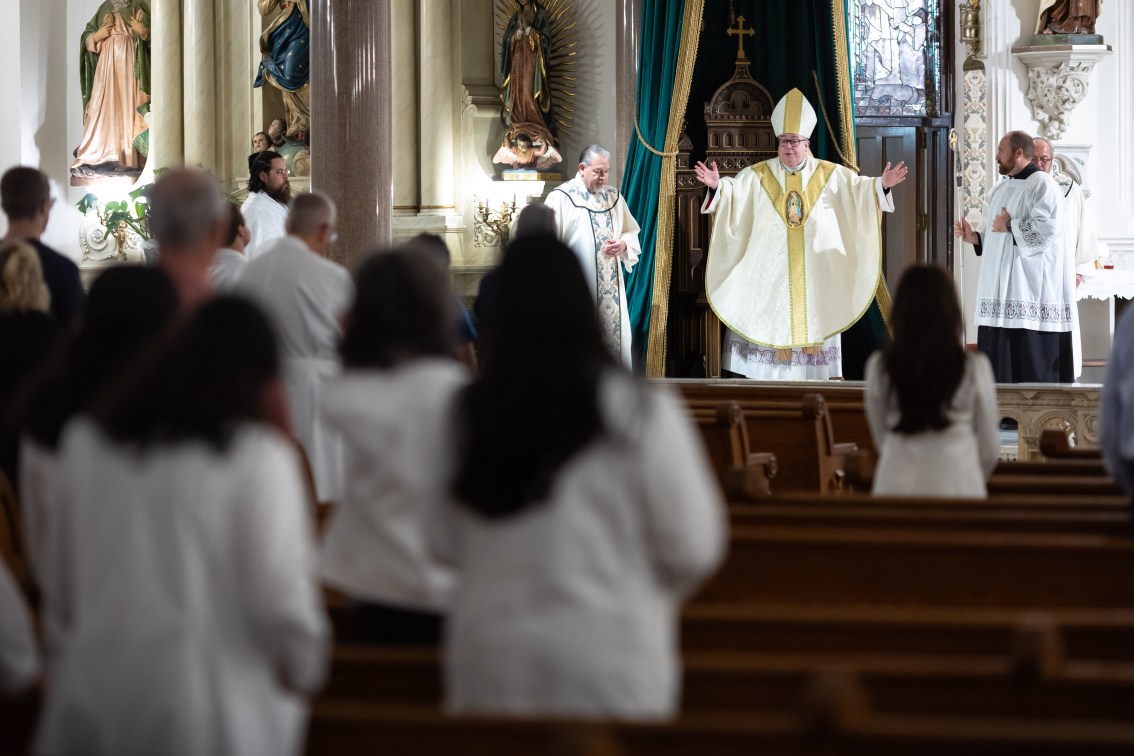
Homily for the White Coat Mass for the Diocese of Fort Worth
October 14, 2024
St. Patrick Cathedral
Fort Worth, Texas
Galatians 4:22-24, 26-27, 31-5:1
Psalm 113:2
Luke 11:29-32
Medicine is both a profession and art. This statement applies to each of the professions associated with health care: physicians, nurses, therapists, social workers, and those who professionally aid the professions. As a profession, medicine requires both established credentials to warrant the trust of patients who are always involved in a fiduciary relationship. These credentials of the profession are then further established and justified by how the art is freely practiced by the physician or other health care professional in an ever-changing culture of expectations and demands.
Our first reading is taken from Saint Paul’s Letter to the Galatians. The Galatians too found themselves in a situation of cultural crisis. Some Christians who had come from Judaism had infiltrated the young church in Galatia and began to sow theories contrary to the Apostle’s teaching, even going so far as to attack the character of Saint Paul. It is the usual method of subversion for disunity, undermining the authority of Saint Paul as an Apostle.
Pope Francis observed, “As we can see, it is an ancient practice to present oneself at times as the sole possessor of the truth — the pure — and to aim at belittling the work of others, even with slander. These opponents of Paul argued that even the Gentiles had to be circumcised and live according to the rules of Mosaic Law. They went back to the previous observances, those that had been superseded by the Gospel. The Galatians, therefore, would have had to renounce their cultural identity in order to submit to the norms, prescriptions, and customs typical of the Jews. Not only that, but those adversaries also argued that Paul was not a true apostle and therefore had no authority to preach the Gospel.”
This situation is not far removed from your experience with many of your patients today. There is no shortage of amateur medical experts who, especially through the new means of social media, can disturb patients and even entire communities. They present themselves to insist, as guardians of the truth — so they call themselves — fomenting conspiracies and playing on the fears of many, thereby bringing discouragement and assailing hope. The vocation of Catholic doctors, nurses, and clinicians is to bring hope by caring for their patients especially where presumption or despair hold sway in their souls.
On June 22, 2019, Pope Francis addressed the International Federation of Catholic Medical Associations as they gathered in Rome to celebrate their consecration to the Sacred Heart of Jesus with these words, “Your mission is a witness of humanity, a privileged means of helping others to see and feel that God our Father cares for every individual, without distinction. To do this, he wishes to employ our knowledge, our hands and our hearts, in order to care for and bring healing to every human being. To each of us he wants to grant life and love.”
The modern age of medicine, with its philosophical principles like physiological dualism, the technological imperative, and highly specialized knowledge brought about the social problem of doctors playing God. Our contemporary age marked by the radical distrust of authority as a hallmark of postmodernism, now presents us with the problem of patients playing God. Patients present themselves as experts who consult their professionals but who jealously guard their own sense of autonomy as absolute and sovereign. This sovereignty brings about slavery to illness.
Neither the modern age of medicine and healthcare nor the contemporary and postmodern milieu offer much hope for patients or for physicians because hope requires a humble recognition of one’s own powerlessness that accompanies a confident trust in God’s omnipotence. If either the physician or patient claim the place of God in their relationship with each other, there can be no room for hope and soon caring is replaced by the imperious demands of consumerism. Like Saint Paul’s approach to the young Galatian church, you can take courage in your care for these challenging patients by remembering his words, “For freedom Christ set us free; so, stand firm and do not submit again to the yoke of slavery.”
Like the audience of Jesus in the Gospel this evening, the words of Jesus apply to too many patients, “This generation is an evil generation; it seeks a sign, but no sign will be given it, except the sign of Jonah.” The fact that a person looks for signs is not wrong; in fact, it is essential for good health care including patient responsibility. However, Jesus is referring to the practice of looking for more signs only to reinforce one’s own opinion to defer a response to abandon that which is bad to seek what is good. Seeking signs that can justify our dismissal of reality is what is evil about this sign-seeking.
The sign of Jonah is that despite our disappointing expectations, sometimes, much to our surprise, people hear the message and repent and change their behavior. That is true in the realm of physical health, and it is true spiritually and morally as well. The sign of Jonah is that the response of the Ninevites is truly a response, not just to Jonah, but to God — which calls for a deeper response on the part of Jonah, one of conversion and one of hope.
We have heard and believe the Gospel that Christ has come and is the full and final revelation who heals, elevates, perfects and completes nature. Christ is the greater than Jonah who brings us hope through His rescue, protection, healing, and payment of the debt of sin on our behalf. Let us approach with hopeful confidence the banquet table of the Lord Jesus where the Divine Physician might heal and sustain us from the maladies of discouragement and fear.
 Life on the Chrism Trail