
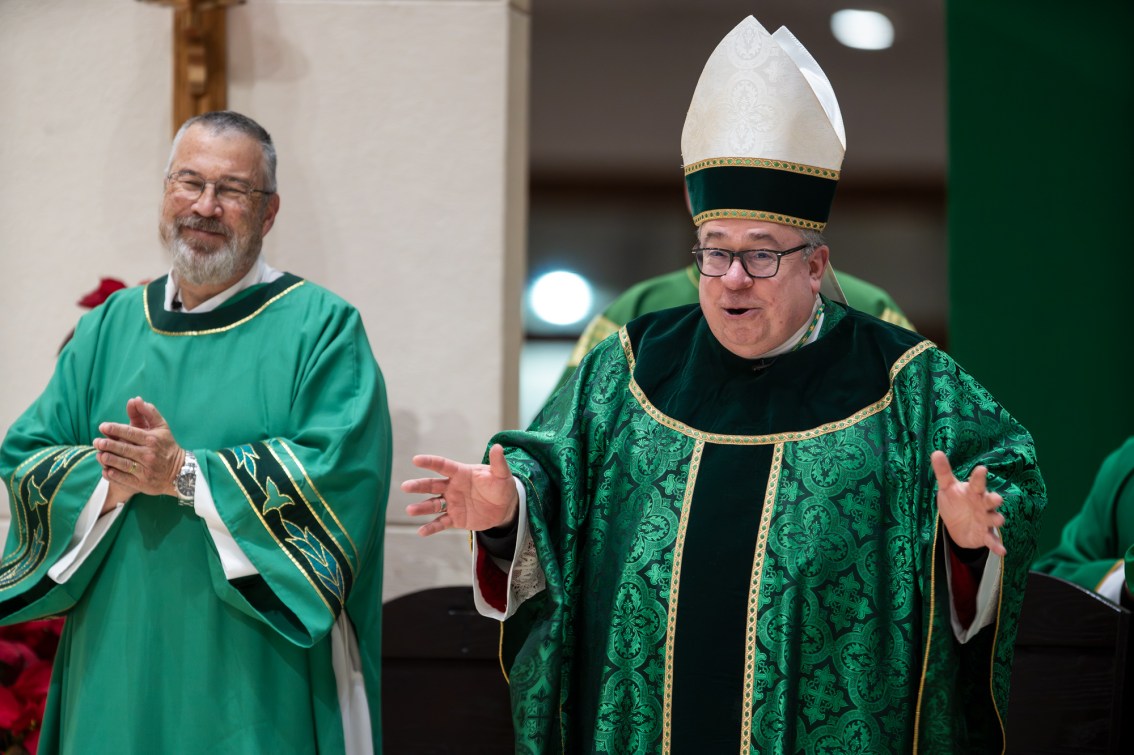
Homily for the Second Sunday of Ordinary Time
Mass for the Preservation of Peace and Justice, Dr. Martin Luther King Jr. Commemoration
January 18, 2025
Saint Joseph Catholic Church
Arlington, Texas
Isaiah 62:1-5
Psalm 96:1-2, 2-3, 7-8, 9-10
I Corinthians 12:4-11
John 2:1-11
The wedding at Cana in Galilee probably involved a friend or relative of Mary and Jesus since they were invited. Either the details of this event were not well planned, or perhaps there were unexpected guests. In any event, it doesn’t surprise us to find out that Mary was the kind of person who paid attention to details, who thought of others with compassion, and who wanted to prevent embarrassing situations, especially the type of embarrassment of not having enough wine at a wedding that culturally would have harmed this couple, their children, and their children’s children for generations.
What does surprise us is Jesus’ response to his mother: “Woman, how does your concern affect me?” Here we must remember that this event in Cana came at the very beginning of the public ministry of Jesus. The reply of Jesus to his mother’s intervention reflects the newness of this moment: “Woman, how does your concern affect me? My hour has not yet come.” Jesus’ response to Mary requires an act of faith on her behalf. His hour, of course, is His suffering and death, and from this moment at Cana He begins to reveal Himself to the Twelve, to the multitudes of Israel, and to all the nations of the earth. He proceeds on the journey to His hour, on the Way of the Cross. Mary believes and has no doubt that Jesus will respond as she confidently tells the attendants: “Do whatever He tells you.”
Jesus proceeds to give some simple instructions: “Fill the jars with water and take some to the headwaiter.” Somewhere in the process the water turns into wine, and a better wine than previously served according to the witness of the headwaiter. Neither he nor the bridegroom seems to be aware of what Jesus has done but the Gospel tells us that the servants knew. John tells us that the disciples began to believe in Jesus because of this sign. Yet, at this point, the disciples only began to believe in Jesus. Conversion and the development of faith take time, prayer, and practice.
The alertness of the servants to the needs of others enables them to recognize the miracle of water to wine, and then they recognize the inferior vintage to greater vintage. The Gospel makes clear that it is the people who are sensitive and open to serve to the needs of others who are most likely to be the first to see the hand of God at work through Christ. As Doctor Martin Luther King Jr. taught, “By opening our lives to God in Christ, we become new creatures. This experience, which Jesus spoke of as the new birth, is essential if we are to be transformed nonconformists. Only through an inner spiritual transformation do we gain the strength to fight vigorously the evils of the world in a humble and loving spirit.”
The first part of John’s Gospel consists of a series of signs. Signs point to something other than themselves. The sign at Cana is water changed into wine. Wine is a sign in the Old Testament of the joyful banquet God will prepare for His faithful, and the wedding is a sign of God’s intimacy with us, as Isaiah tells us today, “For the Lord delights in you and makes your land His spouse. As a young man marries a virgin, your Builder shall marry you; and as a bridegroom rejoices in His bride so shall your God rejoice in you.”
When Mary says that the wedding party has no wine, she means that they have no joy. Saint Thomas Aquinas tells us that joy is the delight in the presence of the beloved and delight in seeing the purposes of the beloved fulfilled. Jesus’ response to Mary means, “Of course, they have no joy because I have not completed my work yet.”
Time is a gift, but it is not in itself enough for conversion. Time does not heal all wounds, only love heals all wounds. What is needed by us for conversion and healing is the courage of the servants who recognize the miracle of Christ and are willing to be changed by His selfless generosity of the most excellent and timeless vintage provided by Him — His mercy. It is the courage to change our ways by following Jesus in word and deed on His Way of the Cross. It is the courage that begins in this hour, the hour of the Lord, that has now begun for us at this Eucharistic table where we are nourished by Him. It is an hour that requires our perseverance in word and deed when we depart this church and return home and to our places of work and school.
Doctor Martin Luther King described this courage when he said, “Courage is an inner resolution to go forward despite obstacles; Cowardice is submissive surrender to circumstances. Courage breeds creativity: cowardice represses fear and is mastered by it. Cowardice asks the question, is it safe? Expediency asks the question, is it politically correct? Vanity asks the question, is it popular? But conscience asks the question, is it right? And there comes a time when we must take a position that is neither safe, nor politically correct, nor popular, but one must take it because it is right.”
Three more years of Christ’s public preaching, miracles, and private teaching were needed for them to come to understand and accept the full implications of what they glimpsed that day at a wedding feast, but the Twelve Apostles had now encountered the revelation, mystery, and light of Christ. They stumbled along the way, and they were discouraged at times, but they did not give up.
John tells us that “Jesus did this as the beginning of His signs at Cana in Galilee, and so revealed His glory, and His disciples began to believe in Him.” Only after Pentecost would the Twelve grasp fully the meaning of His Resurrection and Ascension to the glory which was His before He made the universe and that all creation is called to rejoice forever at the Wedding Feast of the Lamb, the Lord Jesus Christ.
The hour of the Lord has come for us to follow Him. We are called to be His servants, and in our service to those in need our hearts are sensitized to the miracles that the Lord is willing to work for us in bringing about reconciliation. We now approach the banquet table of the Lord’s Sacrifice of love. Just as the young couple at Cana were spared generations of shame and misery by the intercession of Mary and the intervention of Jesus, we can only be spared and healed of generational suffering caused by sins of racism through her intercession and His intervention. We pray for the gift of the willingness to be courageous, the willingness to reject cowardice, and the humility to listen to Mary and to do whatever Jesus tells us to do.
 Life on the Chrism Trail