
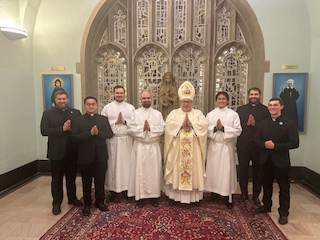
Homily for the Optional Memorial of Saint Ansgar
Mass for the Institution of Ministries of Lector and Acolyte
February 3, 2025
Theological College
Washington, DC
Isaiah 52:7-10
Psalm 96:1-2, 2-3, 7-8, 9-10
Hebrews 10:19-25
Mark 1:14-20
To consider the lay ministries of lector and acolyte in the life of the Church and in their role in seminary formation requires us to review two Papal documents: the Motu Proprio, Ministeria Quaedam of 1972 by Pope Saint Paul VI and the Motu Proprio, Spiritus Domini of 2021 by Pope Francis. Ministeria Quaedam identified the character of Lector and Acolyte not as minor orders inherently within the clerical state but as being “closely linked to liturgical actions that in practice were being exercised by the laity.” This shift in focus led to the development in doctrine within the Latin Church that these ministries while distinct from ordained ministry are open to all the baptized. This Magisterial recognition has graciously spared the Church from clericalizing male and female members of the laity.
This development has prompted, almost fifty years after Ministeria Quaedam, Pope Francis to teach in Spiritus Domini that these ministries while open to all the baptized, remain preparatory for ordination not as an introduction to the clerical state but because “they offer appropriate support to the role of evangelization that is incumbent upon the ecclesial community.”
It is the ecclesial community of the Church that is necessary for the direction of these ministries. In our second reading proclaimed moments ago, the Letter to the Hebrews instructed us that, “We should not stay away from our assembly, as is the custom of some, but encourage one another, and this all the more as you see the day drawing near.”
The Word properly finds it place in the liturgical setting of the Eucharist. In that sense the liturgical setting of the Eucharist is the context by which the text of Sacred Scripture can most fully be appreciated and received as the Word of God and by which the gathered assembly of believers becomes the Church.
When we consider the life of the early Church, we are reminded that the Psalms were prayed together by the assembly in the context of the Eucharistic setting. We are reminded that the Gospels, the Pauline epistles, and the other books of the New Testament received their formation and acceptance as authoritative through their incorporation into the communal prayer of the Eucharistic liturgy. This is how the Canon of Scripture was formed not as an authoritative list of books, but as the ordered corpus of authoritative books: Norma normans non normata. Those books that were rejected as incompatible with the authentic Gospel of Christ and the Deposit of Faith. For example the Gnostic gospels were rejected by the Church because they were obnoxious to the ecclesial assembly within the Eucharistic setting.
If we lose the context of the Eucharistic setting of the Church for the text of the Word, we soon become prone to proof texting Scripture and impose a meaning upon the Word that serves our own agenda while dishonestly claiming an authority that Sacred Scripture alone does not have. “Text without context is the pretext for prooftext.”
Likewise, the offering, distribution, reception, and adoration of the Eucharist happens against the setting of the Eucharistic assembly at the Sacred Liturgy. Adoration and benediction of the Blessed Sacrament are not simply acts of private devotion or personal revival but are intensely intimate encounters with God because they draw each of us more intimately into the mystery of the offering and sacrifice of the Eucharist in the setting of the assembly of believers through which we are transformed and as Saint Augustine taught, “we become what we receive.” It is only through the blood of Jesus that we have confidence of entrance into the Sanctuary.
The Word proclaimed in the Sacred Scripture and the Body and Blood of Christ offered and received each together in the Eucharistic setting offer us the source and purpose for the lay ministries of Lector and Acolyte into which our brothers here today are to be instituted. This setting and relationship of which they will be stewards is key for their responsibilities as evangelizers in these ministries now and as they will exercise them later in priestly ministry.
The great challenge and temptation for so many members of the ecclesial assembly today is that too many do not want to be members of the assembly, preferring to take the Word and the Body of Christ as separable from the assembly of the Church and treat each with utility for their own individualized spirituality. Sacrosanctum Concilium teaches that “the treasures of the Bible are to be opened more lavishly so that richer fare may be provided for the faithful at the table of God’s Word.”
As pastors now and for those preparing to become pastors, in the words of Sacrosanctum Concilium, we must be “lavish in our preaching of Holy Scripture” by being more than vaguely familiar with the Word. The Word of God must be the marrow of our prayer life, that even when privately praying with the books of Sacred Scripture, we only do so within and for the life of the Church.
This is such a non-negotiable aspect of our Eucharistic identity that even in those celebrations of the Traditional Latin Mass, the Church makes clear that the readings from Scripture are to be proclaimed in the vernacular, using translations approved for liturgical use by the local Episcopal Conference. “Text without context is pretext for proof text.”
Likewise, as pastors, we must expose the Blessed Sacrament for the faithful to ponder the Eucharistic celebration and reception of Holy Communion more deeply but not as a separate and private devotion that reduces the liturgy to spectacle and abuses the Blessed Sacrament as a talisman. In the ministry of carrying the Eucharist to the homebound and infirm, we must remember that we do so in charity as a ministry that draws the marginalized closer into the Eucharistic assembly from which we have been sent. In your continued development as lectors and acolytes, you are like the sentinels spoken of by Isaiah, who raise a cry and shout for joy of the Lord’s return to His People as proclaimed as the Word in the Eucharistic setting and as broken and received in the Eucharistic setting of the Liturgy and Mass.
In today’s Gospel, we heard the call of Jesus to the Apostles each by name to become fishers of men by preaching repentance and belief in the Gospel to be brought in to the Assembly of the Church. This is your call too. You have been called by name like the Apostles first for the sake of the ministry of evangelization drawing people into membership within the Church, the ecclesial assembly and secondly into the mystery of Holy Orders. The grace of ordination can only follow most clearly and effectively from the development of your baptismal call to preach the Good News by your lives and service because this is the time of fulfillment for the Kingdom of God is at hand. Text without context is pretext for proof text.
 Life on the Chrism Trail