
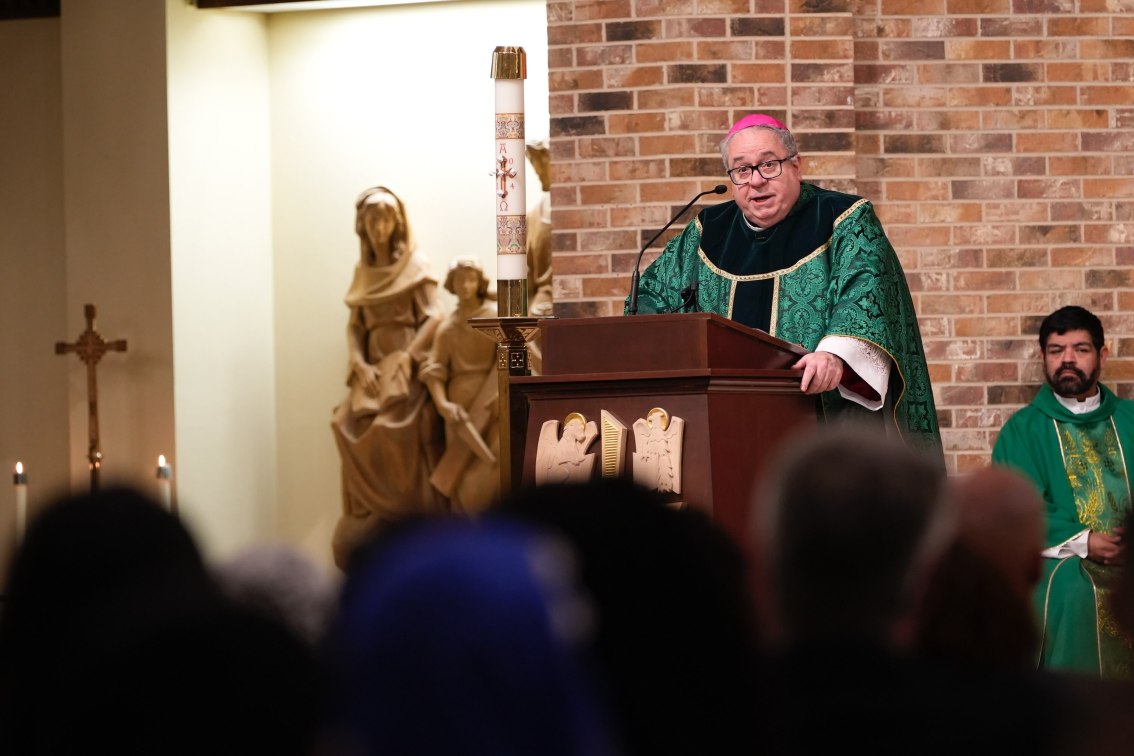
Homily for the Sixth Sunday of Ordinary Time
February 15, 2025
St. Bartholomew Catholic Church
Fort Worth, Texas
Jeremiah 17:5-8
Psalm 1:1-2, 3, 4, 6
1 Corinthians 15:12, 16-20
Luke 6:17, 20-26
Jesus cautions us that prestige, power, and complacency can prompt us to lose our way with Him. To be a disciple of Jesus involves our dying to these selfish preoccupations so that the life of Christ can exist in us that we might raise with Him from the dead on the last day. His teaching on the Beatitudes in today’s Gospel requires us to invert the sense of values and purposes that our contemporary world espouses for meaning and happiness — power, financial success, and pleasure. These values only seem to promise freedom and to bring security to the individual. This teaching of Jesus in His Sermon on the Plain invites His disciples to risk estrangement from this world by trusting Him and by following Him in the way that He lives and loves. This way of life and love that involves surrender and trust is most clearly manifested and made present in the sacramental vocation of marriage with its graced and promised intentions of permanence, fidelity, and openness to God’s gift of children.
Remarking on the teaching of the Beatitudes as presented in Luke’s Gospel, Pope Benedict XVI once remarked, “The Beatitudes are based on the fact that a divine justice exists, which exalts those who have been wrongly humbled and humbles those who have exalted themselves. In fact, the Evangelist Luke, after repeating four times “blessed are you,” adds four admonitions: “Woe to you that are rich…. Woe to you that are full now…. Woe to you that laugh now” and: “Woe to you, when all men speak well of you,” because as Jesus affirms, the circumstances will be reversed; the last will be first, and the first will be last…This justice and this Beatitude are realized in the “Kingdom of Heaven,” or the “Kingdom of God,” which will be fulfilled at the end of times, but which is already present in history.”
Just as much as it is a sacrament of love, matrimony is also a sacrament of justice that corrects the injustices brought about when sin entered the world through disobedience to God committed by our first parents in the Garden of Eden. Original sin in a particular way brought injustice into the relationship between man and woman initially designed by God to be a relationship of perfect trust and intimacy. As the Catechism of the Catholic Church teaches, “their relations were distorted by mutual recriminations; their mutual attraction, the Creator’s own gift, changed into a relationship of domination and lust; and the beautiful vocation of man and woman to be fruitful, multiply, and subdue the earth was burdened by the pain of childbirth and the toil of work.” (CCC 1607)
It is the compendium of values of the contemporary world with its assault on the goods of marriage — permanence, fidelity, and openness to God’s gift of children that has prompted so much fear in young adults when faced with a decision to be open to give themselves in marriage.
These advocates for a suspicious and woeful manner of living discourage the generosity and trust of God that is needed for true happiness in married life. Marriage is presented as being too risky and socially unnecessary. They have rejected the order of grace and the order of nature. Married life seems too difficult to live with permanence, with generosity, and with fidelity, given the unbridled sexual drive that is presumed to be true and unavoidable for human beings.
This hopeless view that sin has the last word and selfishness is inevitable is the “woe” promised by Jesus in today’s Gospel. Jesus clearly warns us about this way of selfishness and fear. This way of living undergirds the same values presented in the contemporary world regarding human sexuality. These values discourage the vulnerability required in the loving commitment of married life. These values cynically propose that sexuality is utilitarian and selfish, that marriage inevitably collapses into the pain of divorce, and that children are an expensive investment that can only serve as a distraction from the occasional loneliness of human existence. These values lead to the conclusion that embodied human sexuality is not binary.
As the Catechism of the Catholic Church succinctly clarifies, “This unequivocal insistence on the indissolubility of the marriage bond may have left some perplexed and could seem to be a demand impossible to realize. However, Jesus has not placed on spouses a burden impossible to bear, or too heavy — heavier than the Law of Moses. By coming to restore the original order of creation disturbed by sin, He Himself gives the strength and grace to live marriage in the new dimension of the Kingdom of God. It is by following Christ, renouncing themselves, and taking up their crosses that spouses will be able to “receive” the original meaning of marriage and live it with the help of Christ.” (CCC 1615)
We know through faith and full consideration of human nature that the shared life of marriage between a husband and a wife requires sacrificial love on the part of each to prepare each other through holiness and virtue for eternal life in the Kingdom of Heaven. The discernment of marital life has eternal import. The commitment of husband and wife ends with death, but the love between them is of an eternal character. As Blessed Karl of Austria spoke to his wife the Empress Zita on October 22, 1911, the day after their wedding, “Now we must help each other to get to heaven.”
The grace of the sacrament of Holy Matrimony opens the eyes of a husband and wife and each of our eyes to acquire the understanding of what is eternally true and authentically real about our humanity redeemed in Christ. God offers this Grace to heal the cynical shortsightedness with which the woeful spirit of this world infects us. With his paradoxical Word, Jesus through the gift of the Holy Spirit stirs us and enables us to discern and to recognize what is truly good and satisfying and restores our joy and dignity; the risk of commitment to love that truly gives meaning and hope to human life and to appreciate that sexuality is for the sake of marriage and not marriage for the sake of sexuality.
As young adults, as Christians, and as members of Christ’s One, Holy, Catholic and Apostolic Church, now is the time to prepare through prayer and chaste living to discern the path of married life for beatitude and not woe. Do not trust the voices of the relativism of today that lead us to woe. Trust the selfless and sacrificial example of Jesus in following the path of obedience to His Father that shows the eternal love required for a happy and holy marriage. Jesus nourishes us with His loving sacrifice of the Cross made real in the Holy Eucharist to draw us into His life, death, and Resurrection. We now approach the altar of Christ’s sacrifice and banquet where we can be so nourished as a hopeful foretaste of His Kingdom of justice and love.

Young adults pray at Mass at Saint Bartholomew Catholic Church in Fort Worth on Feb. 15. (NTC/Juan Guajardo)
 Life on the Chrism Trail