
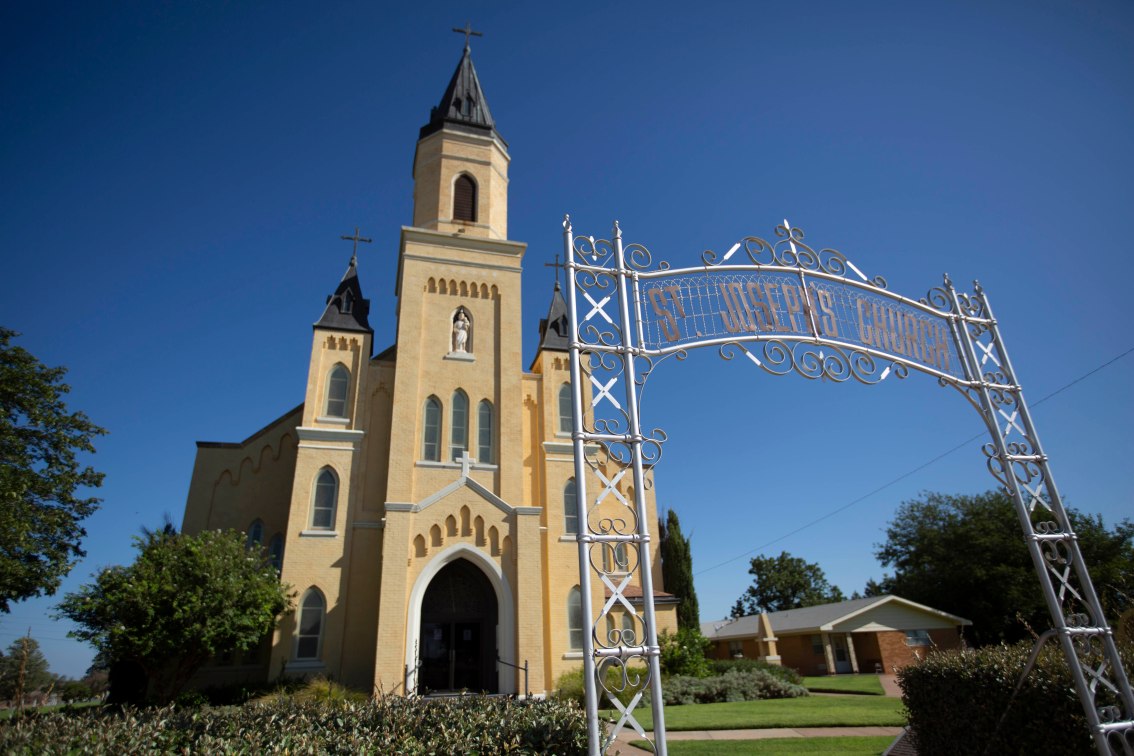
Homily for the Twenty-second Sunday in Ordinary Time
Celebration of the 130th anniversary of St. Joseph Parish
August 31, 2025
St. Joseph Catholic Church
Rhineland, Texas
Sirach 3:17-18, 20, 28-29
Psalm 68:4-5, 6-7, 10-11
Hebrews 12:18-19, 22-24a
Luke 14:1, 7-14
“God in your goodness, you have made a home for the poor.” Our responsorial psalm for today’s Mass, taken from Psalm 68, describes the essence of the prayer life of Father Reisdorf’s vision and labor in the foundation of this parish and the community of Rhineland that this parish has served for one hundred and thirty years.
Your parish history records that Father Joseph Reisdorf secured 12,000 acres in this part of Texas with the help of a land agent in Galveston and on March 19, 1895, began work on a colony house for community gatherings for settlers. Such gatherings would include both meals and the celebration of Mass. Advertisements and invitations were published in German in newspapers in Germany inviting Catholics to immigrate, not just to the United States but to Texas and to this community of Rhineland. German Catholics had just suffered through a period of persecution because their religious life of faith and their beliefs that they taught in their schools did not align with the modern and secular approach to society imposed upon them by the German government.
As your parish history recounts, Rhineland’s first residents tended to be poor and of modest financial means. Cherishing their Catholic faith and desperate enough to leave Germany for an unknown and unwelcoming land, they arrived and struggled to pay for the smallest available plot of 160 acres at 3 to 8 dollars per acre in order to establish a family home and livelihood. Part of your parish’s oral history tells that “The first man who came to look for land arrived on a day when there was a strong sandstorm. Taken aback by the conditions, he became so angry he would not even get out of his buggy to survey the land. He is quoted as saying that ‘If I owned Rhineland and Hell, I would rent out Rhineland and live in Hell.’”
While it is a humorous story, I would offer that it provides a good point for our reflection, this man neglected to observe that what makes Rhineland so very different from Hell is not the weather but the centrality of Christ who forms and protects your families, your parish, and your communities. It is not simply your material possessions, so hard-earned, but your humility and kindness that comes with being a follower of Christ and member of His Church. Those who have come before you and have stayed and worked to flourish had in their hearts what we have just prayed in the responsorial psalm, “A bountiful rain you showered down, O God, upon your inheritance; you restored the land when it languished; your flock settled in it; in your goodness, O God, you provided it for the needy.”
Your presence here in this church today reveals not simply that you have flourished materially since your ancestors arrived in Rhineland, it shows that like them, you are aware of your own neediness for Christ and His Church and that He is the only path to true belonging and love. The love that you have been showered with by God and that you share with gratitude in so many ways among the poor in this community and throughout the Diocese of Fort Worth is what keeps us all from Hell. God continues to shower you with a bountiful rain and has provided for all of us who are needy for over 130 years and until His Son comes again.
So, we come together today for the Eucharistic banquet and also to a shared meal to celebrate this great anniversary of your parish. In today’s reading from the Gospel of Luke, Jesus is a guest at a dinner party, and it is in this setting that He teaches His two parables. Jesus first offers us an example and then concludes with guidance and direction through the preaching of two parables. In the first parable, the guest who seeks out the lowest place is Christ. He seeks out the lowest place — the lowest place that is humanity fallen and weakened by sin. Christ seeks His place among all of us who are powerless to reach what Sirach calls the “sublime heights” of God who is love. Christ takes His place among us so that His Father might call us to be seated at a higher place with Christ our brother.
While Christ takes the role of the guest at the banquet in the first parable, He is the host of the banquet of the second parable. The first parable concerns places of belonging; the second parable refers to reward. Christ does not just invite those who seek to use Him for their own purposes, those who ignore or distort His Gospel. Christ invites the poor, the stranger, the migrant, the crippled, the lame, the blind, the sinner. He invites us! We are those listed guests at His banquet of the Eucharist — the foretaste of heaven — for which we cannot repay Him, if we are humble. Our reward is Him. Christ’s place is with His heavenly Father. Our place is with Him. Our reward and our place are one and the same, Jesus Christ as the gift of His Father for our salvation. We are given our place of belonging and we are drawn into this reward by the same gift of the Holy Spirit.
For one hundred thirty years, because of the generous hope-filled vision of Father Reisdorf and of your ancestors who shared in that vision and handed it on to you, you have belonged not just to a place but to Christ and His Church. As beneficiaries of their patrimony, may we continue to make a home for the poor. In a few moments, He invites us again to come up higher to receive Him in our poverty as His guests. It is in this way that God in His goodness has made a home for us in our own poverty. May we receive His justice and rejoice and exult before Him praising His Holy Name by our lives lived charitably and faithfully.
 Life on the Chrism Trail