
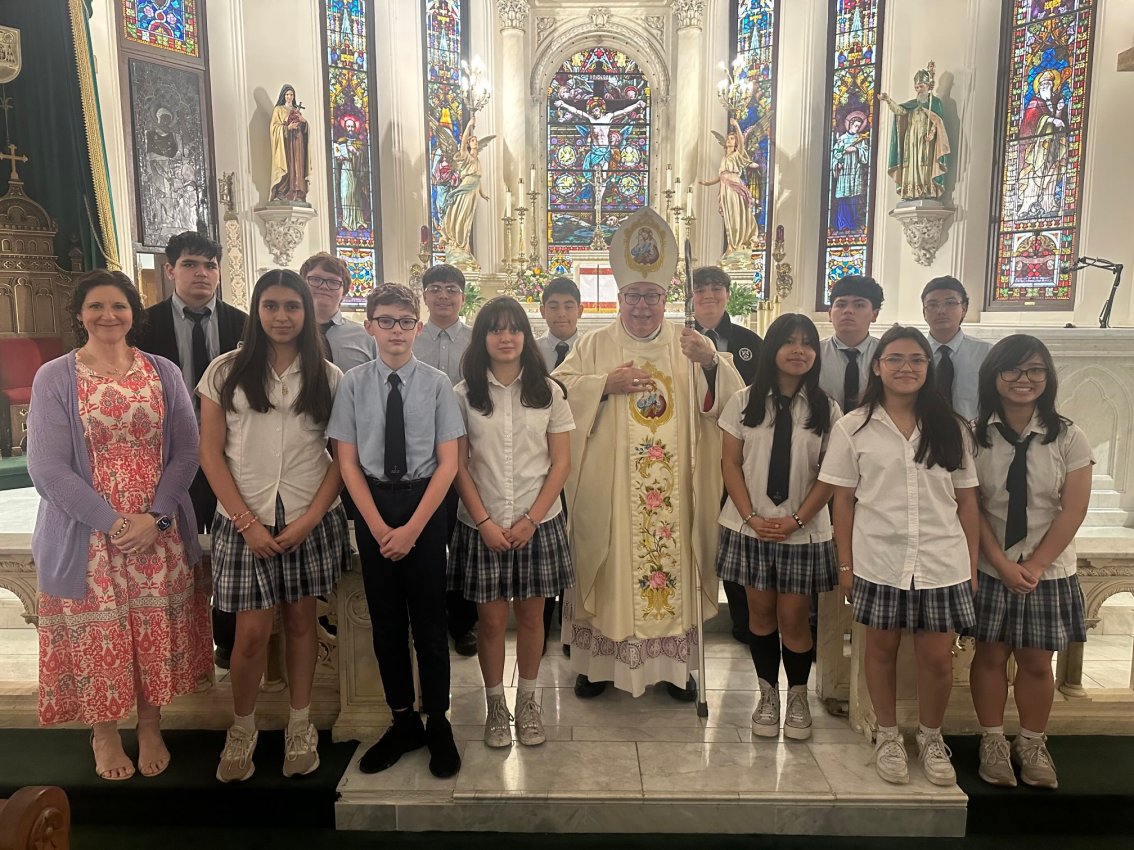
Homily for the Thursday of the Third Week of Easter
Eighth Grade Vocations Mass
April 23, 2026
St. Patrick Cathedral
Fort Worth, Texas
Acts 8:26-40
Psalm 66:8-9, 16-17, 20
John 10:11-18
We all need to earn money to live, but money cannot satisfy our deepest desires. A true vocation has nothing to do with money because it comes from love. Most people are called to love another person in Holy Matrimony, and then husbands and wives love their children. That kind of love cannot be bought. And other men and women are called to love without being married, and they become priests and religious sisters. That kind of love cannot be bought either. Vocations, either to married life or priesthood and religious life, cannot be bought just as Jesus Christ, the Good Shepherd teaches us: someone who works because of a desire for money is not following a call from God.
Jesus identifies Himself as the Good Shepherd. In so doing Jesus also speaks of two characteristics of His mission as the Good Shepherd. First, He knows His sheep with a closeness conveyed by the statement that He knows the name of each of His sheep and that in turn His sheep recognize His voice, and they follow. Secondly, Jesus the Good Shepherd teaches that He is willing to die for His sheep — which He does. The parable of the Lost Sheep in the other Gospels shows us just how important this teaching and image is for the preaching of Jesus. The Shepherd is willing to take great risks to save the sheep even to the point of dying for the sheep.
Jesus knows us better than we know ourselves. Jesus loves us better than we love ourselves. We come to know Jesus and love Him when we spend time listening to His voice in Sacred Scripture and in the prayers of the Mass. We come to know Him and love Him when we spend time quietly listening to Him in silent Adoration before His Eucharistic presence.
The love and care that Christ the Good Shepherd has for us, His sheep, is such that He has designed His flock as the Church in which all the sheep need not only Him but each other. They are to be one flock, and the unity of the flock depends only on the centrality of Jesus Christ as the Good Shepherd. The hired hands, unlike the Good Shepherd, do not care about the sheep either as individuals or as a unity. The hired hands assess the value of the sheep by considering how useful they are. Hired hands are willing to abandon the weaker and more vulnerable sheep because they do not matter in light of the hired hands’ private gain.
The pastoral mission of Jesus and His Church is carried out in such a way that soon the stronger sheep of the flock surround the weaker members of the flock who are placed at the center away from the edges of the flock — these are the poor, the unborn, the terminally ill, the refugee, the oppressed. The stronger members of the flock soon keep close and surround the weaker members because of the call of the Good Shepherd’s voice and His presence in their midst. From this united flock who hears His voice, the Good Shepherd calls some men to be ordained and configured to His image sacramentally as priests who are to care for the flock by leading others to the Good Shepherd, Christ Himself. The vocation of the priest involves the same missionary and pastoral obedience and love that the Good Shepherd exemplifies and only that He can offer.
People will not believe that Christ matters if Christians act as though Christians do not matter. Without the Good Shepherd and our obedience to His voice, we His sheep soon abandon each other and wander off lost on our own selfish paths that drive us to pools of dingy water, dry earth, and the vicious attack of the wolf. In hearing His voice, we come to recognize that our lives are not our own. We come to know that we must lay down our lives for others in accepting inconveniences, difficulties, and sufferings as our part of God’s plan.
We follow the Good Shepherd by committing ourselves to follow the Commandments and to live the Beatitudes through loving actions to serve the poor and outcasts and beginning by anchoring our lives in prayer. We seek forgiveness for our sins out of sorrowful love, and we forgive others as the way of the life of a disciple of the Good Shepherd. When we freely decide to accept this life, we have not only heard the voice of the Good Shepherd, but we have listened to it and have become one with Him. It is time to decide to listen and to follow the Good Shepherd.
 Life on the Chrism Trail