
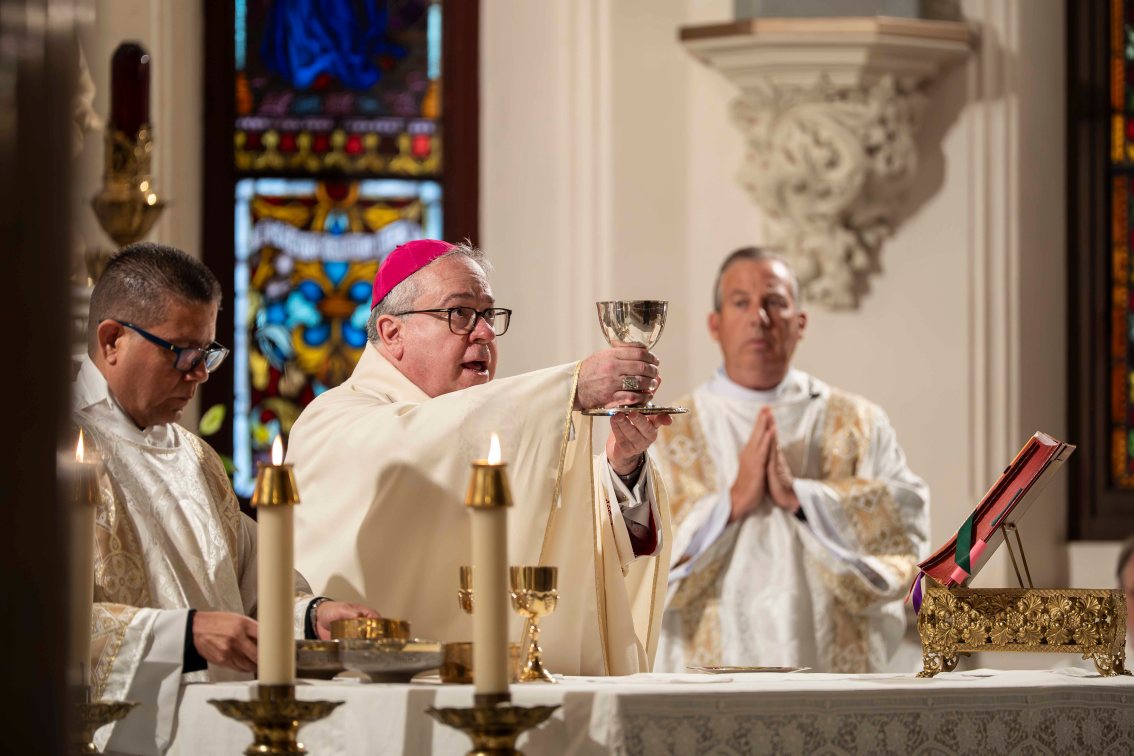
Homily for the Tuesday of the Fourth Week of Easter
Opening Mass for the National Association of Diaconate Directors Conference
April 28, 2026
St. Patrick Cathedral
Fort Worth, Texas
Acts 11:19-26
Psalm 87:1b-3, 4-5, 6-7
John 10:22-30
“It was winter.” These are the words we read in today’s Gospel as written by John the Evangelist. “It was winter.” It was a winter not so much of discontent but of disbelief. It was a winter of cold disbelief among those who saw the works of Jesus but refused to understand them. It was a winter of cold disbelief among those who heard the words spoken by Jesus but refused to listen to them or to recognize His voice. It was a winter of suspense and anxiety among those who waited for the Christ but would only recognize and accept Him on their own terms. “Tell us plainly.” It was winter.
Winter indicates a lifeless and cold season, awaiting the Spring of new life. It is a winter of disbelief among the listeners of Jesus who refuse to allow the seed of His works to be rooted in their lives. They refuse to recognize His voice as their shepherd because change is so frightening that it appears not to be in their personal interest, even the change from slavery to freedom, the change from sin to holiness, the change from death to life. It takes faith to recognize Him as the Christ in His works and in His words. This faith is born at Pentecost and brings clear recognition and acceptance of the works of Christ in His death and Resurrection.
Saint Stephen was graced as a deacon with such faith that he could clearly recognize the eternal significance of the culminating work of Christ in His death and Resurrection. He could hear the voice of His Shepherd and follow it. The Acts of the Apostles record his martyrdom as fully configured to Christ’s death manifesting the configuration of his life to that of Christ who came not to be served but to serve.
Remember that Stephen was ordained and entrusted by the Apostles as a deacon to care for the Greek-speaking widows and orphans that they should be included in the charity that is essential to the Communion of the Church. Since most of these Greek-speaking Christians were also Jews they carried with them in their experience a past association with the conflict between the members of the Synagogue of Freedmen and others in mainline Jewish society.
The Synagogue of Freedmen consisted of Greek-speaking slaves of the Romans who had been liberated, became proselytes of Judaism, and had a synagogue in Jerusalem. They also consisted of people who had been born Jewish, enslaved by the Romans, and then set free. In any event, they were probably held suspect by larger elements of the Jewish community who distrusted all things foreign in an effort to maintain the purity of Temple worship and Jewish identity. So, the so-called Synagogue of Freedmen disrupted Jewish society and worship in a spirit of political activism.
We can be sure that this conflict among the Jews, Greek-speaking and Aramaic-speaking Jews, was exploited by the Romans and their surrogates for the purpose of maintaining power and control. We can be certain that Saul of Tarsus was right in the middle of that conflict and a beneficiary of this discord. We can also be sure that Saul of Tarsus as a Pharisee was more than capable of presenting the conflict in theological language and argue with Stephen.
Yet, Stephen did not take the bait of argument. Having been configured to Christ, he exemplified the admonition of Jesus. “You will be given at that moment what you are to say. For it will not be you who speak but the Spirit of your Father speaking through you.” Most clearly the Lord gave Stephen his own words spoken from the Cross for Stephen to utter at the supreme moment of teaching and witness in Stephen’s life and in that of the early Church: “Into your hands Lord, I commend my spirit.”
It is this same Saul of Tarsus who would be converted and for whom Barnabas, whose name means “son of encouragement,” would send to bring the Gospel to Jew and Gentile with its accompanying tranquility of order to the Church in Antioch where both Jew and Gentile would first and foremost be identified most truly as “Christians.”
Today, in our life as the Church and in broader society, it is winter. We see the same exploitation conducted against the poor and weak by the partisan activists on both sides of political life for financial and political purposes. The weakest among us, refugees, trafficking victims, crime victims, the unborn, and all in the margins, are used for political purposes outside and sadly inside the church but are cared for by nobody except Christ and those who are in authentic communion with Him. It is a hallmark of the culture of death and the tyranny of relativism to pit the weak against the poor in a struggle for survival when instead Christ would offer them freedom and authentic communion. Stephen’s life and martyrdom manifest clearly that deacons are to be at the forefront as advocates for the centrality of Christ in Christian life beginning with their own lives in heralding the Gospel for all people as ministers of charity.
Pope Benedict XVI reminded us in his first encyclical entitled, Caritas in Veritate, “Without truth, charity degenerates into sentimentality. Love becomes an empty shell, to be filled in an arbitrary way. In a culture without truth, this is the fatal risk facing love. It falls prey to contingent subjective emotions and opinions, the word “love” is abused and distorted, to the point where it comes to mean the opposite…Charity goes beyond justice, because to love is to give, to offer what is “mine” to the other; but it never lacks justice, which prompts us to give the other what is “his,” what is due to him by reason of his being or his acting. I cannot “give” what is mine to the other, without first giving him what pertains to him in justice. If we love others with charity, then first of all we are just towards them. Not only is justice not extraneous to charity, not only is it not an alternative or parallel path to charity: justice is inseparable from charity.”
In many ways, it is winter today, but the springtime of the Gospel is always upon us wherever we live according to its teachings. It is the ministry of deacons as heralds of the Gospel that saves us from the winter of discouragement and disbelief through their authentic witness of charity fully revealed in Christ. The ministry of deacons helps us to overcome past ideological disputes because the Gospel of Christ is more powerful than any ideology. Our deacons must be reminded that they are first of all ministers of charity and not of sentimentality. Just as the blood of Stephen the Martyr was poured out to water the seeds of the Church in its springtime, we pray for our deacons that they might faithfully discharge their ministries even at the risk of social martyrdom. We approach the altar of Christ for His Sacrifice that configures all of us to His Body as His Church, that we might first always and everywhere be known as Christians.

