
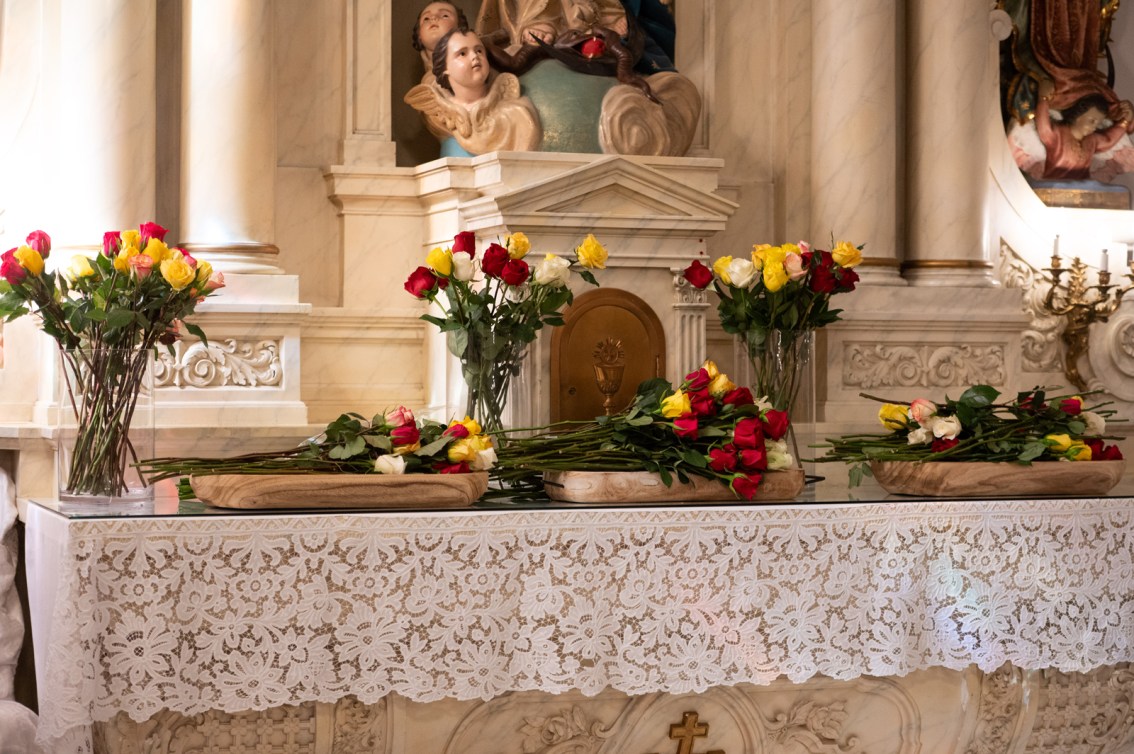
Homily for the Mass for Babies Who Died Before Baptism
October 3, 2026
Saint Patrick Cathedral
Fort Worth, Texas
Job 42:1-3, 5-6, 12-17
Psalm 119:135
Luke 10:17-24
Bishop’s homily in English begins at paragraph 7
Nuestras lecturas de esta Misa nos ofrecen tres puntos para nuestra reflexión y meditación: el silencio, el santo temor, y la revelación de Dios a los pequeños por el don de Su Hijo, el Hijo de nuestra Señora también.
Nuestra primera lectura es la conclusión del Libro de Job. Termina con la decisión de Job de guardar silencio y poner fin al torrente de palabras que habían brotado en forma de quejas y preguntas dirigidas a Dios, así como de discusiones con sus vecinos, quienes lo habían juzgado. Job ha llegado a comprender que los sufrimientos que ha padecido no son cuestiones que puedan resolverse mediante la razón y la retórica. Más bien, tales sufrimientos forman parte del misterio de la condición humana —un misterio que solo puede aceptarse y afrontarse en el silencio— y no son un problema, o un enigma, que se resuelva con palabras o silogismos, sino únicamente mediante el amor de Dios, bajo los términos del propio Dios. Tales términos se manifiestan en la muerte de su propio Hijo en la Cruz.
El silencio nos conduce al santo temor. El silencio de Job lo ha llevado a sentir el santo temor ante la majestad de Dios. Este santo temor solo puede ir acompañado de una esperanza sostenida por el don del Espíritu Santo de la fortaleza, una fortaleza vivida en solidaridad compartida entre los quienes sufren. Este es el misterio de la Cruz, pues la Cruz no es un acontecimiento limitado en el tiempo por los confines de la historia; la Cruz es un misterio que Cristo nos ofrece como un madero al que podemos aferrarnos, compartiéndolo con Él y entre nosotros en nuestros propios sufrimientos. Más aún, nos regala a su propia Madre, quien al pie de la Cruz vivió la muerte inefable de su Hijo, absolutamente inocente, cumpliendo así la profecía que san Simeón había pronunciado en la Presentación.
El santo temor ante el misterio de la Cruz y los dolores que acompañaron a la silenciosa María nos conducen a la presencia de Dios. Este misterio es el que se revela a los niños pequeños, quienes son humildes y dóciles porque saben que dependen de Dios. Al regresar de su misión junto a Jesús, los setenta y dos discípulos comprenden que cualquier éxito que experimentaron no se debió a su propia elocuencia, sino al nombre de Jesús, el nombre que le dieron María y José. El motivo de alegría es que sus nombres están escritos en el cielo. Este es el mismo motivo de alegría que nosotros tenemos y compartimos con los niños por quienes lloramos y oramos en el silencio de la presencia y la gloria de Dios.
Los discípulos aprenden aquello que se revela a los pequeños: que el éxito y el poder en este mundo no son el centro de nuestra misión como discípulos, sino más bien la certeza de que pertenecemos a Cristo por toda la eternidad.
El silencio, el santo temor, y la revelación de Dios en el don de su Hijo nos han traído hoy aquí para orar por nuestros hijos, cuyos nombres no solo están grabados en los corazones de sus padres, sino escritos en el cielo por Dios mismo. Al acercarnos al altar, lo hacemos con silencioso temor, teniendo presentes en nuestros corazones sus palabras: “Dichosos los ojos que ven lo que ustedes ven. Porque yo les digo que muchos profetas y reyes quisieron ver lo que ustedes ven y no lo vieron, y oír lo que ustedes oyen y no lo oyeron”.
The Church offers us in her liturgy today these readings from the conclusion of the Book of Job and from the Gospel of Luke which describes the lessons taught by Jesus to His 72 disciples upon their return from the mission that He had given them to preach in His name. We proclaim these Scripture readings in this liturgy in which we pray for those children who died before Baptism, entrusting them to the love of God and the protection of the Blessed Virgin Mary, and as we pray for solace for the mothers and fathers of these children who mourn in hope for their passing from this world. These readings offer us three points for our reflection and meditation: silence, awe, and God’s revelation to the childlike.
Our first reading is the conclusion of the Book of Job. It ends with Job’s resolution to be silent and too end the stream of words that have flowed out in complaints and questions to God and arguments with his neighbors who have cast judgment upon him. Job has come to a point where he receives the understanding that the sufferings that he has endured are not questions that can be answered through reason and rhetoric. Rather, these sufferings are part of the mystery of the human condition, a mystery that can only be accepted and encountered in silence and not a problem that can be resolved through words or syllogisms but only by the love of God on God’s terms. God’s terms are displayed by the death of His own Son on the Cross.
In his book entitled The Power of Silence: Against the Dictatorship of Noise, Robert Cardinal Sarah offers the following profound insight, “The tragedy of our world is never better summed up than in the fury of senseless noise that stubbornly hates silence. This age detests the things that silence brings us to: encounter, wonder, and kneeling before God.” The imponderable suffering that fathers and mothers experience at the death of their children defies reason for satisfactory explanation.
In fact, the well-meaning but clumsy attempts to offer words of solace to parents in their grief can aggravate the suffering and intensify a sense of stark isolation that comes with the death of a child. When the death of a child is experienced before the child is baptized, even the words of sacramental faith can become onerous because the death of a child before baptism cannot be encapsulated neatly in the categories of theology without mistreating authentic sorrow in a way that can only be received trivially. The only response is the silence of sacred mystery in which we encounter God who spares us from noise.
Silence brings us to awe. The silence of Job has brought him to awe before God’s majesty. Awe can only be accompanied by hope that is sustained by fortitude, a fortitude lived in shared solidarity among the suffering. This is the mystery of the Cross because the Cross is not an event limited in time by the confines of history; the Cross is a mystery that Christ offers us as a plank to which we can cling and share with Him and each other in our own sufferings. Even more, He offers us the gift of His own Mother whom at the Cross experienced the imponderable death of her purely innocent Son thereby fulfilling the prophesy of Saint Simeon made at the Presentation.
The Blessed Mother’s share in her own Son’s suffering cannot be adequately presented in spoken words but only described in the untold words of the interior silence of the Stabat Mater: “Can the human heart refrain from partaking in her pain, in that Mother’s pain untold?” The awe of the mystery of the Cross and the accompanying sorrows of silent Mary bring us to the presence of God.
This mystery is what is revealed to little children who are powerless and docile because they know they rely on God. The 72 disciples upon returning to Jesus from their mission learn that any success that they experienced was not because of their own power with words but to the name of Jesus, the name given to Him by Mary and Joseph. The cause of joy is that their names are written in heaven. This is the same cause for joy that we have and that we share with the children for whom we mourn and pray in the silence of God’s presence and glory.
The disciples learn that which is revealed to the little ones which is that success and power in this world is not the focus of our mission as disciples but rather the confidence that we belong to Christ for all eternity.
Silence, awe, and God’s revelation in the gift of His Son have brought us here today to pray for our children whose names are not only written on the hearts of their parents but written in heaven by God Himself. As we approach the altar, we do so in silent awe because mindful in our hearts are His words: “Blessed are the eyes that see what you see. For I say to you, many prophets and kings desired to see what you see, but did not see it, and to hear what you hear, but did not hear it.”

