
Homily for the Red Mass for the Diocese of Fort Worth
September 23, 2026
Saint Patrick Cathedral
Fort Worth, Texas
Isaiah 58:6-11
Psalm 112:4-5, 6-7, 8-9
James 2:14-18, 26
Matthew 25:31-46
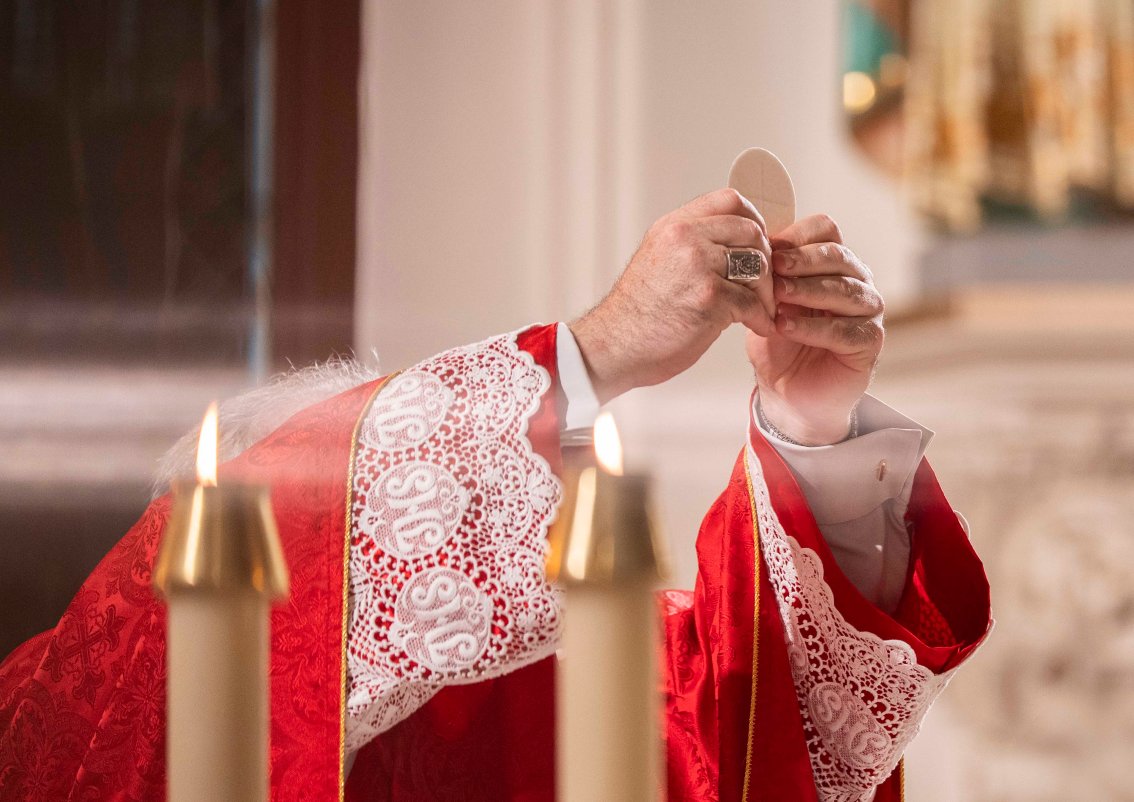
We come together this evening not only as judges, attorneys, legislators, priests, and public servants. This evening, we invoke the fire of the Holy Spirit as symbolized by the red vestments of this Mass, seeking the guidance of the Holy Spirit upon the hearts and minds of those of us who are especially charged with administration of the law towards the preservation of justice. We do not seek God’s ratification of our political agendas or His blessing upon the ambitions for our careers. We gather to ask the Holy Spirit to purify and to illumine our reason with the fire of His Love.
We live in a world where we are confronted by two temptations regarding law. On the one hand there is proceduralism, when the law reduces itself to the cold exercise of merely bureaucratic mechanisms. When this happens, the law exchanges its moral clarity for administrative efficiency. This approach alienates people and discourages them because the law soon ceases to serve as a shield for human rights and effective justice.
On the other hand, the discouragement of people can become charged with anger where the law is stripped of its procedural guardrails and begins to facilitate anarchy. Precedents are discarded or twisted to fit a specific narrative for a desired political outcome. The ends are used to justify any means. Without the stable foundation of God-given human nature, our judicial system degrades into a tool for imposing power, leading to lawlessness masked by false narrative as “justice.” The result is disorder, violence, and chaos — a path away from God.
The Prophet Isaiah gives us a stark warning. He speaks to a formally religious people who are compliant — they fast, they pray, they perform rituals — yet their moral and social lives are corrupt. God rejects their worship because they oppress their workers, they ignore the poor, and they are dishonest.
For you who serve the common good of society through the practice of the law, the temptation is rarely blatant lawlessness; it is frequently proceduralism. It is the temptation to believe that because a statute is procedurally correct, it is automatically just. This temptation is frequently spurred on by the fear of being overturned by appeal, the fear of being primaried and losing re-election, or the fear of losing a lawsuit.
As legal professionals, Psalm 112 directs you to be a “light in the darkness to the upright.” Your degree, your bench, your political office, and your bar license are shields meant to protect the vulnerable by assuring fairness. The purpose of law is not merely to impose order, but to vindicate the dignity of the human person through an appeal to authentic justice. When a lawyer defends the worker, the unborn, the immigrant, the property holder, the victim of crime, the victim of slander, or the destitute, one allows the light of true justice to pierce the darkness of limitless self-interest that otherwise reduces legal procedures to a type of game.
But how do we know what is just? Human reason is fallible. It is easily blinded by fear of reprisal, ideology, self-interest, and the thirst for the preservation of power. Saint James tells us today that “faith without works is dead.” For those who serve in the courts and statehouses, putting faith into works means allowing your faith to purify and to illumine your reason without demanding religious assent from others. Your faith anchors you in the natural law. The light of your faith casts no shadow and enables you to recognize Christ present in other people, defendants, clients, judges, opposing counsel, the criminally accused, plaintiff, and defendant, all of whom are owed reverence for the truth. Your faith does not replace your legal training; it elevates it. It frees you from the blind spots of your personal heritage and culture, as well as from your sin.
Saint Matthew reminds us that there is a Higher Court. The day is coming when each of us will stand before the Judgment Seat of Christ where the secrets of all hearts will be revealed.
Christ articulates the criteria for this judgment. We will be judged by a single standard: how we treated the “least of these.” When you pass laws that protect the weak, you serve Christ. When you ensure an indigent defendant receives a zealous, fair defense, you clothe Christ. When you judge with absolute integrity, refusing to tilt the scales of justice but instead advocating only for the truth, you welcome Christ. Only the redeemed human heart can serve and deliver authentic justice. We cannot genuinely love our neighbor unless we first respect our neighbor’s rights as a human being created in the image and redeemed in the likeness of God.
In the coming weeks as you begin the new legal season, do not leave your faith at the door of this Cathedral. Ask the Holy Spirit to fill you with wisdom and fortitude. Be the light in the darkness that He enables you to be. As we approach the Eucharistic table tonight, may God help us to eschew the temptations of proceduralism and of anarchy by relying on the clarity of faith, the firmness of hope, and the warmth of charity, so that when you stand before the judgment seat of Christ, you may hear those words: “Well done, good and faithful servant… enter into the joy of your master.”

