
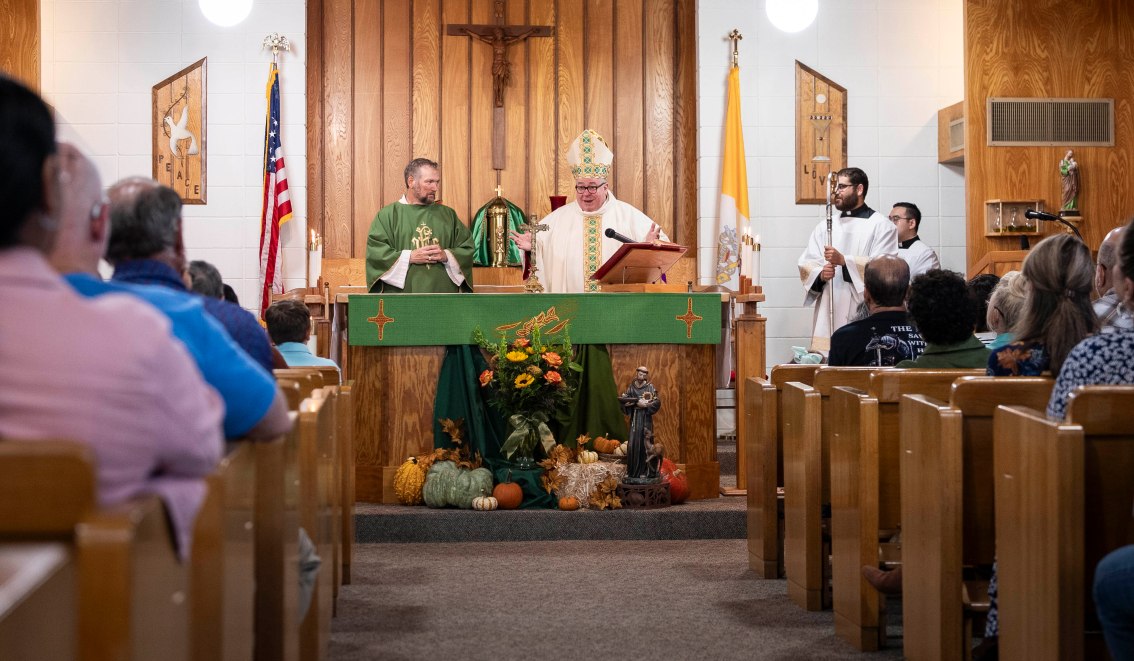
Homily for the Feast of Saint Francis of Assisi – 800th Anniversary of the Death of Saint Francis
Twenty-seventh Sunday in Ordinary Time
October 4, 2026
St. Francis of Assisi Church
Graford, Texas
Isaiah 5:1-7
Psalm 80
Philippians 4:6-9
Matthew 21:33-43
Today we celebrate the 800th anniversary of the death of Saint Francis of Assisi. He is the patron of your parish who intercedes on your behalf and that of your loved ones. We thank him for his intercession that has helped to deliver many from the recent fires and we ask him for his continued intercession for those who have been harmed by these fires. In no small way, he was with you spiritually in assisting the charity your parish showed to first responders in providing meals and rest to assist them in their life-saving and heroic work.
In the first reading we hear a poem that Isaiah probably wrote for a harvest celebration. In it he depicts God’s people as a choice vine and a well-cared for vineyard. Isaiah depicts God as saddened: “He looked for a crop of grapes, but what it yielded was wild grapes.” Wild grapes appear when the vineyard is not well-tended or cared for. God expects us to recognize our gifts and the beauty of our lives, and He condemns those who are apathetic to their brothers and sisters and indifferent to His gifts and let them go unattended. If we look at Matthew’s recapitulation of Isaiah’s poem in presenting Jesus’ parable, it seems that God does not so much condemn our mistakes and misdirected energy, but our laziness or sloth that permits evil to be perpetrated against others and against the vineyard as a whole.
The image of the vineyard and that of those who tend the vineyard is one that evokes the gift of creation and our correlative responsibility for stewardship of creation. “Creation” is not simply an old-fashioned word for “environment.” Creation is a relational word. Creation is the activity of God in which the world (not just the planet), everything that is not God, is brought into existence and sustained in existence and life. God is not perfected or completed through His act of creation of the world. He creates in complete generosity and love, in complete selflessness, and out of nothing He brings something but not just anything.
What He brings about is His creation of each and every being as His beloved creature. This establishes a relationship of dependence upon the Creator by His creatures and of interdependence of creatures with each other within a system ordered by God’s Providence. It is a relationship that calls forth gratitude among volitional creatures capable of reason, angels and human beings. It is a relationship that calls forth mutual responsibility and love.
As Pope Benedict XVI thoughtfully observed about today’s Gospel, “The vineyard tells us that the reality in which God has placed the human being is not a wild forest but a place that protects, nurtures and sustains; and human beings must not consider the world as a property to be looted and exploited but as a gift of the Creator, a sign of His saving will, a gift to be cultivated and safeguarded, to increase and to develop with respect and in harmony, following its rhythms and logic in accordance with God’s plan.” It is very easy in modern times for human beings to forget that God is our Creator and like the people in the parable from today’s Gospel come to treat the vineyard, ourselves, each other, and all within the vineyard as ours to trample underfoot and to dominate instead of to develop.
The life and ministry of Saint Francis in responding to the call from Christ on the Cross of San Damiano exemplifies for us the life of the disciple of Jesus Christ. The Cross of Jesus Christ shows us that God keeps His Word and entrusts that continued mission to us to renew that which has fallen into ruin. The Cross of Christ shows us as Saint Francis learned, that God’s offense at our sins is not the last word and that He keeps His Word and does not seek vengeance upon us.
We are creatures, we are not the Creator. We are finite and we are not sovereign. We are both subjects and instruments of Christ’s saving work, and the call to the perfection of creation, which is found in the fulfillment of God’s purposes for creation, rather than in any fallen human scheme for the arrangement or redistribution of material wealth and earthly goods. We are poor because our sin has made us incomplete. We are rich because God has created us for glory. We are poor because alone we cannot attain the glory for which God made us. Our poverty reminds us of our incompleteness and insufficiency. The message of the Gospel is that our poverty, if it is true, Christian poverty, can make a clearing for God’s initiative and God’s saving and redemptive work. We are sinners but we are loved sinners because of Christ. It is only in this way that we can approach confidently the banquet table of the Eucharist.

