
Homily for the Twenty-Ninth Sunday in Ordinary Time
World Mission Sunday
October 22, 2026
St. Mark Catholic Church
Argyle, Texas
Isaiah 45:1, 4-6
Psalm 96:1, 3, 4-5,7-8, 9-10
1st Thessalonians 1:1-5b
Matthew 22:15-21
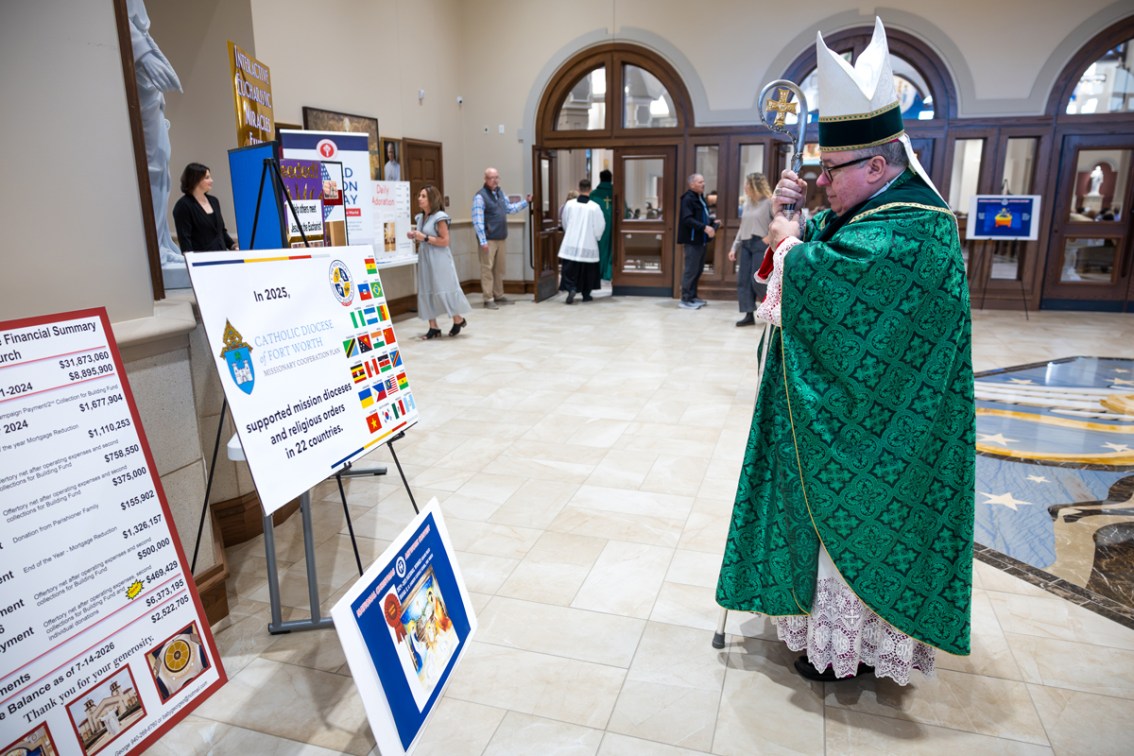
Today marks the 100th anniversary of the establishment of the World Day of Missions. In 1926 Pope Pius XI established this day of prayer and support for the missions throughout the world, that the cause of the liberating Gospel of Christ would be advanced everywhere through a spirit of sacrifice, intentional prayer, and witness of Christian life for the sake of the salvation of souls. The theme of this year’s world mission Sunday is entitled “One in Christ, United in Mission.” This title is derived from the Papal motto of Pope Leo XIV, “In Illo uno unum,” “In the One We are one.”
It is only in Christ that we can experience authentic communion with each other and with all people in the world. History has shown that the Church’s missionary activity is only effective when we keep our focus on Christ and His teachings, but when members of the Church have forgotten that true purpose, sin and scandal take root. One historical aspect of that includes those instances where missionaries allowed themselves and their work to become subordinated to the aims of colonial powers or on the other hand to radically Marxist ideologies instead of Christ and His Gospel — when Christ takes second place to these purposes. Our Gospel reading today offers us some encouragement to rightly live our missionary vocation as Catholics.
In today’s Gospel, the Pharisees and followers of Herod, whose fear of Jesus has prompted them for the moment to abandon their own mutual mistrust and rivalry, devise a plot to trap Jesus since He had exposed their respective hypocrisies. Jesus’ integrity threatens them so much that they conspire to ask Jesus if it is lawful to pay tax to Rome or not. This is a trick question, since either way Jesus responds to the question would be unfavorable to the crowds. A yes will make Him seem to endorse Rome’s colonial rule over the Jews, and a no will make Him look like He is a revolutionary enemy of Rome. The people would see Jesus as either a traitor or a rebel, and His enemies would trap Him.
Jesus’ response to the question is unforeseen in its honest simplicity. His answer shows a difference between our lives as worldly citizens and as members of God’s Kingdom. Jesus’ response is not just unexpected, but it is also challenging. The poverty and simplicity of Christ always confound the complications inflicted upon the human soul by sin and error. Jesus confounds his confronters with an answer that calls for a commitment and not just an acknowledgement. He displays the Roman coin with Caesar’s image and says, “Give to Caesar the things that are Caesar’s, and to God the things that are God’s.” What are the things that are Caesar’s, and what exactly belongs to God?
In every age, every Caesar has put his image on coins of gold, to announce to the world Caesar’s warping of the Golden Rule, namely, “He who owns the gold makes the rules.” However, God has impressed His image upon the greatest currency of His Kingdom, the human person, each of us, through His creation and redemption of us by His Son Jesus. We are to announce to the world that we are His; and we are to treat each other as He has treated us; we are called to love Him and our neighbor as ourselves. Our human nature is such that we cannot separate God’s image from our being. We must remind each other of who we are and whose we are. We may form fellowships and organizations and even states, and we may rightly serve them with loyalty and patriotism if they are just, but our final and absolute obedience belongs first to almighty God. This is at the heart of the Gospel.
Caesar will usurp authority over life and death. Caesar will impose a hedonistic ideology of gender upon the embodied and God-given sexuality of human beings. Caesar will force a redefinition of marriage from its divinely instituted nature of a permanent and faithful covenant between one man and one woman open to God’s gift of children. Caesar will grab as his own the responsibilities of fathers and mothers in the education of their children. Caesar will seize the freedom of assembly and authenticity of worship to suit his own purposes. Caesar will foment divisions and acrimony among peoples of different races to subjugate and divide them into terror and violence. Caesar will exploit private property and material resources for his own ends. Caesar will wage his wars for his own riches and for those of his powerful collaborators.
However, we belong to Christ. The Word of God reveals to us in today’s Gospel that those who govern us are not gods and that the state, however it is conceived and organized, is not sacred. And more than that, every human person has not only rights but also obligations to the one true God that prevent us from giving certain things to any human ruler or state, and thus a sphere of integrity exists within each man and woman where no earthly authority may tread without committing sacrilege against the dignity of the human person engraved in his soul with the image and likeness of God. It is Christ who liberates us and to whom alone we owe our obedience and love.
It is our mission that He entrusts to us that we pray persistently for the gift of faith that we not become indifferent to this precious gift or lose our focus upon Him and His will. This mission requires our conversion through a spirit of sacrifice, through intentional prayer, and through the witness of charity.
We have as our patrons of the missions: Saint Francis Xavier, the exemplar of a spirit of sacrifice in going to the missions; Saint Therese of Lisieux, the exemplar of intentional prayer for the conversion and salvation of souls; and now Blessed Fulton Sheen, the exemplar of the witness to charity, the very life of the Triune God. Let us now approach the Eucharistic banquet table of the Lord with them and be nourished together by Christ who is our only king.

