
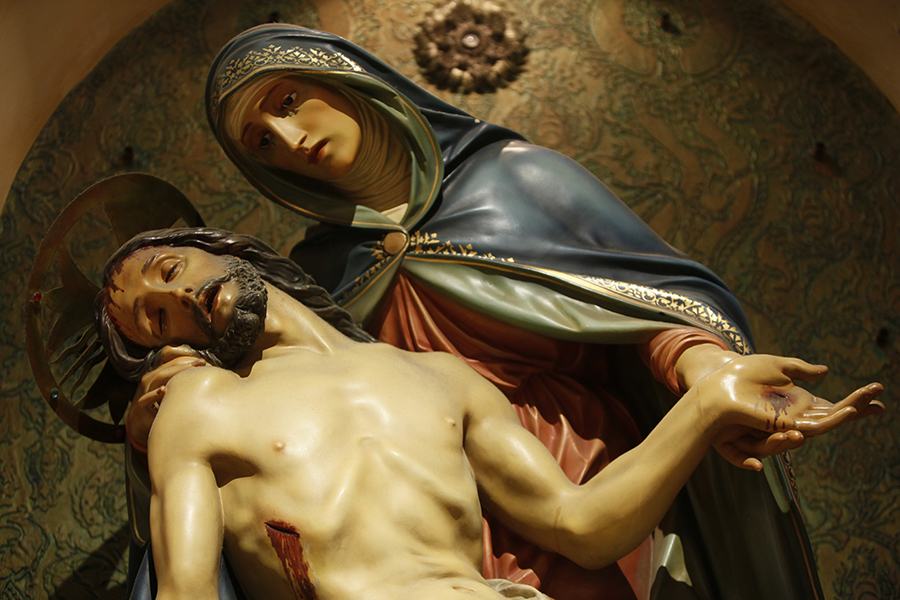
Homily for the Memorial of Our Lady of Sorrows
Mass for the Repose of the Souls of Deceased Basselins
September 15, 2026
Caldwell Hall Chapel, The Catholic University of America
Washington, D.C.
Genesis 3:9-15, 20
Psalm 31:2 & 3b, 3cd-4, 5-6, 15-16, 20
Hebrews 5:7-9
Luke 2:33-35
The Liturgy of the Church offers us this memorial dedicated to the Blessed Virgin Mary under the title of Our Lady of Sorrows. This memorial is placed immediately after the Feast of the Exaltation of the Cross because the Blessed Virgin Mary, through her being preserved from the stain of all sin by the merits of her Son, shares most closely in her Son’s mission of salvation and is united with Him in His suffering. We come together on this day, here in this chapel at this university, to offer Mass and to pray for the repose of the soul of Theodore Basselin and the souls of all deceased recipients of the scholarship named in his honor.
We as Basselins pray for these men who answered the call of Christ to follow Him as priests or in other areas of ministry to glorify Him through their gifts that were honed by the gift of their education and formation as Basselin Scholars at Theological College and at the Catholic University of America.
Saint Thomas Aquinas teaches us that joy is delight in the presence of the beloved and delight in seeing the purposes of the beloved fulfilled. Aquinas continues that the opposite of joy, sorrow, also arises from love, either through the absence of the thing loved, or because the loved object to which we wish well, is deprived of its good or afflicted with some evil. So, it follows that the Blessed Virgin Mary, whose heart is perfectly pure and free from the selfishness of sin, both makes herself perfectly available to the joy of her Son’s victory on the Cross without any self-seeking and also suffers the rejection of her Son’s gift of salvation by our sins because her heart is pure and she suffers only from others’ sins and never her own, for she has none. The pure-hearted and intimate share of her Son’s sufferings is the alloy of the sword that Simeon prophesied would pierce her heart seven times. Simeon’s prophecy that the thoughts of many hearts will be revealed includes the callousness and indifference of human beings to her son’s love as offered perfectly on the Cross.
Our Lady has a sense of the horror of sin that we, because of our wounded human condition, cannot have because she clearly understands the good intended by God through her Son’s Cross, which we cannot fully grasp in this vale of tears. She sees, because she is full of Grace, with perfect charity of heart and clarity of mind the reason for God’s plan of salvation and her part in it, which she accepts without hesitation and in docile obedience of will. There is an expansiveness to Our Lady’s heart because she is sinless that also expands her capacity for sorrow. The pure-hearted attentiveness to God is in contradistinction with the cowardice and deflection for their disobedience offered by each of our first parents to God as described in our first reading. With the first sin of our parents in Eden comes the darkening of the intellect and the replacement of reason with excuses.
Having betrayed the greatest Good, human beings will begin their long embrace of excuses and rejection of right reason out of fear and self-seeking. That long tragic embrace clamps a vice upon our will to act in accord with God’s desires for us and replaces it with mediocrity. It is the Son of God, the Son of Mary, the Word Incarnate, and the Way, the Truth, and the Life, Jesus Christ who is rejected and contradicted by sinners who prefer blame and excuses over mercy and reason.
As we have seen in the history of the Church, when human nature has received the offered Grace, there come saints that strive to conform their hearts to the Immaculate Heart of Mary — like Louis de Montfort and Maximilian Kolbe. The purity of the Blessed Virgin does not make her so different from us that she becomes inaccessible and ultimately irrelevant to our human condition. So, too, Basselins find in the Blessed Virgin Mary, the Seat of Wisdom, a willing helper in our lifelong purification and transformation from a life of excuses and selfishness to one of conformity to Christ the Good Shepherd who willingly gives His life for His sheep.
It is only the Grace of the Holy Spirit that can move human beings from excuses made in contradiction of right reason to full conformity to the truth that transforms us from rebels to loved sinners, redeemed by Christ. It is the vocation of a priest, and in a particular manner the vocation of a Basselin, to accompany the faithful Catholic on the path to transformation and conversion in Grace. Basselins are especially formed for this vocation because it involves their own transformation in humility through their formation to preach well, to administer the sacraments in a way that is beyond simple functionalism, and to offer pastoral guidance through the articulation of helpful distinctions that offer understanding, illumination, and compassion.
A priest who has humbly received a Basselin formation in each of the four dimensions of priestly formation offers three things well. First, he is well acquainted with the fact of human nature through sound metaphysics, a full anthropology, and a eudemonistic ethics replete with virtue that displays human nature in its excellence. Secondly, he has practical and theoretical knowledge of the reasoned fact of the fallen human condition brought about by the rebellion in the Garden of Eden. He can recognize that virtue and human nature are abstractions, that in the practical order, because of the effects of sin, fall short in human affairs, and that gratia sanans is the only thing that can transform this broken order in which we now find ourselves in the human condition. This entails not only a healing of man in body and soul but an elevation through grace ultimately leading to the beatitude of heaven and communion with the Divine Persons and all the saints. Such an elevation exalts us in God’s love in a way where the original sin of our first parents even becomes a grace.
Finally, and most importantly, the Basselin formation provides compassion in the character of a priest because he himself frequently deals with the frustration of not being understood and accepted in the contemporary world that cherishes excuses and rejects reason in exchange for selfish narrative and in effect has no place for him. Because of these three aspects of Basselin formation, the priest is able and willing to say to his parishioner, “I know you need to hear this hard truth because I need to hear it too — now let me help you by telling you the truth, offering the sacramental helps of nature and grace. I offer you my consecrated hands and priestly paternity. I invite you to join all of us in the pilgrim church to follow our path set out by Christ to our place in heaven.”
As His last gift to us as He died on the Cross, Jesus gave us the gift of His Mother to be our mother that she might help us with her most pure and compassionate heart to encourage us on the path of her Son. Let us pray at this Mass for the repose of the souls of Theodore Basselin, all our benefactors, and each of our Basselin brothers who have gone before us. Let us also pray for each other that the Blessed Mother might protect us with her compassionate and pure heart and that we might be strengthened in love in the present moment with gratitude for the past and hope for the future all in God’s hands.

