
Homily for the Feast of Saint Matthew the Apostle
Institution of Acolytes
September 21, 2026
Saint Mary of the Assumption Catholic Church
Fort Worth, Texas
Ephesians 4:1-7, 11-13
Psalm 19:2-5
Matthew 9:9-13
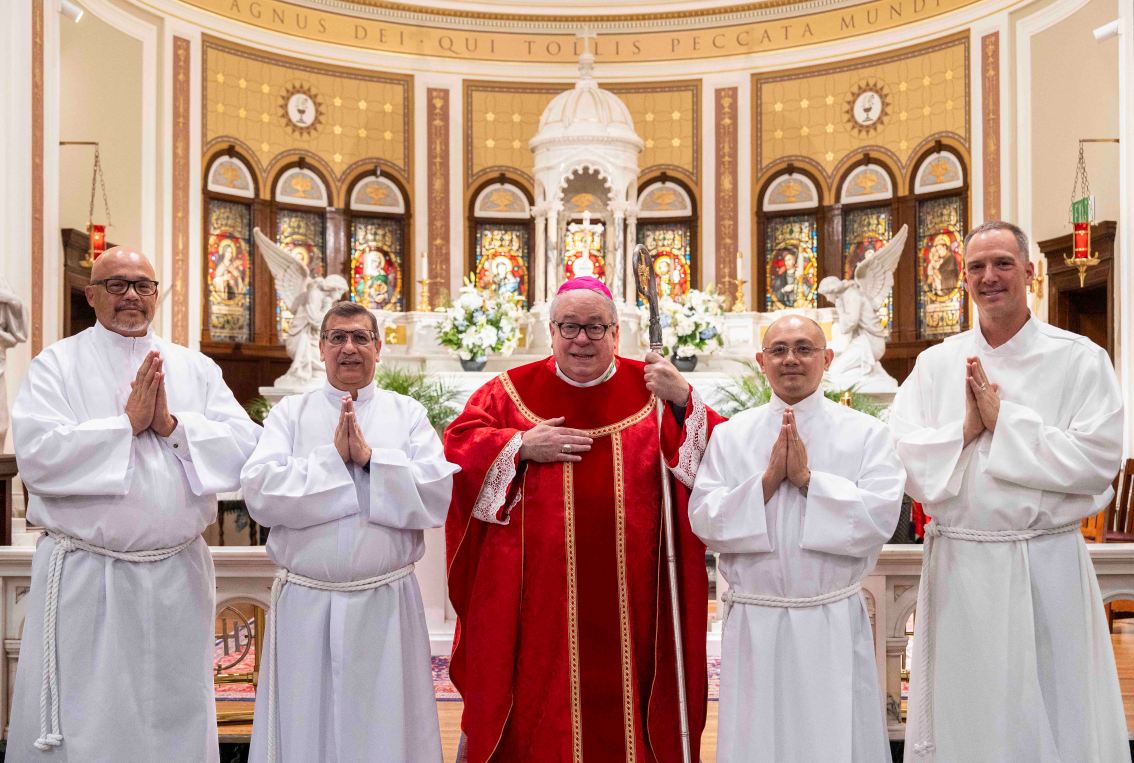
Today we gather at this Mass of the Feast of Saint Matthew the Apostle and Evangelist to pray for these men who are to be instituted in the ministry of Acolyte as part of their preparation and formation on the path towards ordination to the permanent diaconate. We pray also for their wives and families. Finally, we pray for the Church, both local and universal.
The readings from this Feast offer us good points for reflection upon the vocation and ministry of the deacon in the life and mission of the Church. I will briefly touch on three points: listening and responding to the call of Christ, friendship with Christ, mercy offered and received in Christ.
The Gospel presents the call of Saint Matthew in a very direct manner. Jesus sees Matthew sitting at his customs post busy collecting taxes and Jesus directly says to Matthew, “Follow me.” Matthew responds by immediately leaving his post and following Jesus. The call to follow Jesus, including our own, is always direct and simple. It is a simple call to those whom He chooses to be with Him. Those whom He selects frequently live lives complicated by circumstances caused by original sin and further convoluted by personal sins with their accompanying compromises and rationalizations. The call of Jesus never comes to us at a convenient time. He calls us and we hear and answer His call amidst the complexities of our frail lives.
As a tax collector, Matthew would have undoubtedly lived a very lucrative existence but also an extremely tumultuous one. He would have needed to have navigated a multifaceted system that demanded that he exploit his own neighbors but maintain a working relationship with them while feeding the ravenous avarice of the Roman officials. Matthew must have been consumed by the demand to fit into this bureaucracy without losing his familial identity and sacred heritage. Such a complex and venal system would inevitably compromise a man’s integrity, leading him to trade his covenantal identity for a state of survival that reduces all human relationships to commercial transactions.
Matthew discerned a radical alternative in the call of Jesus, which offered him a promise of friendship, healing, and redemption. Jesus offered him a relationship that did not enslave but rather liberated him. Within this relationship lay the paradoxical heart of the Gospel: that to truly find oneself, one must surrender to God by ministering to those whom the world disregards, but whom Christ deeply cherishes. This gift of friendship prompts Matthew to welcome Jesus into his own home — into the intimacy of his dining room, among his family and friends. In this same way, especially for those of us being formed for the diaconate, the call of Jesus should move us to welcome Him into those hidden nooks of our lives that a pharisaical mindset would compel us to keep hidden from Him.
This friendship with Christ has as its source and summit the mercy of God, fully manifested in the Eucharist. The vocation of Matthew, a public sinner as a tax collector, demonstrates that Jesus excludes nobody from His offer of friendship. By trusting Jesus and by responding with decisive action, Matthew shows forth his desperate need for God’s mercy that only Christ can provide. Jesus underscores this message clearly when He declares, “Those who are well do not need a physician, but the sick do. Go and learn the meaning of the words, ‘I desire mercy, not sacrifice.’ I did not come to call the righteous but sinners.”
On his way to be martyred in Rome, Saint Ignatius of Antioch beautifully echoed this imagery in his letter to the Ephesians, referring to the Eucharist as the “medicine of immortality, the antidote we take in order not to die but to live forever in Jesus Christ.” Ignatius stressed that faith in the Eucharist as the medicine for immortality does not merely extend our earthly existence beyond physical death. Instead, authentic faith in the Eucharist radically transforms our present lives as Catholics, with the love of Christ — because the medicine offered and received in the Eucharist is the Divine Physician Himself.
Ignatius added that our reception of Christ in the Eucharist is inseparably linked to love for sinners and those oppressed by sin. Genuinely loving the Eucharist means that we inherently carry a deep concern for the widow, the orphan, the oppressed, the imprisoned, the hungry and the thirsty. This is why those who are to be ordained permanent deacons must first be instituted as acolytes — entrusted to care for the Eucharist by distributing Holy Communion and exposing the Blessed Sacrament for Adoration. For apart from the Eucharist, we are left vapid: we are without unity; we are without friendship; we are without the Church; we are without healing; we are without mercy; we are without charity; and ultimately, we are without Christ.
As we continue our liturgical celebration, we pray for these men who are prepared to accept the responsibility of the acolyte. We pray that they be strengthened, like Matthew, to be men faithful to the call, men of profound friendship with Christ, and ministers of Christ’s mercy offered perfectly in the sublime mystery of the Holy Eucharist.

